
Some links in this post earn me a small commission, at no extra cost to you.
We made Java a major stop on our two-week Indonesia itinerary for a reason that goes back decades. We had both dreamed of visiting Borobudur and Prambanan since our high school days, but growing up in Communist Romania made travel beyond the country’s borders just a distant fantasy. Well, this dream certainly took a long time to come true!
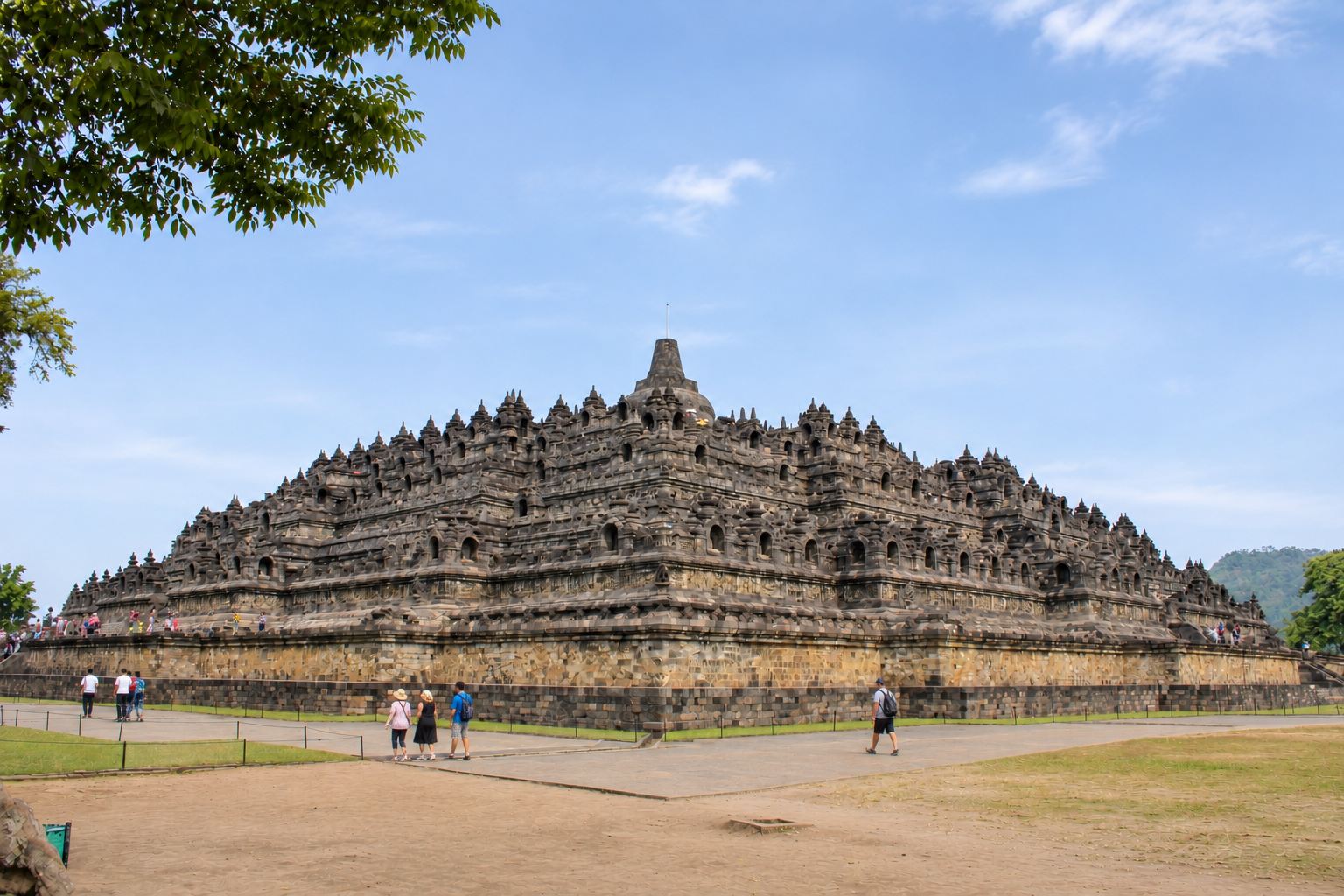
I had seen countless pictures of Borobudur, the world’s largest Buddhist monument, but nothing quite prepared me for its sheer size and the amount of detail in those stone carvings. It certainly lives up to its reputation: monumental, intricate and an extraordinary architectural achievement. The temple itself didn’t disappoint me. The experience of visiting Borobudur Temple, however, was not quite what I had imagined all those years.
The History and Meaning Behind the Monument
Imagine building an enormous stone monument, adorning it with thousands of intricate carvings, only to have it disappear beneath the jungle, centuries later. That’s more or less what happened to Borobudur. But why?
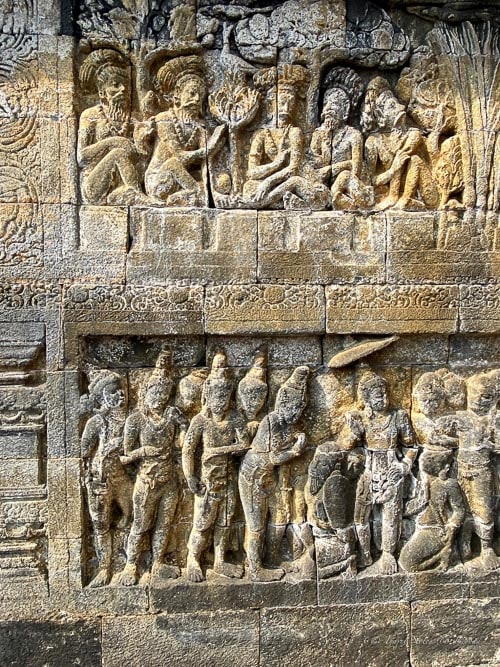
Nobody knows exactly why the temple was abandoned, or even all the details of who built it. It is believed to have been built under the Sailendra dynasty sometime in the 8th or 9th century, when Buddhism flourished in Java. Whoever conceived it had something quite ambitious in mind: a temple where the very act of climbing it would take pilgrims on a symbolic journey towards enlightenment.
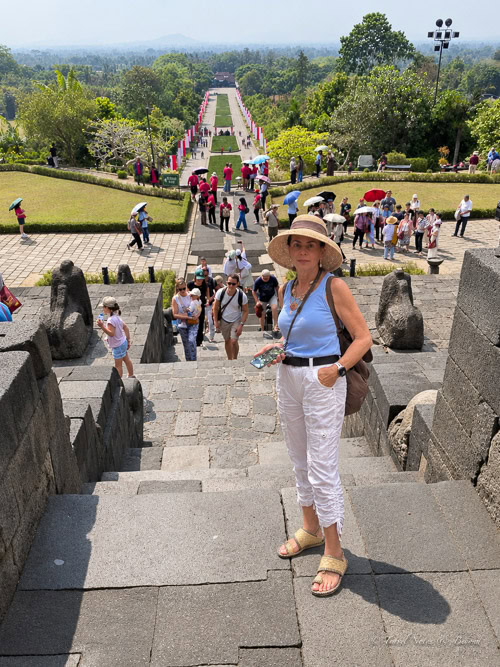
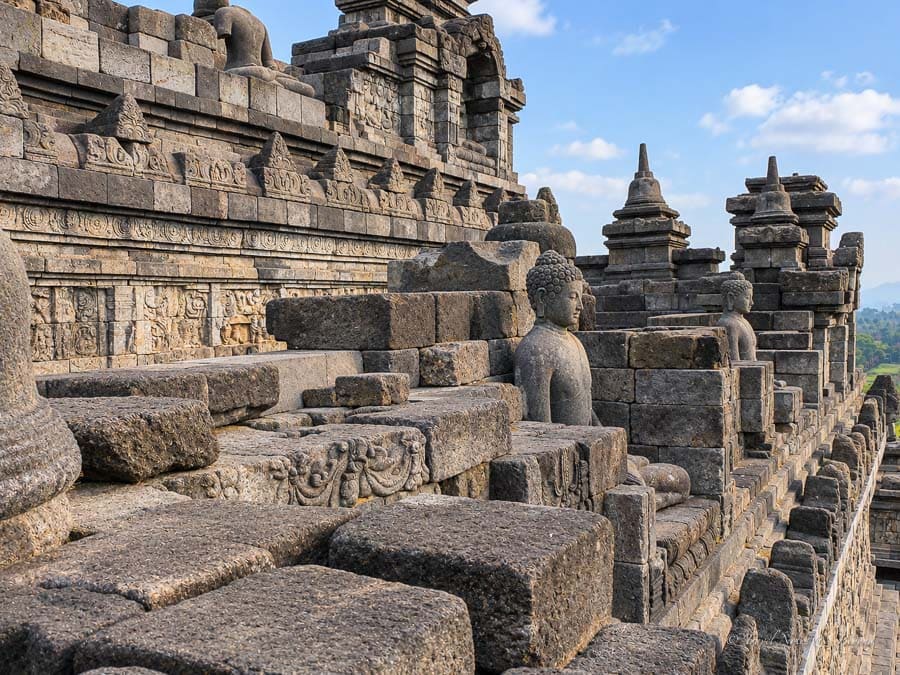
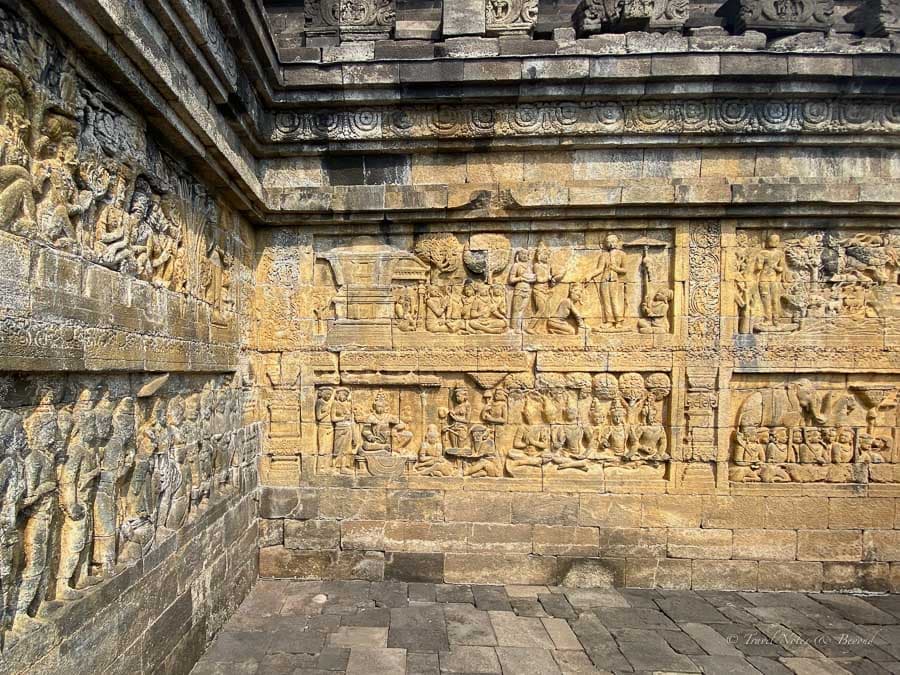
When visiting Borobudur, you’ll climb through a series of terraces, passing hundreds of carved scenes before reaching the circular platforms at the top. What’s interesting about these terraces is that they represent three different stages of existence in Buddhist belief.
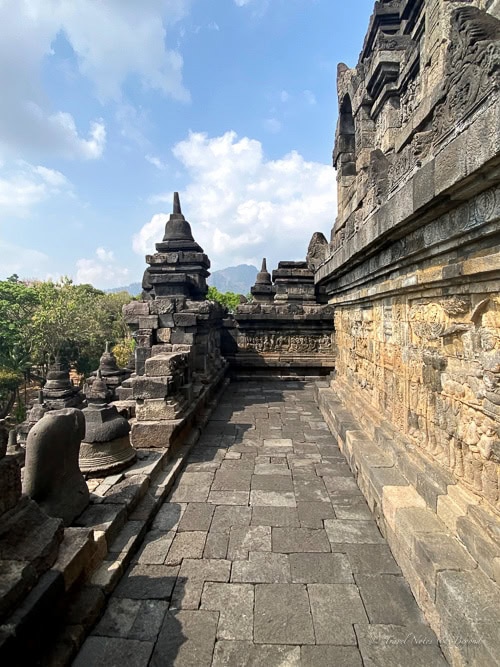
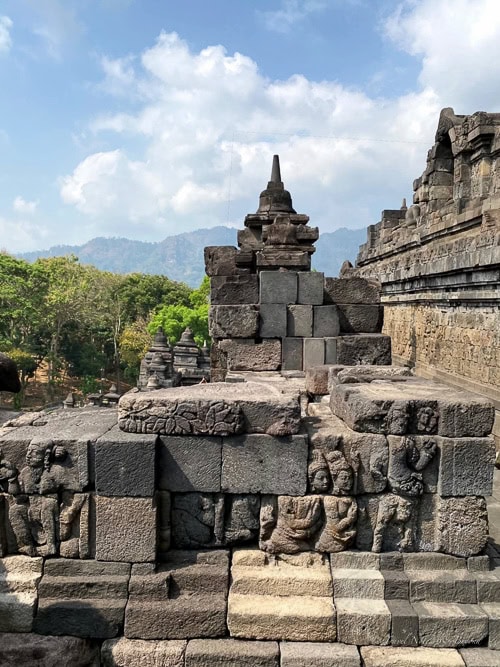
At the bottom is the world of earthly desires, followed by a realm where those desires have been overcome but the physical world still matters. Finally, the three circular terraces at the top represent the formless world, free from earthly attachments.
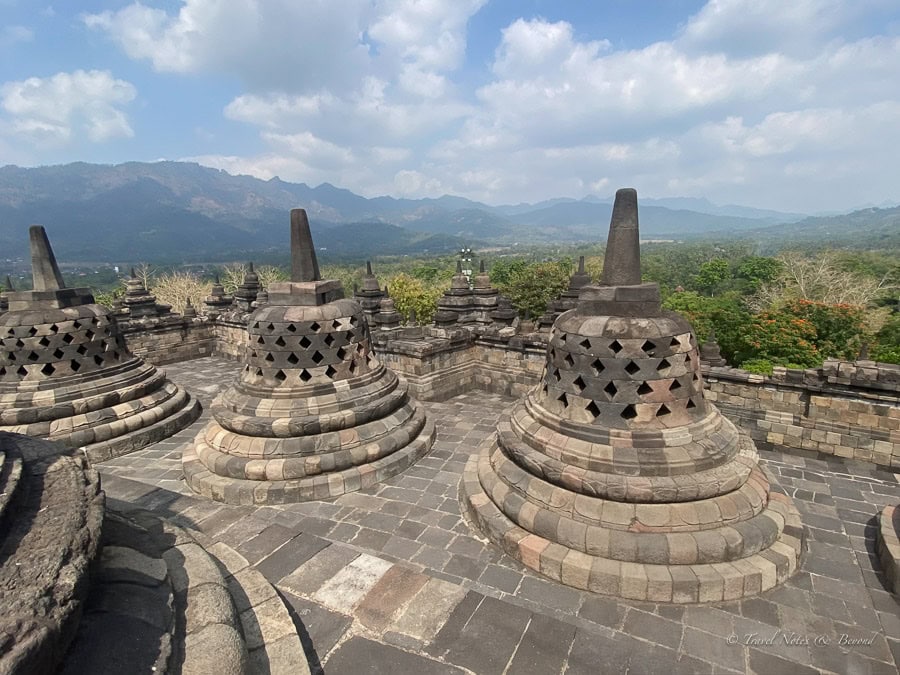
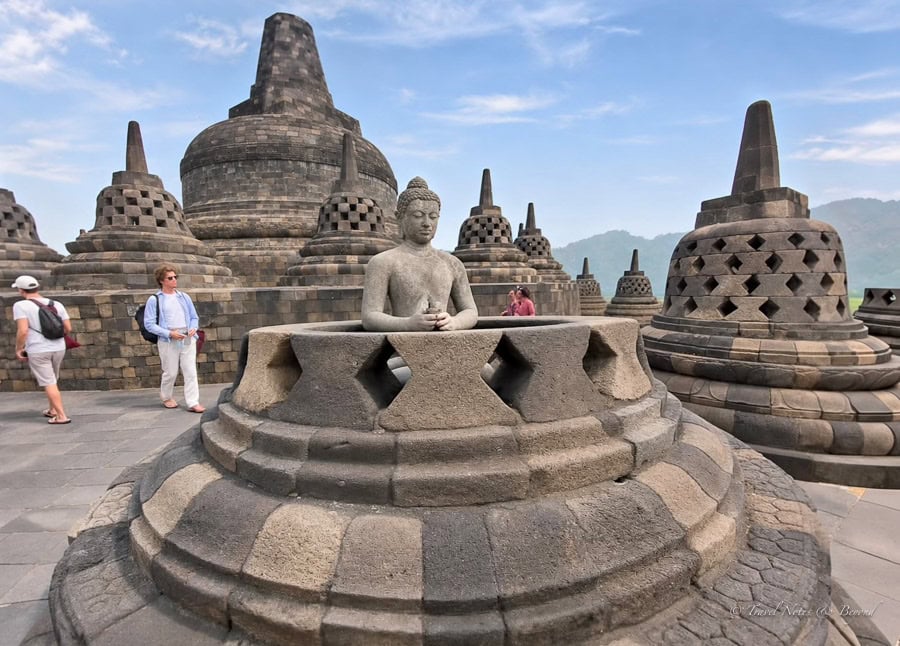
The part of Borobudur you’ll probably recognize from most photographs is the upper section. Here, 72 bell-shaped stupas surround a much larger central stupa. If you look through the openings in the stonework, you’ll see that some still shelter Buddha statues inside their perforated stonework, while others are empty or damaged. Together, they create a striking sight, with the central stupa symbolizing the ultimate goal of the pilgrim’s journey: enlightenment.
Borobudur’s Abandonment and Rediscovery
For hundreds of years, Borobudur lay forgotten, hidden by jungle and volcanic ash. In 1814, the British Lieutenant-Governor of Java, Thomas Stamford Raffles, heard about the ruins from local people and sent someone to investigate. Restoring it was no small job, and it took several attempts over the years. The biggest restoration took place in the 1970s and 1980s, with help from UNESCO.
before you book
Why Visiting Borobudur Requires Advance Planning
We started researching our visit to Borobudur a few months before our trip to Indonesia, and I’m glad we did! It never occurred to me that visiting Borobudur would involve following so many rules. I expected to do what we normally do when visiting archaeological sites around the world: buy our tickets and explore the temple at our own pace. But as it turns out, visiting this temple requires a lot more planning than that.
While you can still wander freely around the temple grounds, climbing Borobudur is an entirely different matter. You’ll need to reserve a time slot, join a group, wear specially designed sandals and follow a guide. The temple authorities even dictate how much time you can spend on the monument.
Since only a limited number of tickets are available each day, visiting Borobudur on a whim is not a good idea. We had only a few days in Yogyakarta and quite a few other places we wanted to see in the region, so we couldn’t afford to leave much to chance.
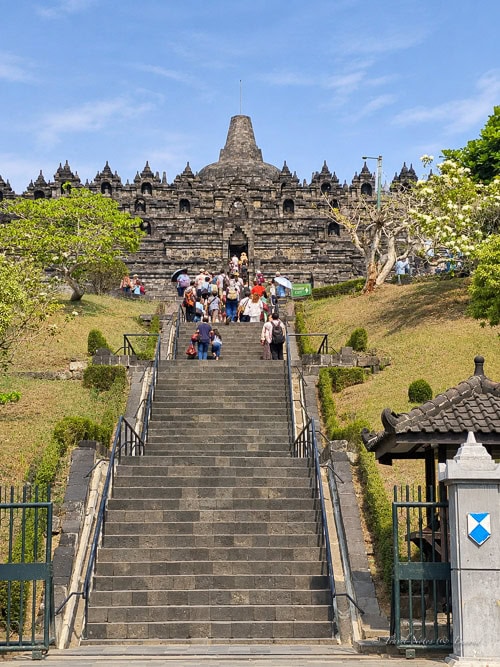
We also had to consider the time of day. The midday sun in Indonesia can be merciless, and the last place I’d want to be at noon is on top of a massive stone structure with virtually no shade.
By the time we arrived in Yogyakarta, we already had our tickets, knew exactly when we were going and had a pretty good idea of what to expect. Or so we thought!
Entrance Tickets: Which One Should You Buy?
One thing you should know before buying your tickets to Borobudur is that not all entrance tickets will get you into the temple. A rather important detail, considering that most of us didn’t travel all the way to Java just to admire Borobudur from below!
There are three types of entrance tickets:
- Borobudur Temple Ground Ticket (Temple Yard) gives you access to the park surrounding the monument. You can walk around the temple, admire it from different angles and take pictures, but you cannot climb any of its terraces.
- Borobudur Temple Structure Ticket (Temple Climb) allows you to visit the grounds as well as climb the monument. We paid IDR 455,000 (approximately US$27) per person for this ticket. This covers the cost of the mandatory guide and a pair of specially designed sandals that you get to keep.
- Borobudur Manohara Premium Experience includes everything in the Temple Structure Ticket, plus a private guide, a separate entrance through the Manohara hotel, a coffee break and a souvenir tote bag. It costs IDR 800,000 (approximately US$48) per person for foreign visitors, with a minimum of two people.
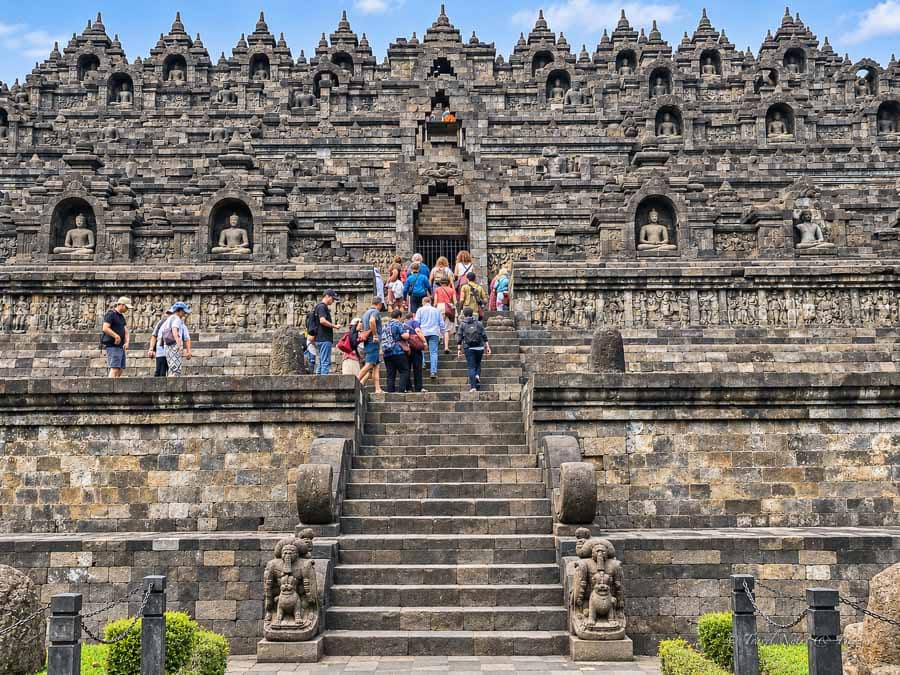
For us, climbing the temple was never in question. After waiting all these years to see Borobudur, I certainly wasn’t going to settle for walking around its base! We bought the Temple Structure Ticket, but I only discovered the Manohara Premium Experience afterward. Knowing what I know now, I would gladly have paid the extra $20 per person for a private guide and a separate entrance. It wouldn’t have eliminated all the restrictions, but it might have spared us some of the frustrations. More about that later.
Now, if you’re hoping to climb Borobudur without a guide, I’m afraid you’re out of luck. Even the premium ticket doesn’t buy you that particular luxury. You can, however, organize the entire visit yourself, without booking an excursion through a travel agency. You can purchase all these tickets directly from the official Borobudur ticketing website.
The Sunrise Tour
Another option is the Borobudur Sunrise Tour, which starts at 4 a.m. and is limited to 100 visitors per day. The ticket costs IDR 1,000,000 (approximately US$60) per person for foreign visitors and includes a guided visit and breakfast at the Manohara Restaurant.
Being early risers, we were tempted by this option. However, after watching several YouTube videos and reading other travelers’ reviews, we decided against it. Despite the advantage of cooler temperatures and smaller crowds, the prospect of negotiating steep stone steps in the dark with a flashlight didn’t appeal to me. Besides, I wanted to see Borobudur in all its grandeur as we approached it. And with our luck, we might have gotten up at 3 a.m. only to see the sun rise behind a thick layer of clouds!
How Far in Advance Should You Book Your Tickets?
Although you can buy tickets when you arrive at Borobudur, I wouldn’t recommend taking that chance. The number of people allowed to climb the temple during each session is limited. And even if tickets are still available on the day of your visit, you may not get the time slot you want. The number of climbers is capped for each session, and the early morning slots tend to sell out first. This applies only to the climb, not to the grounds.
My advice is to book your tickets as soon as you’ve settled on your travel dates. Particularly if you’re visiting during the high season or want one of the early morning slots.
Booking online is fairly straightforward. You select the type of ticket, the date of your visit and your preferred time slot. One thing to keep in mind, though, is that you should arrive 30–45 minutes before the time indicated on your ticket. There are a few formalities to go through before you can actually set foot on the temple, but more about that later.
How to Get to Borobudur from Yogyakarta
Located about 40 km (25 miles) northwest of Yogyakarta, Borobudur is a little over an hour’s drive from the city. Since most visitors to Borobudur and Prambanan use Yogyakarta as their base, there are several transportation options to choose from:
- By bus: The DAMRI shuttle departs from near the Bank Indonesia building in Malioboro. Tickets cost around IDR 20,000 ($1.20) each way.
- By taxi or Grab/Gojek: Expect to pay around IDR 220,000–270,000 ($13–16) each way.
- By scooter: Rentals start at around $5 a day, but given the traffic in Indonesia, I’d leave this option to experienced riders.
- With an organized tour: Many agencies offer excursions that combine Borobudur and Prambanan. Be sure to check whether the price includes access to the temple structure.
Tip: If you make your own way to Borobudur, head to the Museum and Art Village (Kampung Seni Borobudur) in Kujon, where you’ll find the visitor entrance and ticket counters.
For our visit to Borobudur, we hired a private driver for six hours for just $36. Since we had booked the first morning session, we arranged for him to pick us up at our hotel at 6:45 a.m. You should allow yourself plenty of time to get to the site, as traffic jams are common in this area.
In fact, we hired private drivers throughout our trip to Indonesia and found it a very convenient, safe and inexpensive way to get around. It’s a luxury I’d gladly indulge in wherever we travel, if only it were as affordable everywhere! We did the same in Morocco, where we had a private driver for 10 days without breaking the bank.
Practical Information About Visiting Borobudur Temple
Aside from securing your tickets and arranging transportation, there are a few other things worth knowing before visiting Borobudur.
- Opening hours: The temple grounds are open from 6:30 a.m. to 4:30 p.m., while visiting hours for the temple structure are from 8:30 a.m. to 5 p.m.
- Best time of year to visit: The dry season (roughly May through October) offers the most favorable weather conditions, although occasional rain showers are not uncommon.
- When to avoid the crowds: Weekends, Indonesian public holidays and the peak tourist months of July and August tend to draw larger crowds.
- What to wear: Lightweight, comfortable clothing. Although Borobudur doesn’t appear to enforce a strict dress code, modest attire is appropriate at a sacred Buddhist monument.
- What to bring: A sun hat, sunscreen, drinking water and a small bag in which to carry your shoes while wearing the mandatory Upanat sandals.
- Physical accessibility: Climbing Borobudur involves negotiating numerous steep and uneven stone steps. If you have mobility or balance issues, inquire about accessibility arrangements before booking your tickets.
- Photography: You can take photographs for personal use, but flying a drone requires special permission. Avoid touching the carvings or statues when posing for pictures.
- How much time to allow: Although you can spend only one hour on the monument itself, allow two to two and a half hours for the entire visit. If you also want to explore the museums and the surrounding grounds, budget closer to three hours.
Visiting Borobudur Temple: Our Firsthand Experience
After decades of dreaming about Borobudur and months of planning our visit, we were finally about to set foot on this extraordinary monument. We knew about the restrictions beforehand, but reading about them and actually experiencing them proved to be two very different things.
What to Expect Before Climbing the Temple
Having an entrance ticket for a specific time slot doesn’t mean you can go straight to the temple. First, you have to go through a series of formalities, collect your sandals and wait for the staff to assign you to a group.
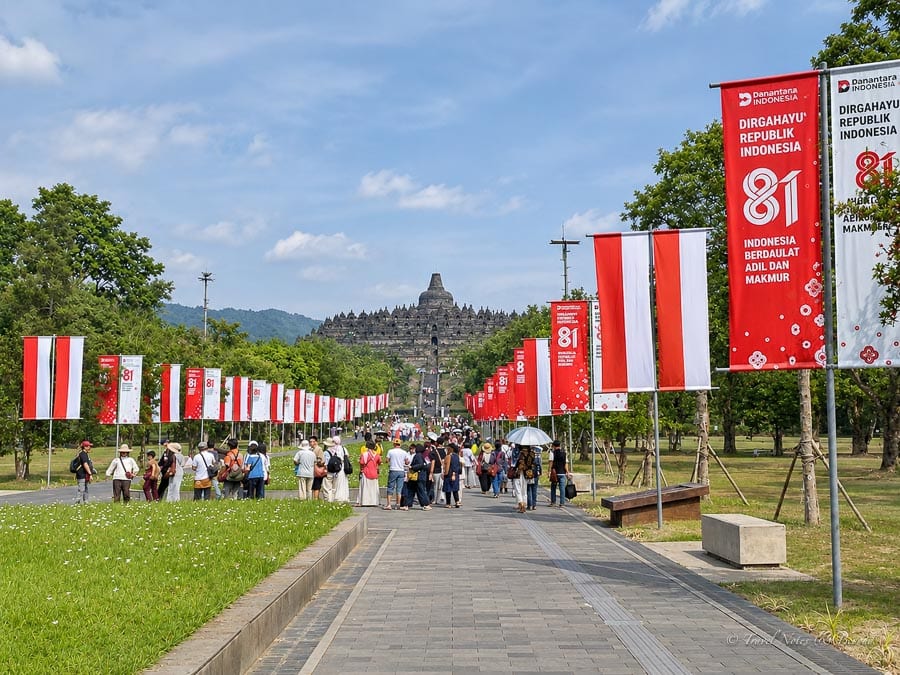
For all the precision with which the authorities regulate your time on the monument, they seem remarkably generous with the amount of time you spend waiting. There we were, sporting our rather ridiculous-looking slippers, sitting wherever we could find a spot and exchanging puzzled looks.
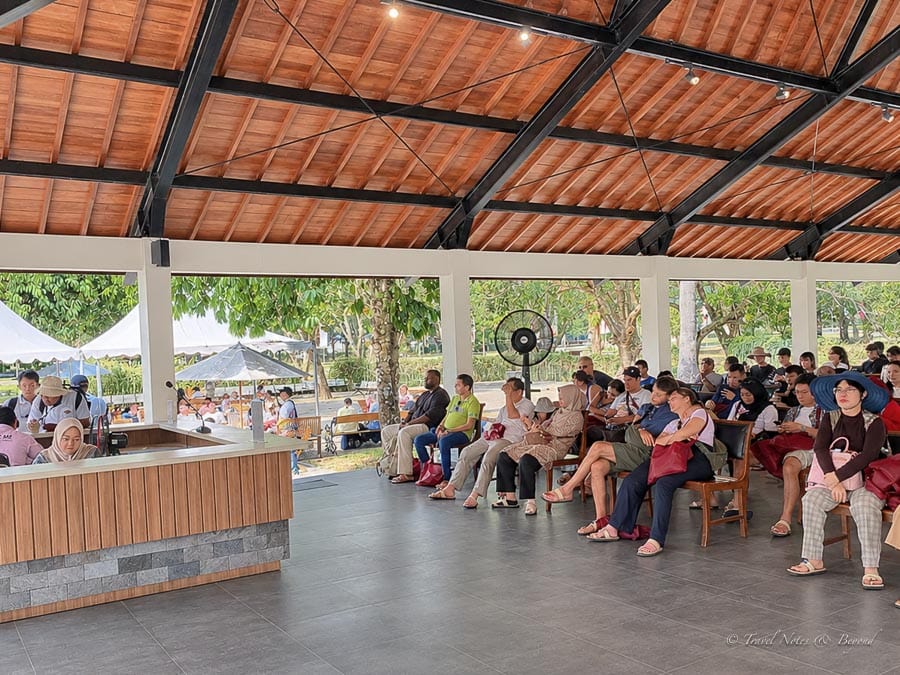
Nobody seemed to think it necessary to tell us what exactly we were waiting for, let alone how much longer it would take. I’m sure there was some method to this exercise, but from where we sat, it wasn’t immediately apparent.
The Mandatory Upanat Sandals
Before you’re allowed to climb Borobudur, there’s one more important ritual to perform. No, nothing spiritual. You must surrender your shoes.
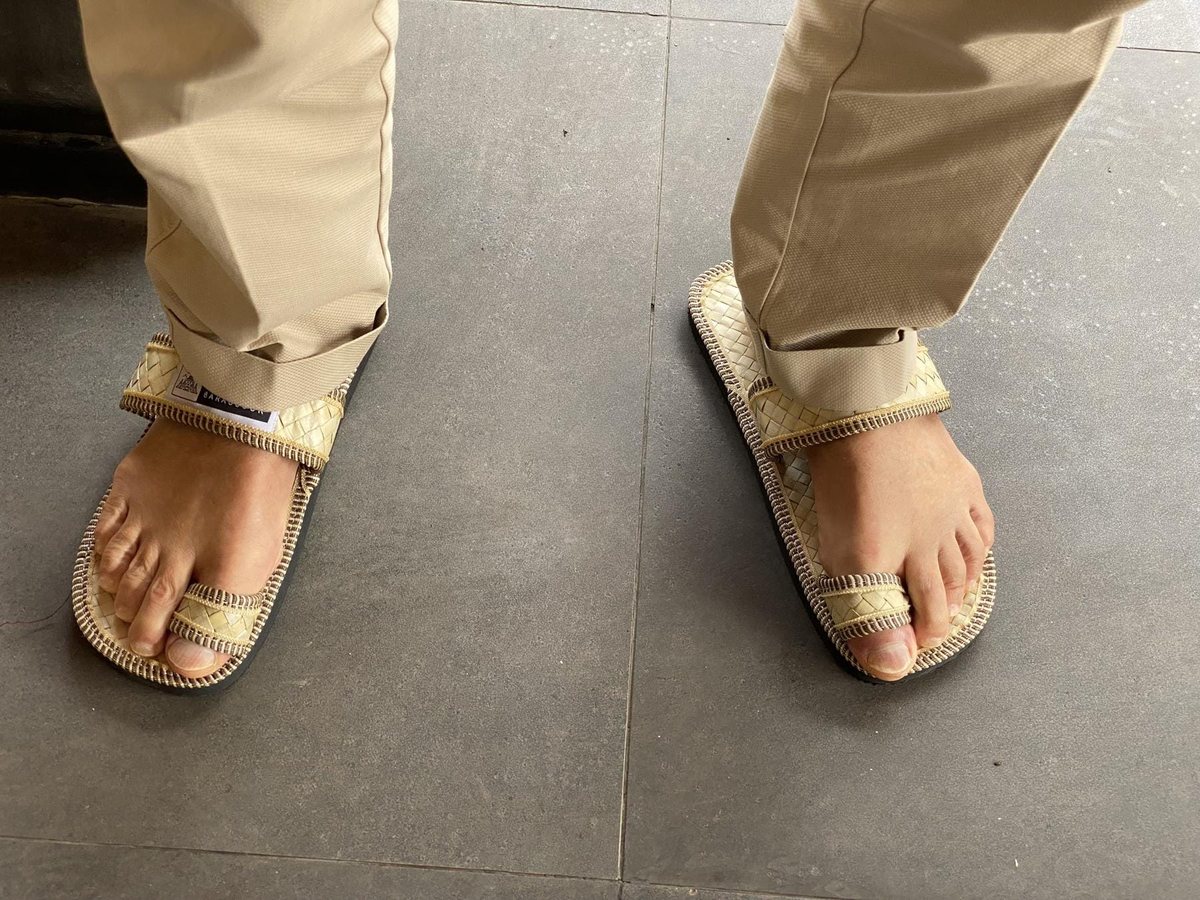
To protect the ancient stone from erosion, visitors are required to wear special Upanat sandals made with natural fibers. A perfectly reasonable conservation measure, at least in theory.
In practice, I had to take off my comfortable rubber-soled tennis shoes and exchange them for a pair of slippers in which I could barely walk. And I was about to climb some rather steep stone steps. Apparently, preserving a thousand-year-old monument and preserving my ankles were two entirely separate projects.
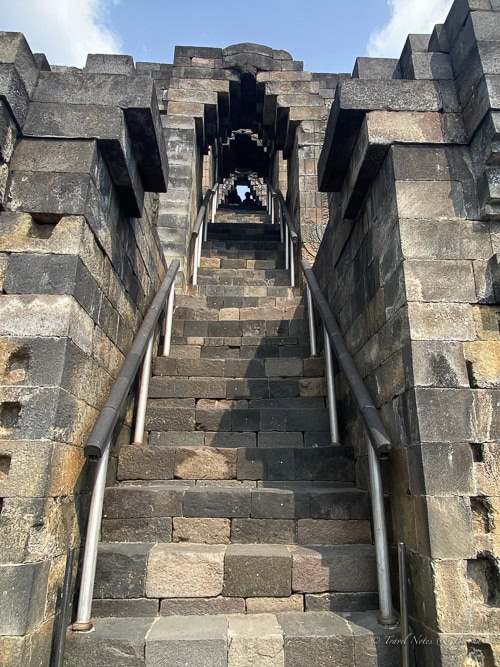
Now, I have nothing against protecting ancient monuments. Quite the contrary. But couldn’t visitors wearing suitable soft-soled footwear be allowed to keep their own shoes? The Upanat sandals could be provided to those who arrive wearing something inappropriate. But seriously, who ventures into the Javanese countryside to visit an ancient Buddhist temple wearing stilettos or the kind of studded boots you’d wear while trekking through Patagonia?
The Guided Tour You Can’t Escape
If you thought that surviving the footwear exchange meant you were finally free to explore Borobudur, think again. You still have to pass the ultimate test: the mandatory guided tour.
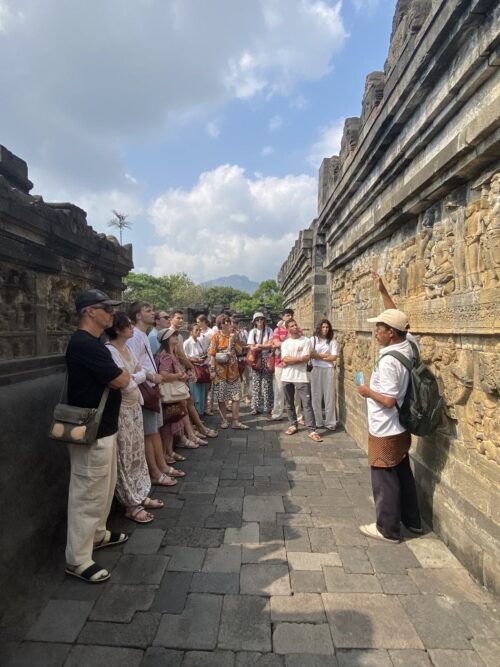
Now, I understand that thousands of tourists can’t be allowed to roam freely around an ancient temple. Some of us can barely be trusted to behave in a supermarket, let alone a monument like this one. Crowd control is necessary, and the time allowed on the temple is perfectly reasonable.
But surely it’s possible to manage groups of grown adults without treating them like kindergarten children on a field trip! An audio guide and a bit of supervision would do the job just as well.
Our guide’s first task, apparently, was to make sure we didn’t get anywhere near the temple until everybody else had gone ahead. We had booked the earliest session to avoid the heat. Instead, we spent an extra half hour standing in the sun, waiting for our turn. We managed to be among the first to arrive and the last to climb, wasting the coolest part of the morning.
Eventually, we were allowed to climb. Unfortunately, our guide seemed determined to squeeze an entire semester of Buddhist studies into the time we had available.
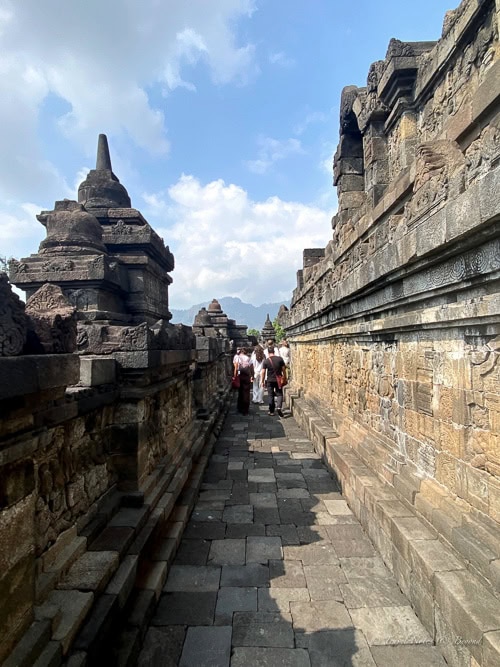
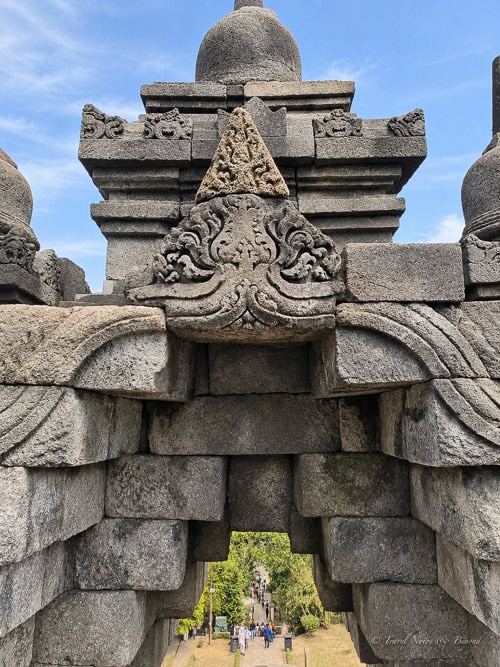
Don’t misunderstand me. I appreciate learning about the places I visit. But when I’m standing in front of one of the world’s greatest Buddhist monuments, I’d also like to look at it. Preferably without having to choose between listening to a lecture and taking a photograph. After all, I could read about those carvings in my hotel room. Borobudur, unfortunately, wouldn’t fit in my suitcase.
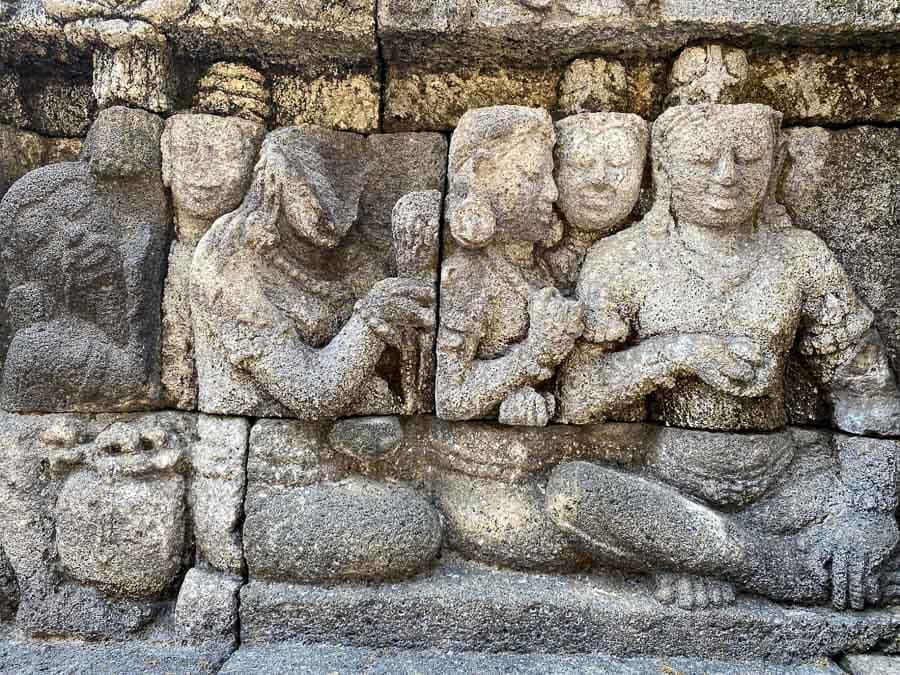
This is exactly why I’d choose the Manohara Premium Experience next time. You still get only an hour on the monument, but with a private guide you won’t spend it waiting for other groups to move along. And you might even get a few minutes to admire the carvings in peace.
Leaving Borobudur: A Carriage Ride and an Unexpected Photographer
Once we came down from the temple, we could finally exchange those lovely Upanat slippers for our own shoes. What a relief! But our visit wasn’t quite over yet. We still had a rather long way to walk back to the parking area, and the morning heat wasn’t getting any more pleasant.
That’s when we spotted some horse-drawn carriages and decided to take one, mostly for the fun of it. As it turned out, this was one of our better decisions that morning. Not only did we enjoy a lovely carriage ride, but we apparently managed to bypass the endless souvenir stalls that other visitors complain about. Pure luck, I assure you. We had no idea they were even there!
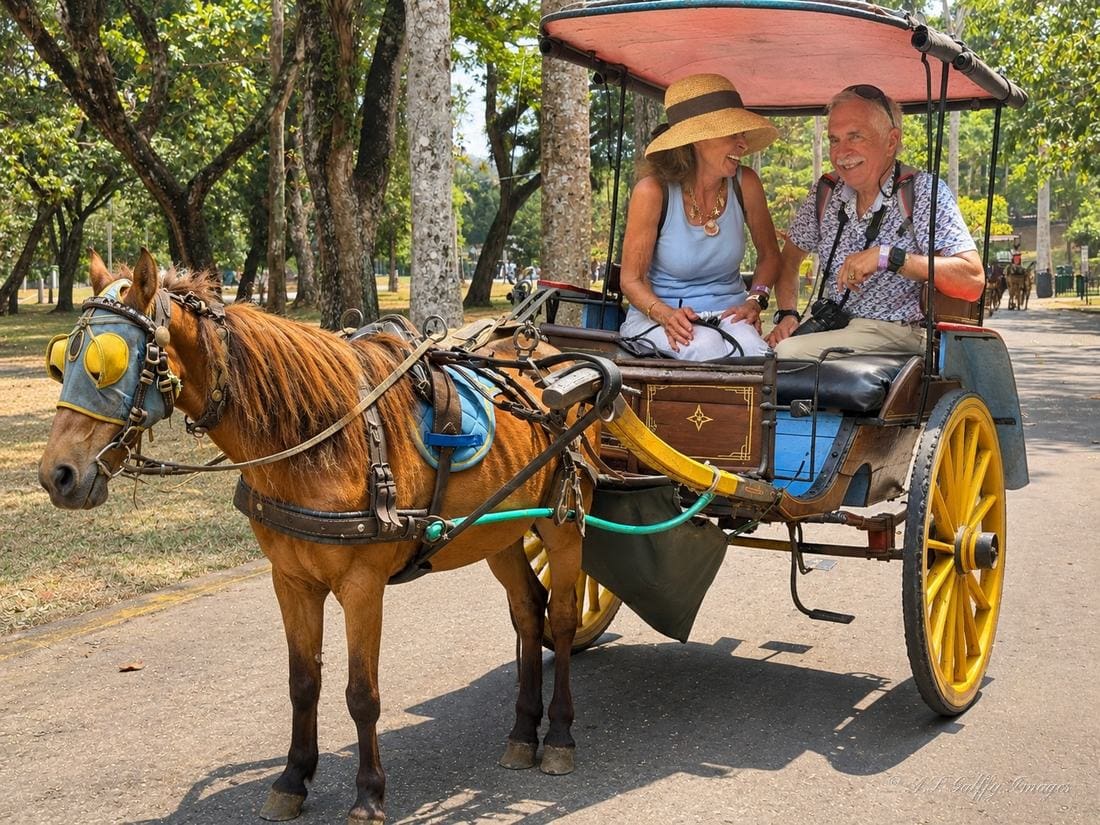
But the best part was our carriage driver. At one point, we asked him to take a picture of us sitting in the carriage. He pointed the camera at us, then suddenly stopped. “Wait, not like that! Don’t look at me, look at each other!”
We were so surprised by his instructions that we couldn’t help laughing. The only other time anyone had directed us so seriously on how to pose was at the photographer’s studio when we had our wedding pictures taken! Apparently, our carriage driver was also an aspiring portrait photographer. And we certainly liked the results!
The photograph turned out wonderfully, much more natural than those usual tourist pictures where everyone stares stiffly at the camera, looking as though they’ve just been asked to identify a suspect.
Is Borobudur Temple Worth Visiting?
After reading this litany of grievances, you may wonder whether Borobudur is still worth visiting. Absolutely! My reservations are about the way the visit is conducted, not about the monument itself. Despite all these inconveniences, you still get to experience one of the world’s most extraordinary Buddhist monuments. Admiring its intricate stone carvings up close, and taking in the magnificent views from its upper terraces is something you shouldn’t miss.
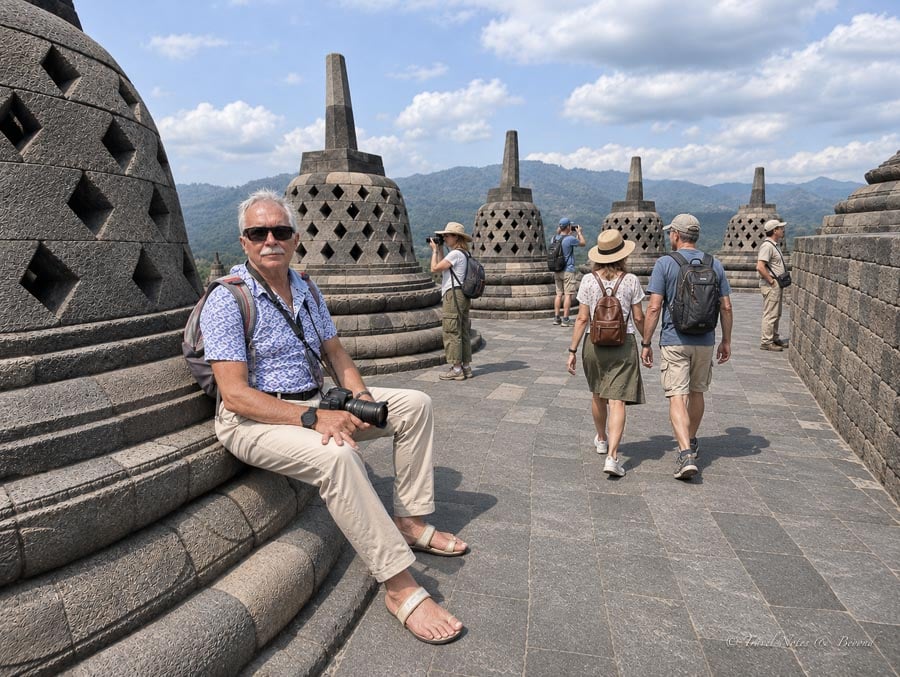
There is something quite extraordinary about standing among those bell-shaped stupas, looking out over the lush Javanese landscape and contemplating what people were capable of building more than a thousand years ago. No photograph can quite convey the magnitude of this architectural achievement or the incredible workmanship that went into it.
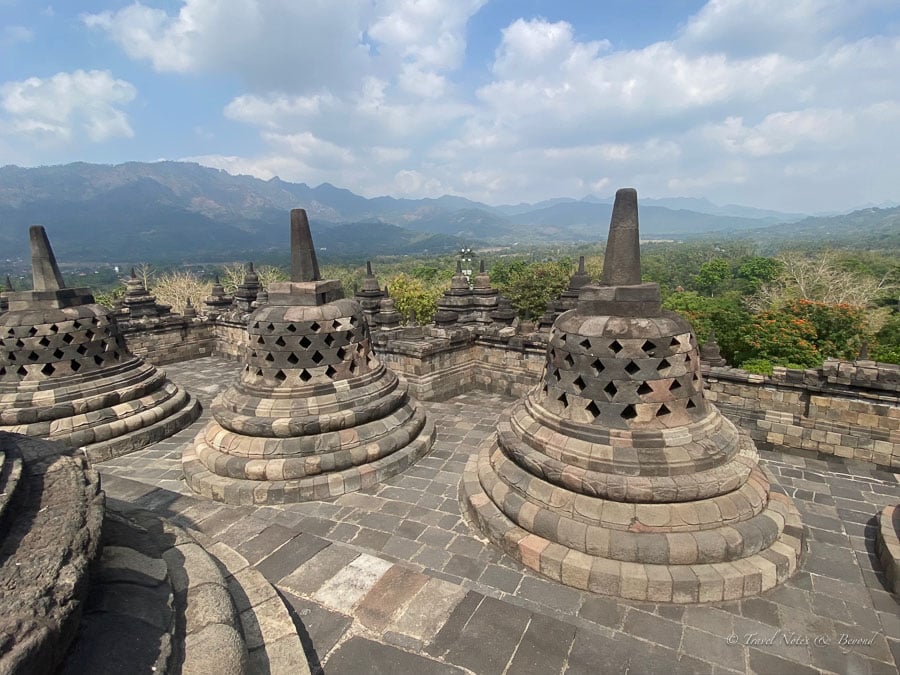
Would I have regretted coming all the way to Java and not seeing Borobudur? Without a doubt. Would I have enjoyed it considerably more with a little less supervision? Equally without a doubt!
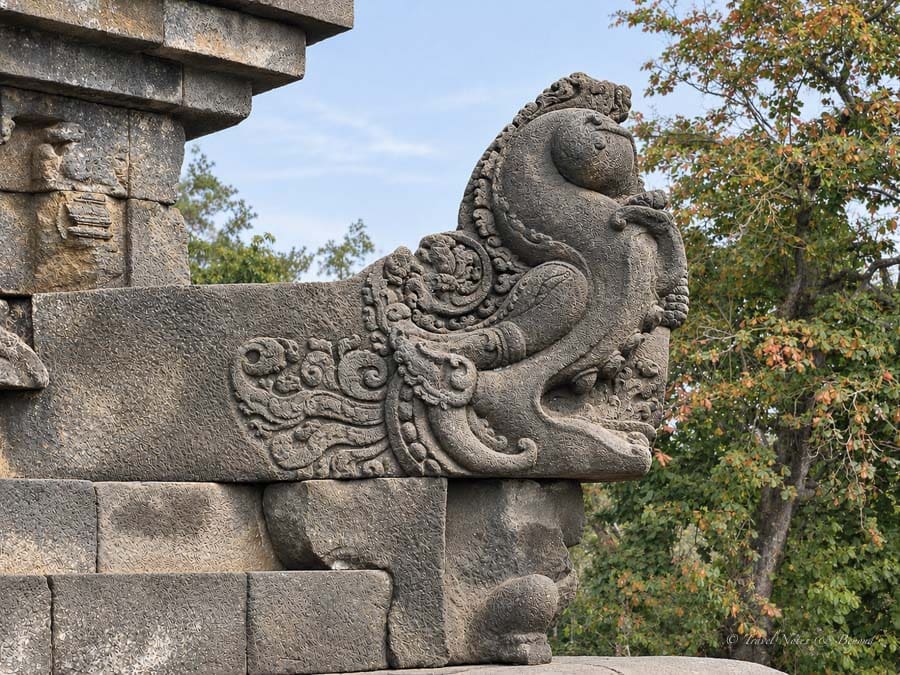
So by all means, visit Borobudur. Just be aware of what the experience entails and adjust your expectations accordingly. And if you value the freedom to explore at your own pace as much as I do, you’ll appreciate Prambanan Temple all the more.
Beyond Borobudur: Mendut Temple and Monastery
If you have some extra time after visiting Borobudur, consider stopping at Mendut Temple (Candi Mendut), about 3 km (2 miles) away. Built in the 9th century, it belongs to a group of three Buddhist temples, together with Borobudur and the smaller Pawon Temple.
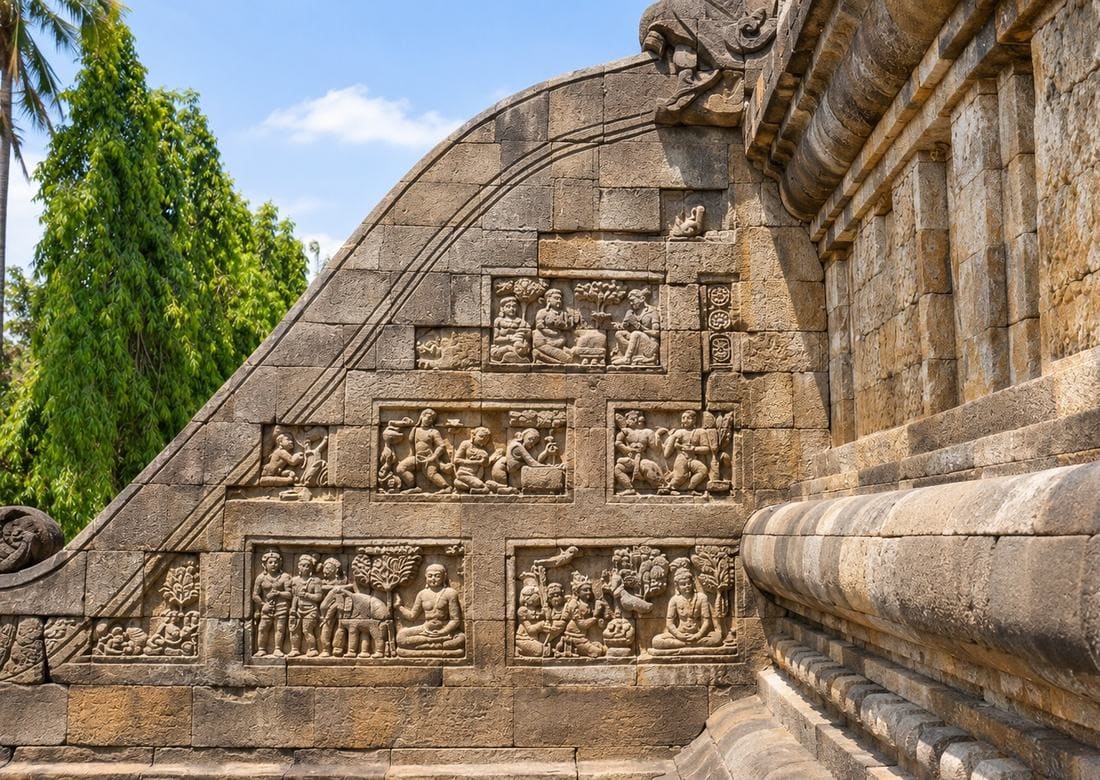
Mendut looks almost insignificant when compared with the grandiose Borobudur, but it was not the size that interested us. We had read that it was well worth a visit for its carvings and statues. The temple stands on a raised stone platform, with a steep staircase leading to its entrance.
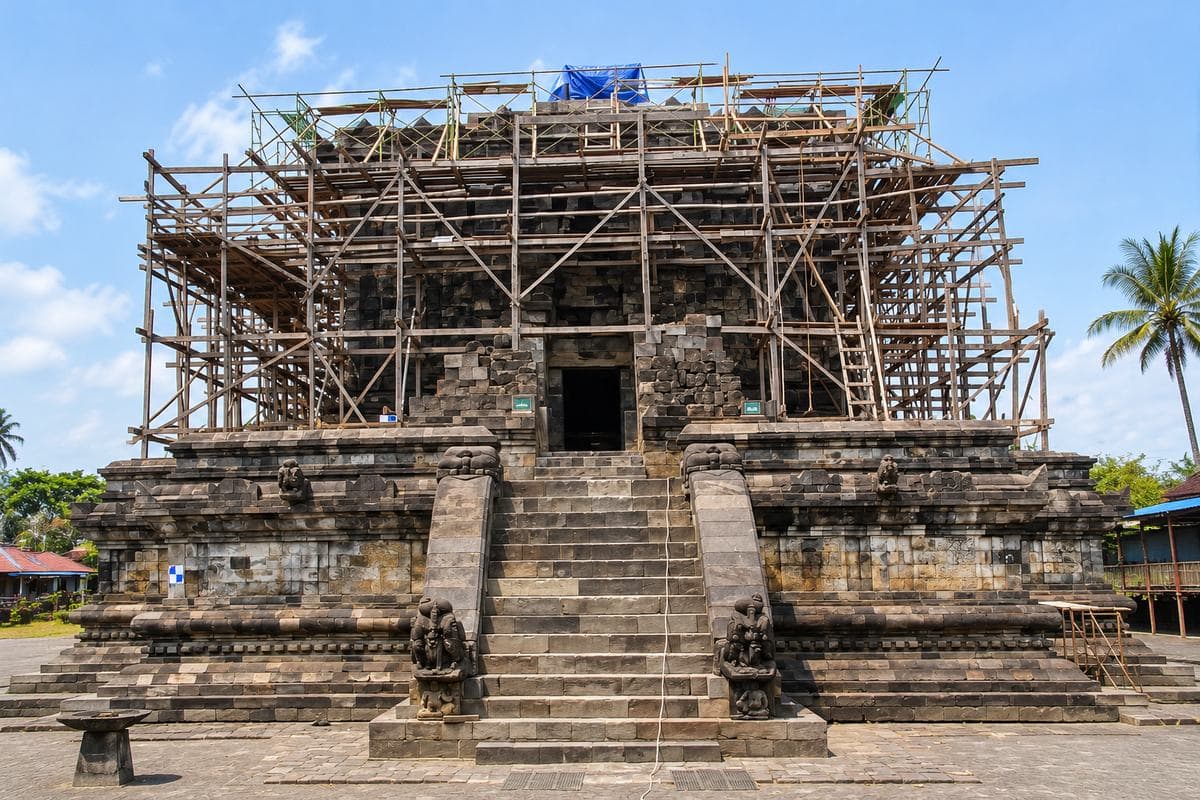
Sadly, the temple was under renovation and we could only see the base. The rest was covered in scaffolding. Even from the little we could see, it was obvious that Mendut was worth a closer look. So if you’re already visiting Borobudur, I’d recommend including it in your itinerary.
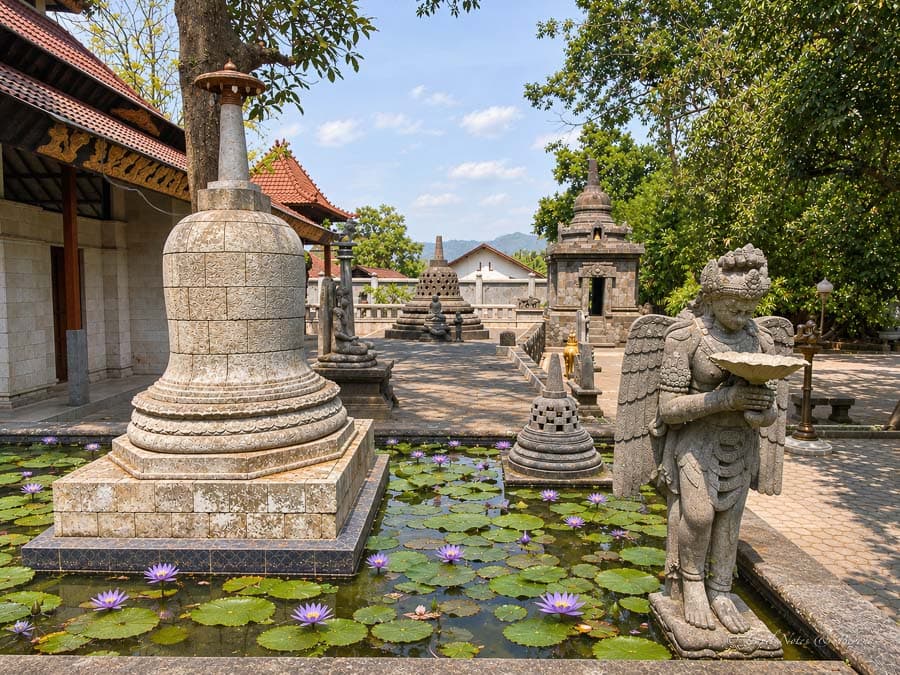
Luckily, the nearby Mendut Buddhist Monastery (Vihara Mendut) was open, so we decided to have a look. Its buildings were pleasant enough, with Buddhist statues and traditional architectural details, but nothing particularly impressive. The gardens, however, were really beautiful, with lush tropical vegetation, ornamental ceramic urns, stone sculptures, and ponds filled with purple water lilies.
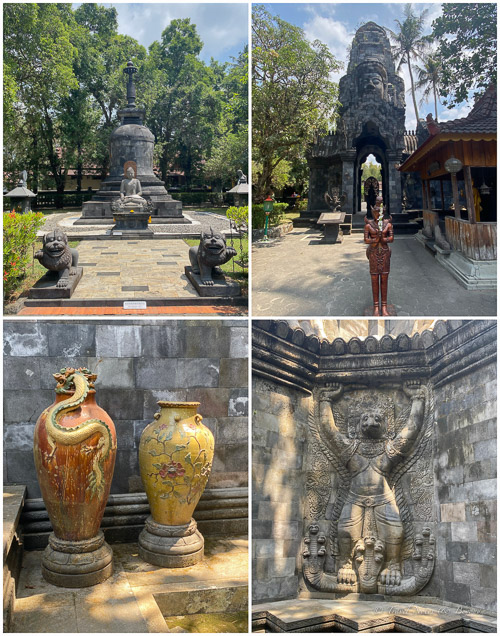
I was particularly fascinated by a large cannonball tree (Couroupita guianensis), whose extraordinary orange-red blossoms looked unlike any flowers I’d ever seen before.
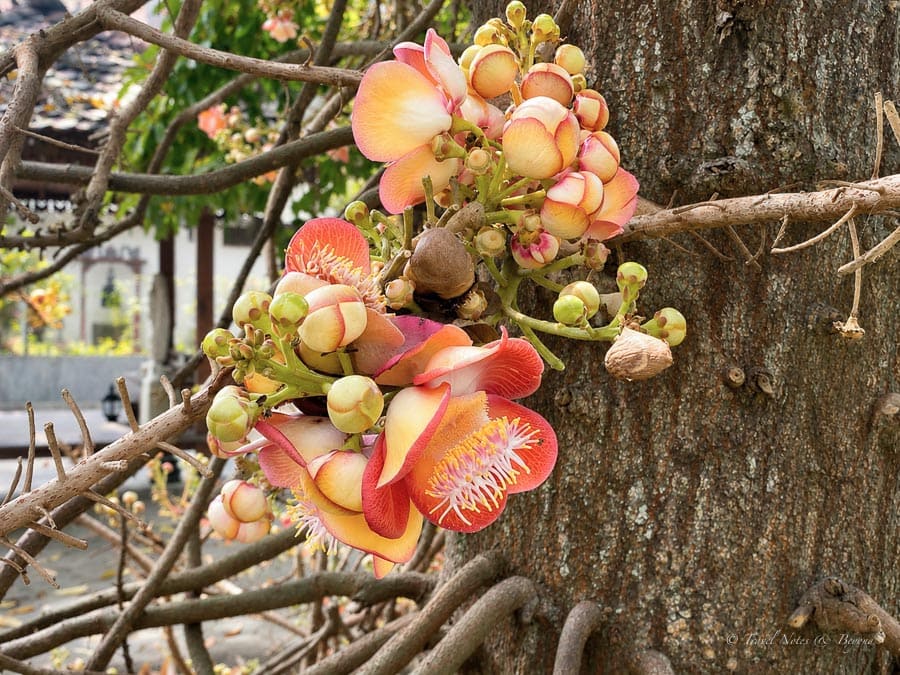
We may have missed seeing Mendut Temple properly, but I’m glad we stopped. The monastery’s beautiful gardens made up for some of that disappointment.
A Final Thought
Borobudur is a humbling place, even if Buddhism is not your religion. As I stood among those stupas, I couldn’t help wondering about the people who built this magnificent monument twelve centuries ago. What kind of faith, patience, and determination must it have taken to devote so much human effort to a project that offered no obvious material reward?
Every stone was shaped and placed by human hands, every carving the work of someone who probably never imagined that people from the other side of the world would one day stand there admiring it. And yet, here we are, centuries later, still trying to understand what those people believed and what inspired them.
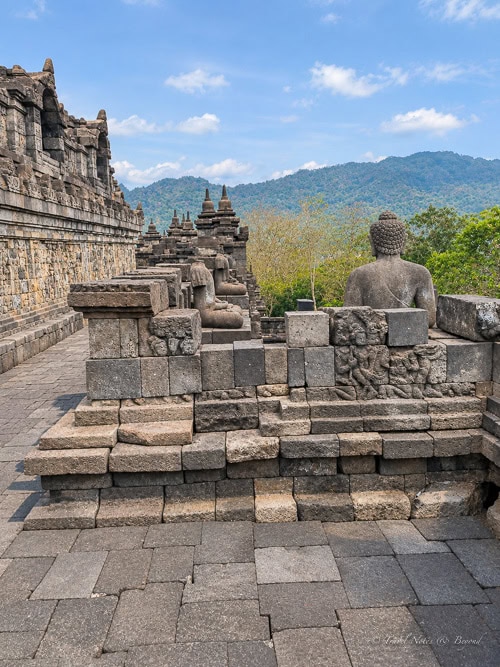
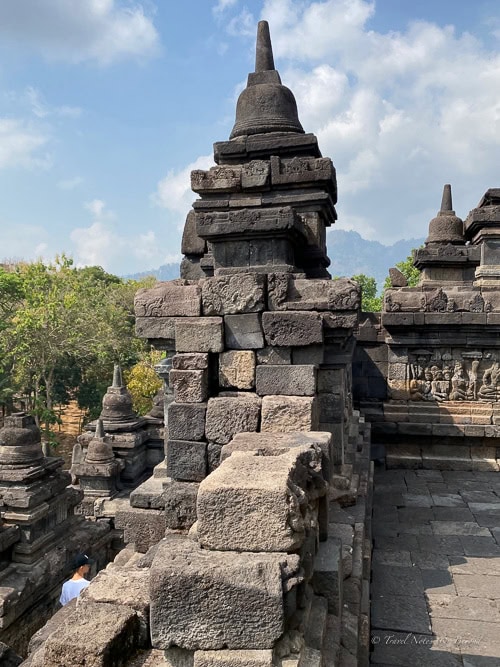
Perhaps that’s what stayed with me most after visiting Borobudur: not simply its beauty, but the realization that faith can inspire human beings to accomplish things that seem almost impossible. We may not share their beliefs, but standing before what they left behind, it’s hard not to respect the depth of their devotion.
You May Also Like
anda
Enjoyed this guide?

Get my new travel guides and stories in your inbox. No spam, and you can unsubscribe anytime.