
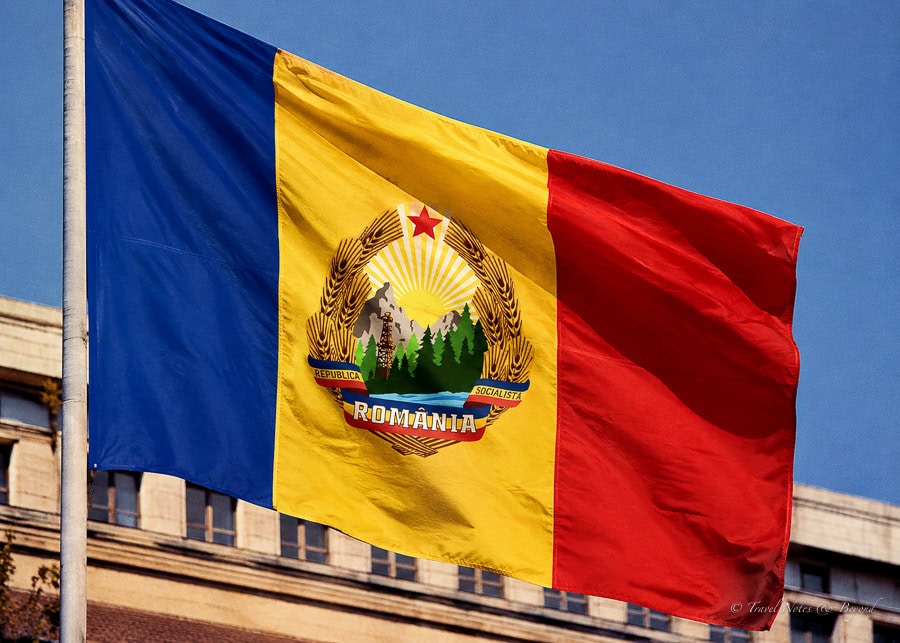
I was born and raised in Communist Romania, but life under communism wasn’t all bad. Yes, I know Romania officially called itself a “socialist” country, but we actually lived in the purest form of communism. So calling it “Communist Romania” best fits my former country’s description, though you’ll see me use both terms throughout.
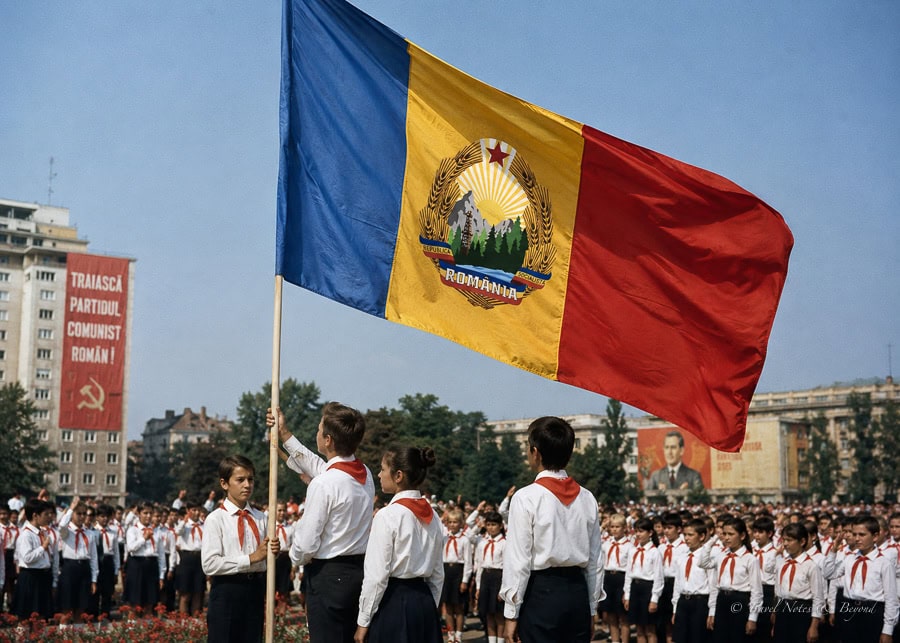
Of course, I could tell you all kinds of dreadful stories about those times, and they would all be true, but not everything was bad there. In hindsight, it was a strange mix of bad, good, and downright absurd. So let me start with the parts that were hard to live through.
The Bad
When I look back at those years lived in the Socialist Republic of Romania, I sometimes find it hard to believe we could tolerate those conditions.
No Space, No Hot Water, No Power
Growing up, there were four of us in a one-bedroom apartment, sometimes more when relatives came to visit and slept wherever there was floor. Privacy was a concept I didn’t understand until much later. You learned to be alone in a room full of people.
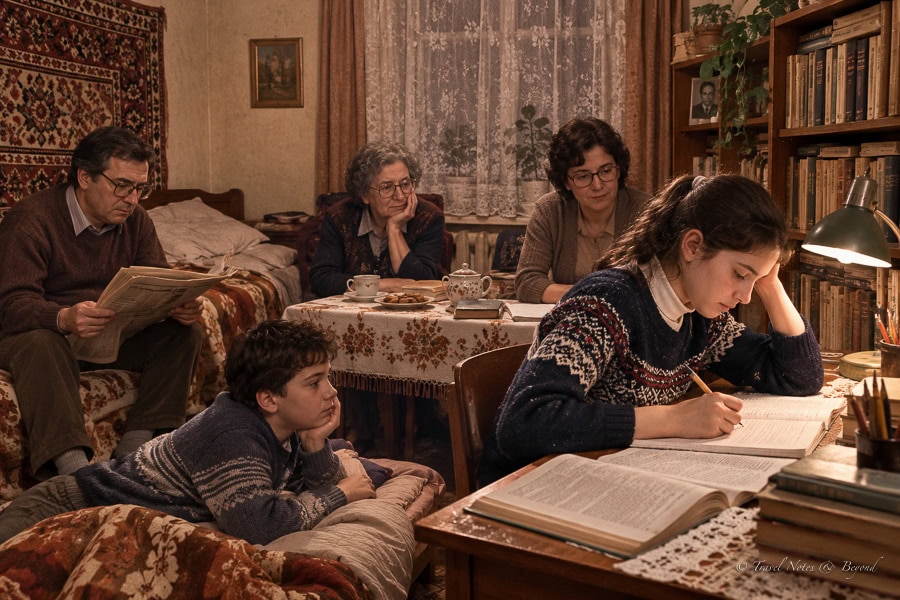
Hot water came two hours a week, on Sunday. That made Sunday “bath day,” and the whole family’s rhythm bent around it—everyone taking turns before the water ran cold again. To this day, a long hot shower still feels like a small luxury I haven’t quite earned.
Power was another daily gamble. The electricity was supposedly cut twice a day, but never at the same hours, so you could never plan around it. As a result, I never dared step into an elevator when my son was young, because I could have been stuck in there for hours. So I had to climb up and down all seven floors, with my baby in one arm and his stroller in the other.
Interminable Queues
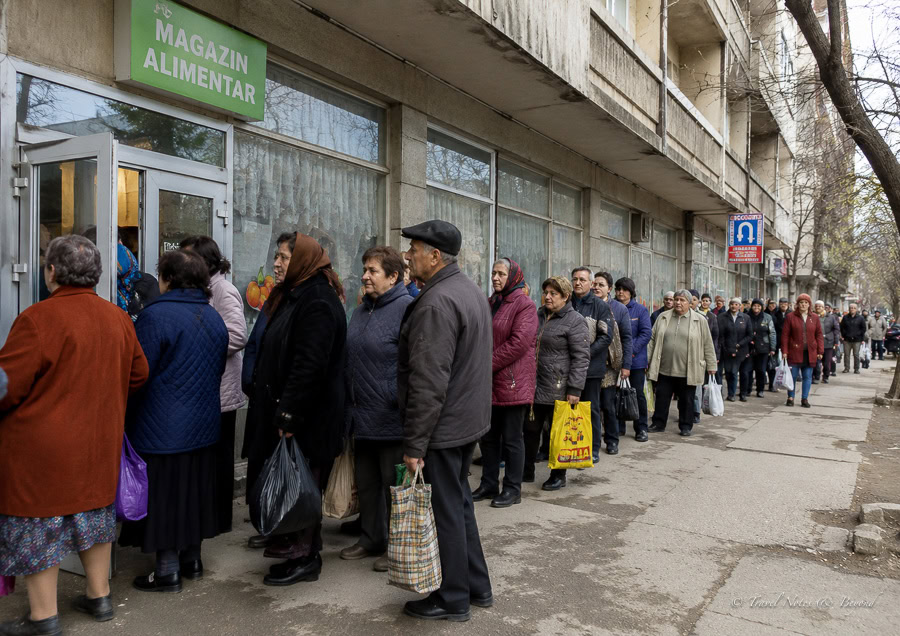
At the store, the lines formed before the merchandise did. You’d join a queue without always knowing what was at the front of it. If people were lining up, it meant something had arrived, or would arrive soon, and you didn’t want to miss it. The shelves stood almost always empty, because there was never time for them to fill.
Food Scarcity
Food was the hardest part, and getting it took more than money. You needed connections. A “friend” at the grocery store who would set something aside for you. A relative in the countryside who grew their own vegetables and could spare a few potatoes. Even in restaurants, where the meat was supposed to be served to paying customers, the manager would quietly take a portion of it and sell it to his own “friends” or hand it to his relatives.
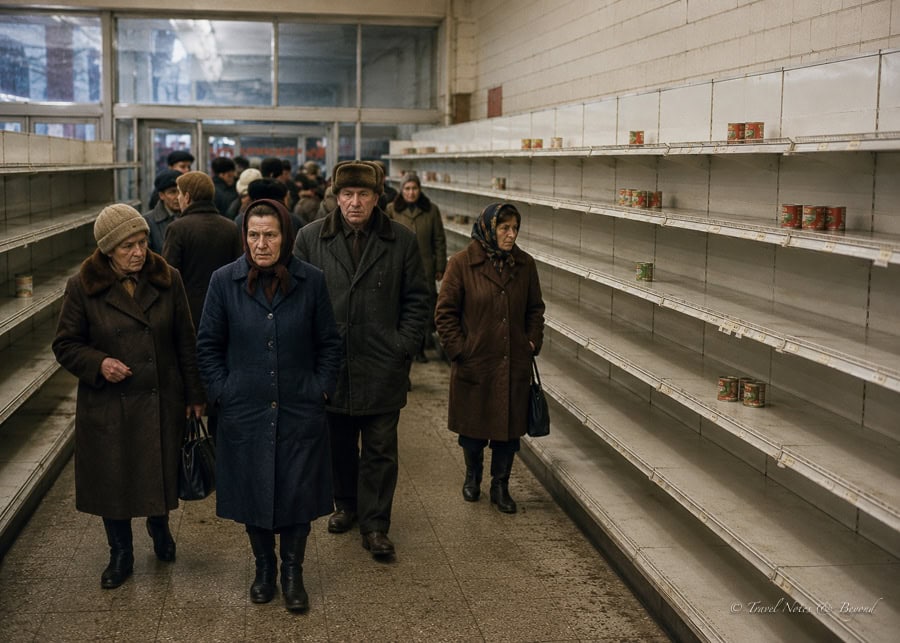
Even with someone on the inside, meat was not more than a once-a-week luxury! Potato or beans soup seven days a week was the norm. I will never forget the winter my son was just a few months old and needed apple sauce. I couldn’t find a single apple at the market for over six months!
Getting Around Was an Ordeal Too
Transportation in Socialist Romania wasn’t just scarce, it was dangerous. Buses and trams ran on a schedule only they seemed to understand, and you could wait at a stop for over 90 minutes, even during rush hour. When one finally arrived, it was so packed that people hung off the outside, clinging to the handrails, the whole bus tilting under their weight.
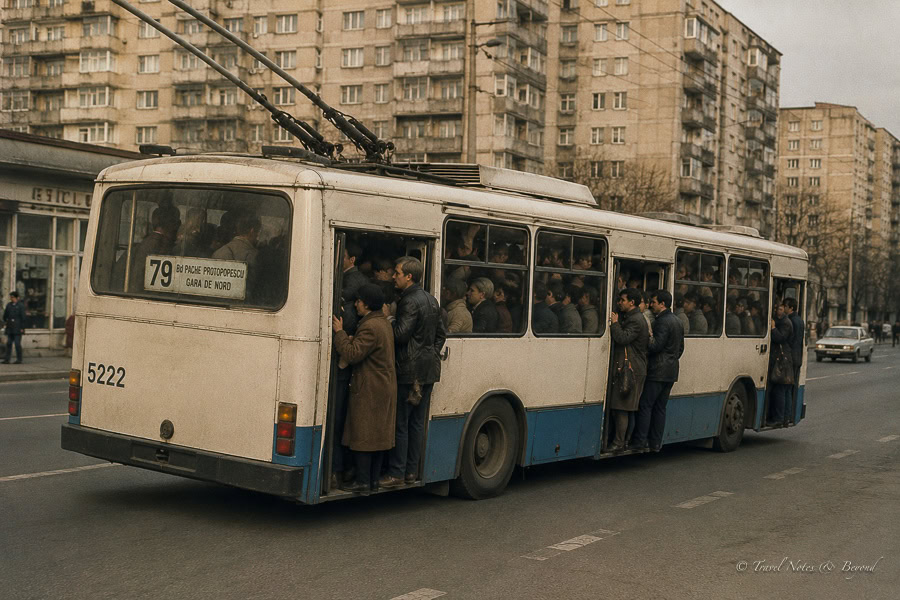
Winter made everything worse. When it snowed, the roads and sidewalks went uncleared for days, sometimes weeks. Nobody came to salt them or shovel them, so snow packed down into sheets of ice. Simply walking to work or to the store to avoid freezing at the bus stop, became a small act of courage. People slipped and fell constantly, breaking wrists, ankles, and hips.
Owning a car wasn’t much of an escape either, because buying gasoline was almost impossible. Cars sat in lines kilometers long outside the gas stations, day and night. Drivers took turns to inch them forward, when fuel would finally arrive. Weekend driving was restricted by license plate: odd-numbered plates one weekend, even the next. So you were grounded every other weekend.
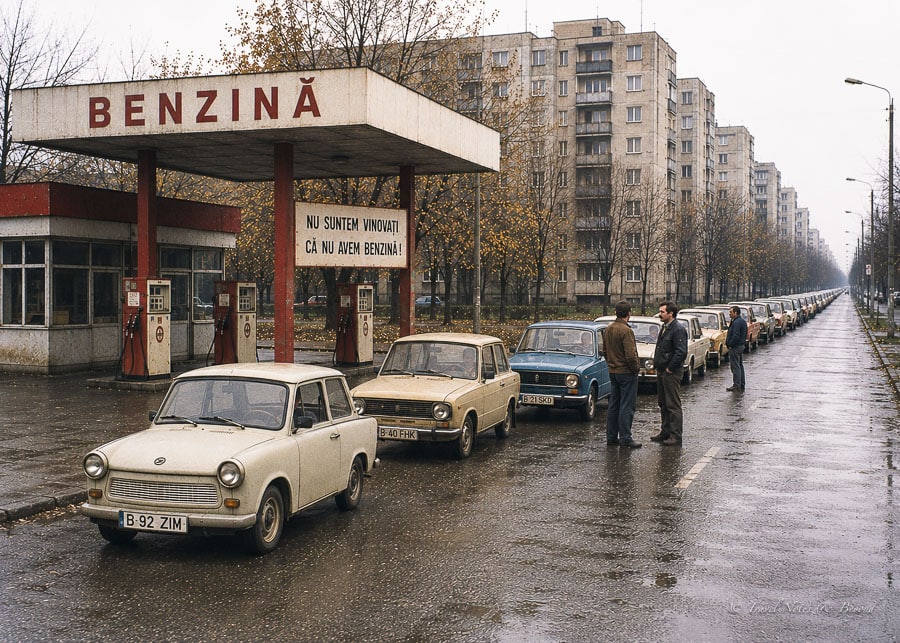
I could go on and on with stories like these till the cows come home, but living in communist Romania wasn’t all bad.
The Good
Despite all this, we were content with our lives. Or at least that is how the Romanians‘ long-enduring patience was interpreted. And why wouldn’t we be? We had free healthcare and free education, two basic “rights” that you have to pay for in the “rotten” capitalist world. That was the official line, anyway, and we half-believed it.
Life Was Stable in Communist Romania
Life in Communist Romania was simple, but stable. Everyone had access to the same goods, nobody owned anything special, so there was very little envy going around. Everyone had the same salary, regardless of productivity. You didn’t have to work hard, and you didn’t have to worry about losing your job.
We Didn’t Struggle with Choices
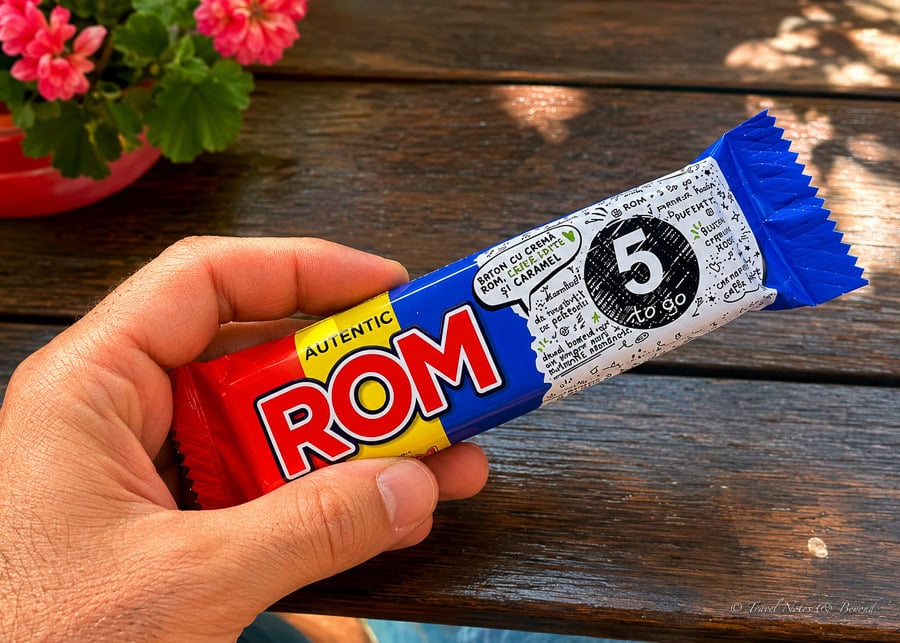
You didn’t have too make too many choices either: there was only one laundry detergent on the market, one brand of shampoo and soap, one single kind of chocolate and the TV had only one channel. Boring? Perhaps, but surely not very stressful.
We Had a Lot of Free Time
Because the pay was so poor and the conditions so bleak, almost nobody cared to work hard, and everyone played hooky from work whenever they could get away with it. If you were on good terms with your boss, you might stretch your two weeks of vacation into a month, show up at 8 a.m. instead of 7, and slip out at 2 p.m. instead of 5 p.m.
Ah, but where was your conscience, you may say! Our excuse was: “they are pretending to pay us, so we are pretending to work.” Cheating the system, even in small ways, became our own quiet revenge, and it made the misery in which we lived a little more bearable.
Friendship Was Real
The best thing about living in Communist Romania was the friendships. Because we were all stuck in the same hellhole, we felt united against the same enemy, and that bond was real. When people have to depend on one another just to survive, they help each other in every way they can. Neighbors looked out for you, coworkers were nicer, and your close friends were the kind you could wake at two in the morning if you were in trouble.
Not everyone was good, of course. But on the whole, you could count on people’s kindness in a way I’ve rarely felt since. Here in the US, people are nice and polite, but that deep, drop-everything-for-you kind of friendship is hard to find.
Now that I think back to those years, I realize that only hope and humor helped us keep it all together. And speaking of humor, here are a few things that you’ll surely relate to if you were raised in Communist Romania.
Absurd Things You’ll Relate to If You Lived in Communist Romania
Growing up in Communist Romania came with its own unwritten life rules and little habits. Nobody taught them to you directly, yet every kid somehow ended up knowing them. Here are the ones that stuck with me.
Drafts and Ice-Cold Drinks Can Cause Pneumonia
If you know any Romanians you must have heard about this health hazard named “curent.” Curent in this context means “draft”, as in a drafty door, or the draught that circulates when two windows are open.
If you catch a draft you will develop headaches, muscle soreness, stuffy nose, sore throat, coughing and eventually pneumonia. Even if you’ve never heard about the danger of a draft, you must have noticed that Romanians never want ice in their water or drinks. In case you wonder why, let me explain it to you.
Growing up under communism meant not only scarcity and hunger, it also meant poor living conditions. We were under the constant threat of getting pneumonia, so our parents became obsessive about sheltering us from the disease. We were not allowed to eat or drink anything cold.
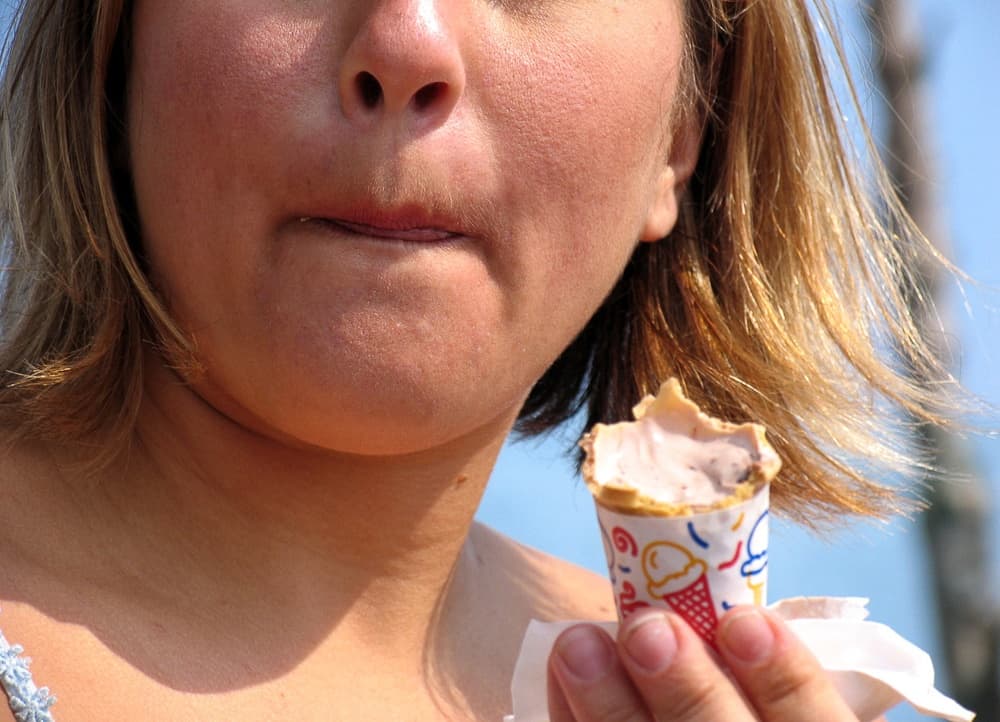
Having an ice-cream in winter was out of any question, but even in summer when we were allowed to eat ice-cream, we had to warm it up in our mouth before swallowing it. Also, drinking cold water when we were hot and sweaty was the surest way of get pneumonia. Not to mention walking bare-foot on cold tiles in winter!
Beer and Pepsi Caps Make a Good Currency
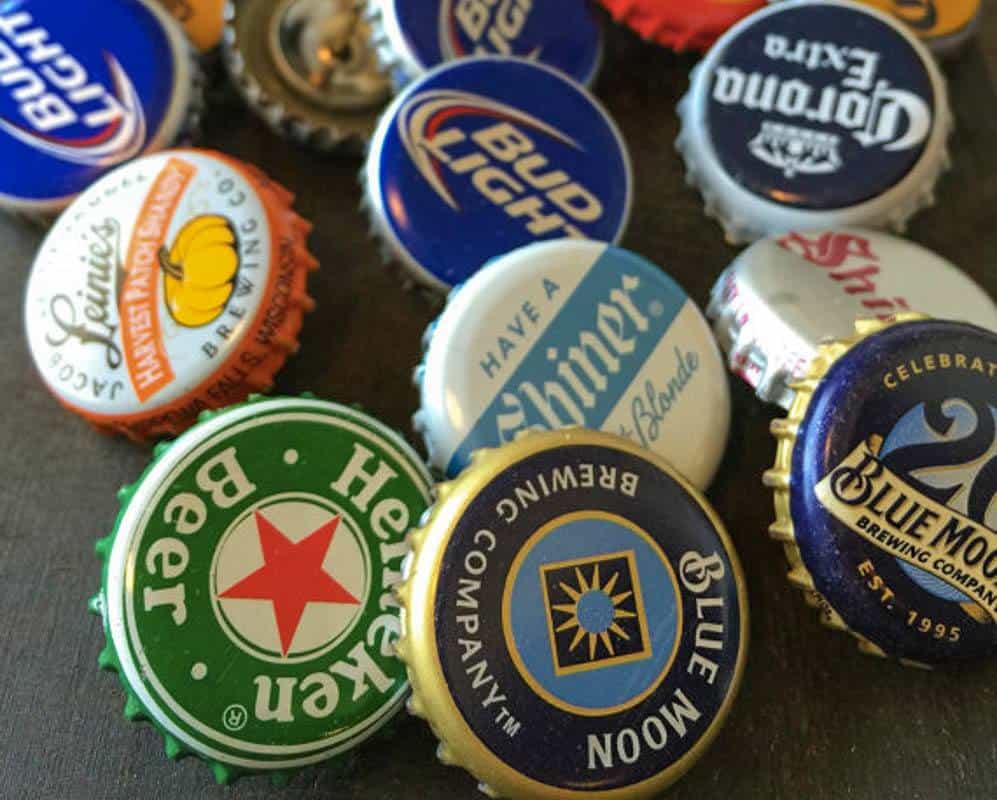
When you don’t have much, you learn to be creative. Toys and games were rare when I grew up in Socialist Romania, but imported beer and Pepsi-Cola were rarer still. So if you got your hands on a few of those caps, you were a rich kid. In my neighborhood, you could trade those colorful bottle caps for almost any toy the other kids had.
Recycling Can Be Taken to Very High Levels
Life in Communist Romania taught us that we can’t throw stuff away. Empty bottles could be used a flower vases, or turned into oil lamps. Old newspapers could be used for window washing, to start up a fire, as trash bin liners, or even turned into toys. Cottage cheese containers could be used for storing nails and bolts. Old shirts, socks and even underwear can make perfect rugs to clean the floors and dust the furniture. Rain water can be gathered in buckets and used for laundry. Even potato peels, rotten fruit and vegetables can be used for something, like feeding the pork or to fertilize the garden soil.
You Don’t Need Medication to Cure a Cold or the Flu
Medication was the last thing a pediatrician would prescribe if you had a cold or the flu. Usually keeping your feet in a basin of hot water, a hot tea with lots of lemon and honey, or standing over a steaming pot of water with a towel thrown over your head would solve the problem.
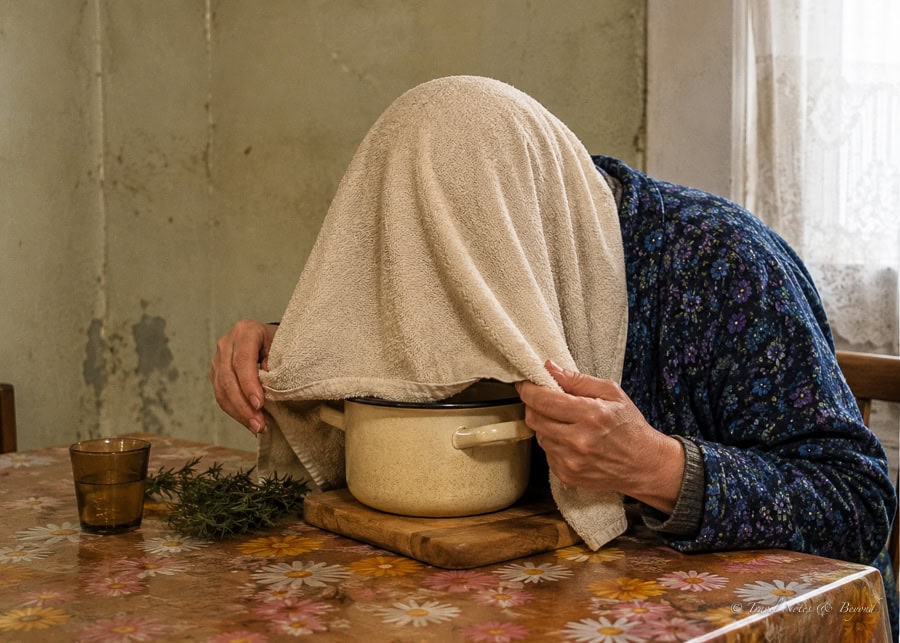
For tonsillitis, a gargle with salty water and some hot chicken soup; for high fever a good alcohol rub and for stubborn chest congestion, mustard plasters (also known as mustard packs) applied on the chest. Primitive? Perhaps, but somehow these natural remedies always worked just as well as any pills or shots. We never knew what a flu shot was.
Leaving Food on Your Plate Is Sinful
Growing up in deprivation you are constantly reminded that food is a gift that not everyone can enjoy. You have to be thankful for it and always finish what’s on your plate.
You can only put on our plate what you could eat or you’ll be made feel guilty for wasting food while children in other parts of the world are starving. So if you put more, you were forced to eat it all. As the old saying went: “Mai bine mațe stricate, decât bucate aruncate” which rhymes in Romanian and means, roughly, “better a ruined stomach than food thrown away.”
Listening to the Radio Could Get You in Real Trouble
Every home had one radio dial that mattered, and everyone knew exactly where to find Radio Free Europe. It was the most listened-to station in the country, precisely because it broke through the state’s controlled news. In the evening the volume went low, the door got shut, and the whole family leaned in toward that crackling, half-jammed signal like it was gospel.
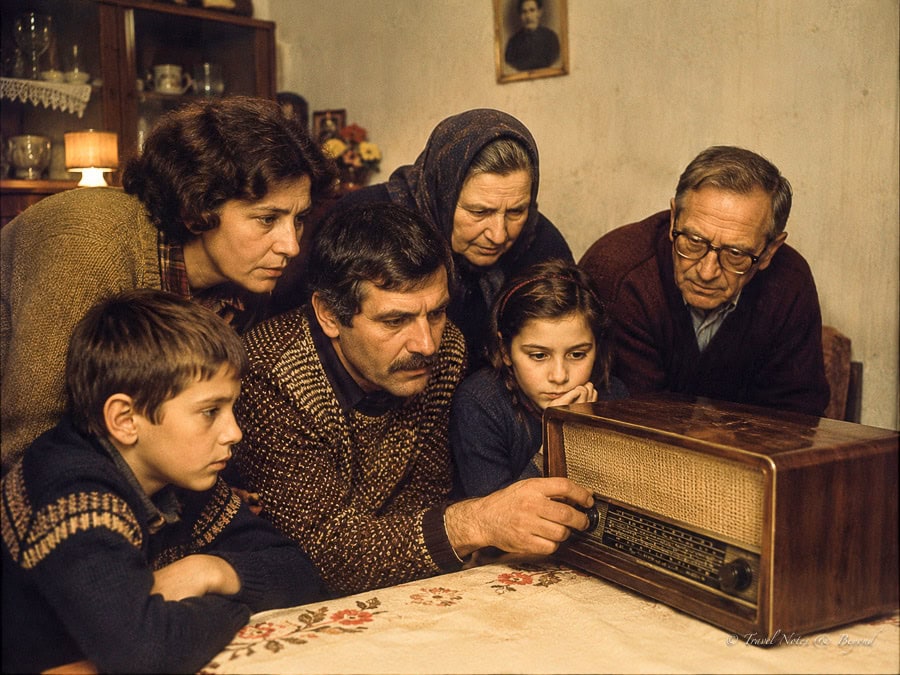
Listening to it was strictly forbidden, but we did it anyway behind a closed door. For us it was “a beacon of hope, culture and a step towards freedom in those dark times,” as a listener put it. The next day, nobody said a word about it at school, but we all felt better somehow, knowing that the world outside hadn’t forgotten us.

People ask if life in Communist Romania was hard, and of course it was. But when I look back, I don’t picture the lines or the darkness. While we didn’t have much, we had families and friends, and we had the two things no shortage could ration: our hope and our sense of humor. That, more than anything, is what I remember. That’s what got us through.
Do any of these resonate with you? Let me know in the comments below.
 The 10 Best Things to Do in Carson City, Nevada




Janko
It is beautifully written—memories that endure, special precisely because they remain only as memories. Things were a bit different in Yugoslavia, yet also very similar. There wasn’t exactly a shortage of basic necessities. It always puzzled me that bananas were considered a luxury, given that we were a key player among the Non-Aligned Movement and a major arms manufacturer. Fortunately, I lived near the Austrian border rather than the borders with Romania, Hungary, Albania, or Bulgaria, so we had an alternative. Of course, the odd-even fuel rationing system was a reality. As for equality—the fact that we didn’t see glaring disparities made things feel quite similar. And much better than today. We didn’t suffer from fibromyalgia because we had volunteer firefighter parties and company outings. People were happy; they loved socializing, drinking, dancing, and singing. Neighbors were friends—unlike today, when people don’t even know each other, let alone socialize. We had access to education and healthcare. Because we held a passport that allowed visa-free entry to almost anywhere in the world, we soon began to travel. With our attractive coastline, we quickly became aware of the differences between ourselves and Czech or German tourists. Sports were huge. There were no overweight children; we were all active. And people here still like to say how lucky we were to be born here rather than in Romania, Moldova, or—let alone—the impoverished regions of Africa. Back then, we really didn’t concern ourselves with other people’s wealth. We were spiritually rich, despite the rising inflation and changes of the 1980s. Humor was always present—even if it was often dark.
Thanks for the post. It reminded me of so many things. And most of those memories are fond ones. I don’t know if my children will have such foundational memories—or, above all, memories that are solid and deep, formed back when time moved slowly. Today, everything happens too fast…
Anda
Thank you, Janko, for reading the post and taking time to comment. It is readers like you that make my work worthwhile.
Beta Metani
I was born & raised in a communist country Albania.
I was only 23 yrs old through bullets I escaped from communist IRON FISTS.
All I know that If they would of catched me I would of been send into a labour camp was called “Spatc” (Spatch) or worsted if they would of seen me from far away they would of shot me, and buried on the spot!
When I think the poverty we went through I say ghettos here in the USA are not poor, they are lazy, dirty, and spoiled” I remember what socialist did to my country,
I was about 8 yrs old I remember all stores and farmers market was full of food until Socialist decided to seized/rob people’s wealth, farmers lands & livestock and every one become equally poor, but they never give anything to the poor as they always they promises they give it to their own party, they kicked people out of their own houses.
that was a nightmare life for all of us in Albania. Dictators had no mercy on no one! Turned family against family, friends against friends and coworker against coworker. people were afraid to speak up or say anything! You knew everyone was fake happy!
By the time I was 12 yrs old I remember all the stores were empty including the farmers market was dead,
For some reason poor always think they are getting something for free but they don’t realize that there is nothing for free. you have to work for it.
My parents had to wait 14 yrs for the communist to give them APT, six children we slept in one studio, remember my mom putting down rollaway mattress (filled with fine ripped rags) we were happy to get (pre-fabricated) two bedroom atp. that was the last place when I left my house and now I live in a five bedroom & three bath house!
Archana Singh
Anda, your post brought alive my memories of the ex-communist countries. I felt so sad when I took several trips there. It broke my heart how people were deprived of as basic things as medicines, food, drinks etc. I still remember my guide telling me in Romania how having bananas was a real luxury in Romania during the communist era. Thanks for this insightful post.
Medha
I have a Romanian friend who was raised under communism and recently when I visited her, she had so many stories to tell! But here’s the thing – I can personally relate to a lot of things you’ve mentioned here as well, having been raised in a middle-class family in India. We always recycled things – bottled would become vases, or lamps and so on. Also, never leaving food on the plate! I grew up NOT taking any medication for flu as well, so much so that even today, I take all sorts of homely remedies for flu and never go to a doctor!
Anda Galffy
I grew up not taking medications, but since I moved to the USA I’ve made up for it, hahaha!
Francesca Murray
I didn’t grow up this way, so this was an interesting read. One thing that sounds familiar though is how cautious the elders were about being cold. My grandmother was almost obsessive about us avoiding the cold, and would go so far as to make us wear socks on the kitchen floor to avoid a severe cold.
Anda Galffy
Hahaha, I’m not so old and still try to avoid the cold.
Christina
Wow, I didn’t realise you grew up in communist Romania, Anda. Having to go through the experiences you described would certainly give you a different perspective on the luxurious life most of us lead. I caught pneumonia when I was a child and had a week in hospital and month off school but I don’t think it was due to a draft.
Anda Galffy
Hahaha, probably not the draft.
Nicole
Oh wow I never thought of this before. I guess when medicine is in short supply you wouldn’t get it prescribed to you for ajust a cold or flu. Very interesting.
Tami Wilcox
This was rather eye-opening. Most of us grew up with everything we needed, lots of options, and didn’t have to worry too much about wasting anything. But some of the things you learned living under communism would be helpful for all of us.
Anda Galffy
Hopefully we won’t need to make use of these old “skills”, hahaha!
Emese
This was a good read, Anda! Took me down memory lane 🙂 Yes, I experienced it all, and I agree with you, it wasn’t all bad. I swore that I would not stand on line ever when I grew up, but in all reality we had fun even doing just that. More human interaction that way, gave us the opportunity to catch up, gossip or play games while waiting. The only difference is, where I grew up we didn’t have bottle caps to trade, I didn’t know it would’ve made a good currency ;). And sometimes I wish for my kids’ sake that we only had two hours of television a day here and now as well; I wouldn’t have to fight them to stop watching it and go outside.
Anda Galffy
Yea, I know what you are saying, Emese. Because we didn’t have too much we developed our imaginations way more than our children had a chance to do. Thanks you for dropping by.
Bell | Wanderlust Marriage
Great post to provide insight into life in communist Romania. I did grow up with some of these as my grandparents were from Ireland, so drafts were indeed dangerous and we had the same cold remedies! Amazing how these small things can connect us regardless of our nationalities.
Elaine J Masters
I must’ve inherited a few of these from my mother’s family who emigrated from Croatia! Still we save food scraps (vegetable and egg shells) but for compost. I use homeopathic remedies first before Western medicine and use old cotton garments for scrubbing! I thought I was being frugal but it seems the habits go deeper!
Megan Jerrard
Really interesting, I loved this insight into your upbringing. Honestly, it sounds like it would have been quite calm and stress free, I’m trying to get back to a lifestyle of as much simplicity as possible too. And my view is that if you grow up not knowing that there’s more out there, or that others are living differently, you have nothing to complain about because the regime is your version of normal. If that makes sense.
Really interesting to hear how pop bottle tops became currency, and how you recycled everything – I wish we could actually take some of these values from the communist era and apply them to today – recycling and medicine – I feel today we’re way to overprescribed when it comes to medicine, and rely on it unnecesarily. It’s going to be to our own detriment too, don’t get me wrong, modern medicine is needed in many cases, and of course I’ve taken anti biodics and panadol pills, but ultimately natural remedies are better for us where appropriate, and can probably cure most common issues.
Thanks for this interesting post!
Anda Galffy
I see your point about “not knowing what’s out there”, but that wasn’t the case in Romania. We were pretty much aware there was a better life outside our “iron gate” but we were locked inside.
chloe lin
This is an interesting insight. I never knew Romania is a country like this. China although claimed to be a communist country, it’s totally the opposite!
Anda Galffy
The opposite of what, Chloe? Did you read this post, or just threw in random comment based on the title?
Cindy Collins
Great post. I was born and lived in France all my childhood and I remember my mother always worrying about the draft too haha. We also were not allowed to leave anything on our plate. Not a communist country but they seemed to worry about the same thing! I think not being envious of others would be nice and free healthcare and school for everyone is definitely a plus. It give everyone a chance.
Anda Galffy
Yea, some of these things are probably common to non-communist countries as well, Cindy.
Rhonda Albom
I think a lot of what you said happened in good old capitalist USA as well. Don’t waste food, home remedies instead of drugs, and bottle caps for trading or toys were all things that I grew up with in the 1960s . The turning off of power and only one thing to pick from at the store were not my experiences growing up. However, when I return to the USA, I am dumbfounded when I go to a store and find two aisles of shampoo or two rows of pain relievers. Sometimes less is more.
Roma Small
Really interesting read. The draught thing is really common throughout Europe, old Italian nonna drilled it into kids at school. We never really understood though, in Australia you had plenty more things to be afraid of than a draughty breeze.
We’ve started to explore ex-Soviet states, really fascinating.
Rosemary Kneipp
Well, Anda, I don’t know what inspired this post, but it was a great idea to write it. I really like the philosophical first part. Not being stressed about work coming in or not or not being envious of what other people have sounds very attractive :). Some of the things you mention still exist in France today, you know, even though it has never been a communist country. The French have an absolute horror of draughts (courant d’air) even in summer. I’ve never heard about warming up the ice-cream though :). Jean Michel always does the inhalation thing when he gets a cold and was taught always to finish his plate. He says it is because he was brought up after the war. As an Australian, however, this was all very foreign to me!
Anda Galffy
Thank you for reading my post, Rosemary. I am not surprised to hear that some of these things are common to other nations. I thought however that only the Romanians fear the draughts. It’s good to hear we are not the only ones, ha,ha,ha.
Suze
What a fascinating insight, and I definitely agree that natural remedies can be better for colds. That’s so interesting about the cold drinks and food. I also think that today’s children worldwide have it a lot easier than when I was a kid 😉
Anda Galffy
Truth is that natural remedies work quite all right but they take longer to cure the cold. That’s probably the main reason why we all reach for the pills today rather than waiting patiently for the alcohol rub or hot tea to do the job.