
Of all the things we planned for our two-week Indonesia itinerary, the Lombok to Labuan Bajo boat trip was the one we were looking forward to the most. And that is saying something, considering the itinerary included Borobudur, Prambanan, Bali and Nusa Penida.
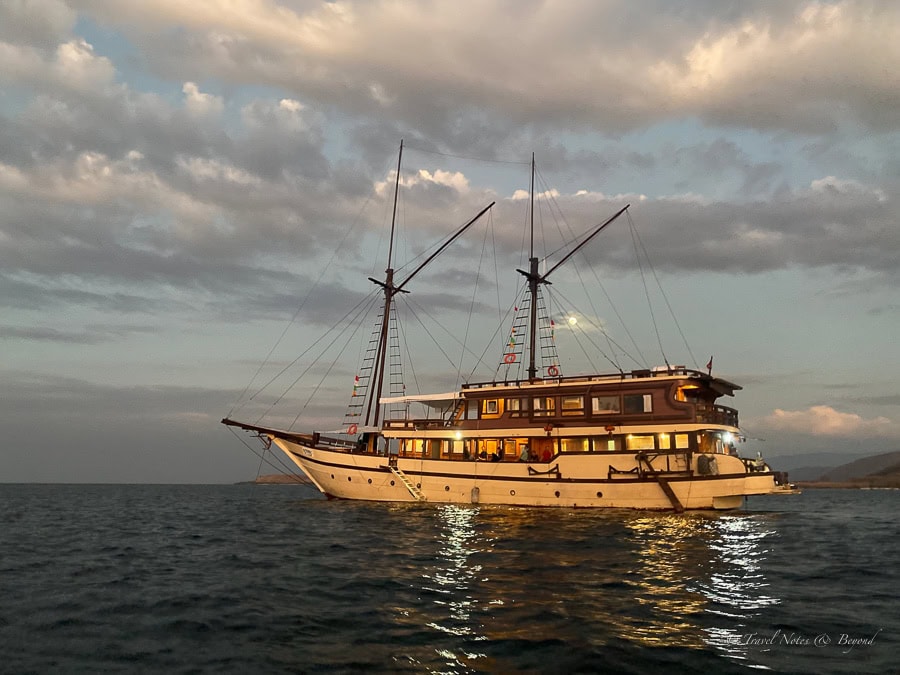
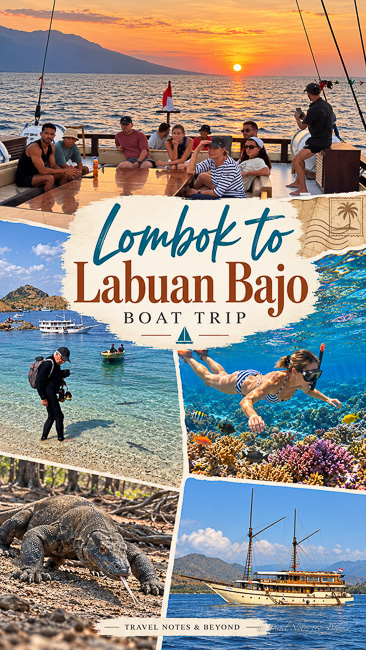
But how could we not be excited? For four days and three nights, we sailed east on a traditional phinisi boat, sleeping on board and waking up in a different place every morning. We watched the sunset from the top of Kenawa Island and snorkeled with whale sharks at sunrise. In between, we swam with manta rays and relaxed on the pink sand of Pink Beach. We hiked to the viewpoint on Padar Island, the one you see in almost every photo of Komodo National Park. And, perhaps the most exciting thing of all, we came face to face with the Komodo dragons in their natural habitat.
To me, the best part was that all of this fit into one single trip. So in this post I’ll tell you what we saw each day, what life on board the Alfathran III was like, and what you should know before booking your own Lombok to Labuan Bajo boat trip.
Lombok to Labuan Bajo by Boat at a Glance
| Trip details | Information |
|---|---|
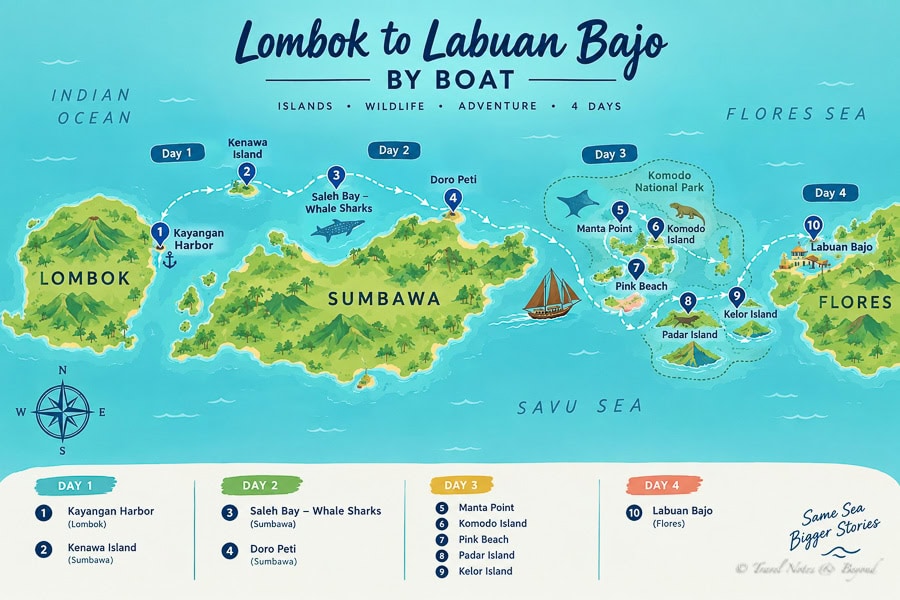
| Route | Lombok (Kayangan Harbor) to Labuan Bajo, Flores |
| Duration | 4 days, 3 nights |
| Boat | Alfathran III, a 29-meter traditional phinisi with 12 cabins and room for up to 28 guests |
| Departure/Arrival | Thursday from Lombok / Sunday in Labuan Bajo |
| Main stops | Kenawa Island, Whale Shark Point, Doropeti, Manta Point, Komodo Island, Pink Beach, Padar Island, Kelor Island |
| Best time to go | May to October |
| Best for | Travelers who want to see Komodo National Park and don’t mind early starts and life on a shared boat |
How We Chose Our Lombok to Labuan Bajo Boat Trip
Choosing the type of trip you want is perhaps the most important thing to decide. There are dozens of boat trips between Lombok and Labuan Bajo, and at first glance they all look the same. But they are not. Before booking, I spent a lot of time comparing trips, and three things made the difference for us: the itinerary, the length of the trip and the boat.
Choosing the Itinerary and Length of Trip
The first thing to decide is what you want to see, because that also decides how long your trip needs to be. My husband really wanted to see whale sharks. However, the whale sharks are in Saleh Bay, off the coast of Sumbawa, far from Komodo National Park. Shorter trips simply don’t have time to stop there. If you want to see both the whale sharks and the Komodo dragons, you will need at least 4 days.
Even then, you need to read the itinerary carefully. Not all 4-day trips stop in Saleh Bay, especially those sailing from Labuan Bajo to Lombok. So before looking at anything else, I checked the itinerary of each trip. If you have a must-see on your list, I suggest you do the same.
Choosing Your Boat
I don’t know about you, but for me, comfort is important. On a trip like this, the boat you choose can make or break the whole experience. So once I had narrowed down the itinerary, I started researching the types of boats and cabins available. Most boats on this route are phinisi, traditional wooden sailing ships often advertised as luxurious. In my experience, that’s rarely the case. Many of them look tired and basic up close, and only a handful are truly comfortable.
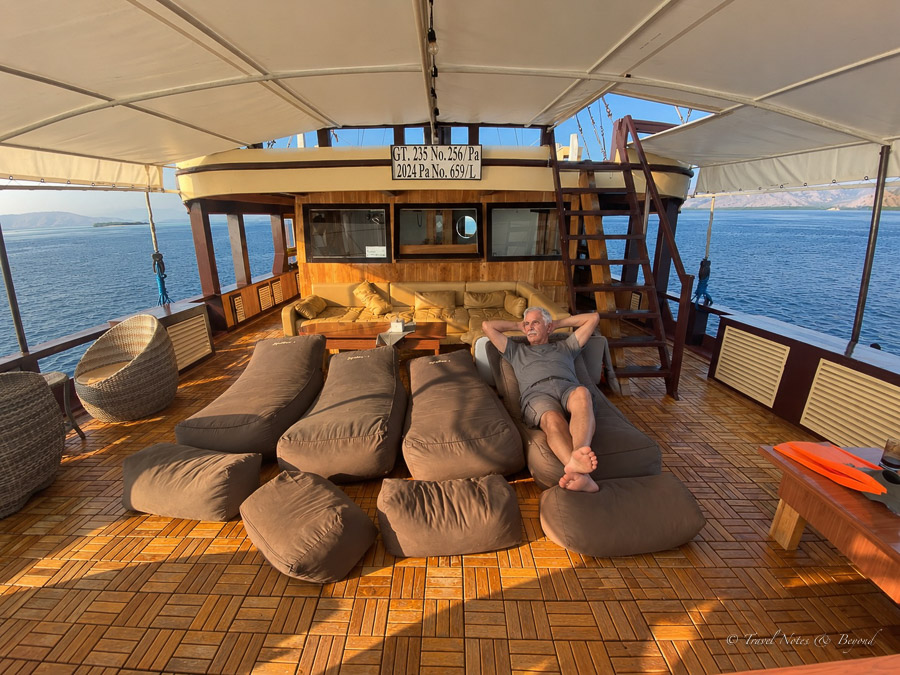
I also paid attention to the common spaces, not just the cabins. On a 4-day trip, you spend most of your time on deck, so it matters almost as much as where you sleep. That’s one of the main reasons we chose the Alfathran III. It has three decks, with plenty of room to relax, read, or just watch the islands go by.
Our Lombok to Labuan Bajo Boat Trip, Day by Day
Getting to Kayangan Harbor
The Alfathran III leaves from Kayangan Harbor, on the east coast of Lombok, around 2 pm. Every passenger gets picked up from their hotel and driven to the port. But where you stay makes a big difference. The driver collects passengers one by one across the island, so some people spend five or six hours in the car before they even see the boat.
We wanted to avoid that, so we booked a room at the Golden Palace Hotel in Mataram, Lombok’s capital. Mataram is one of the last pickup stops on the way to the harbor, so our drive took only about an hour and 45 minutes. If you are planning the same Lombok to Labuan Bajo boat trip, I strongly suggest you stay as close to Kayangan Harbor as you can.
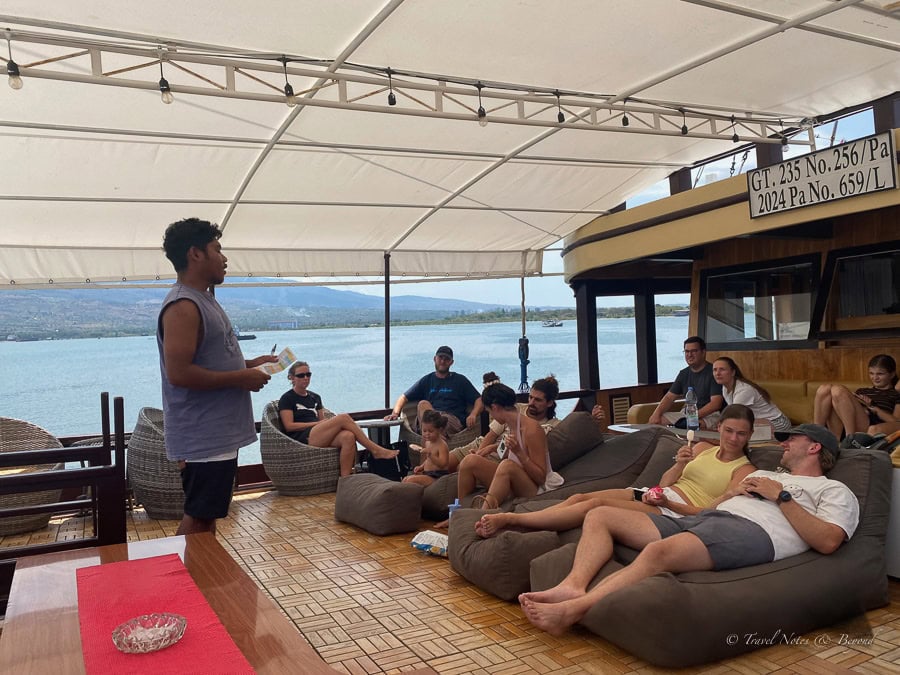
Once on board, the crew welcomed us and walked us through the plan for the next four days. They explained how life on the boat works, where everything is, and what to do in case of an emergency. Then we left the harbor behind. As the boat picked up speed and the sea breeze hit our faces, we both knew this was going to be a special trip.
Day 1: Lombok to Kenawa Island
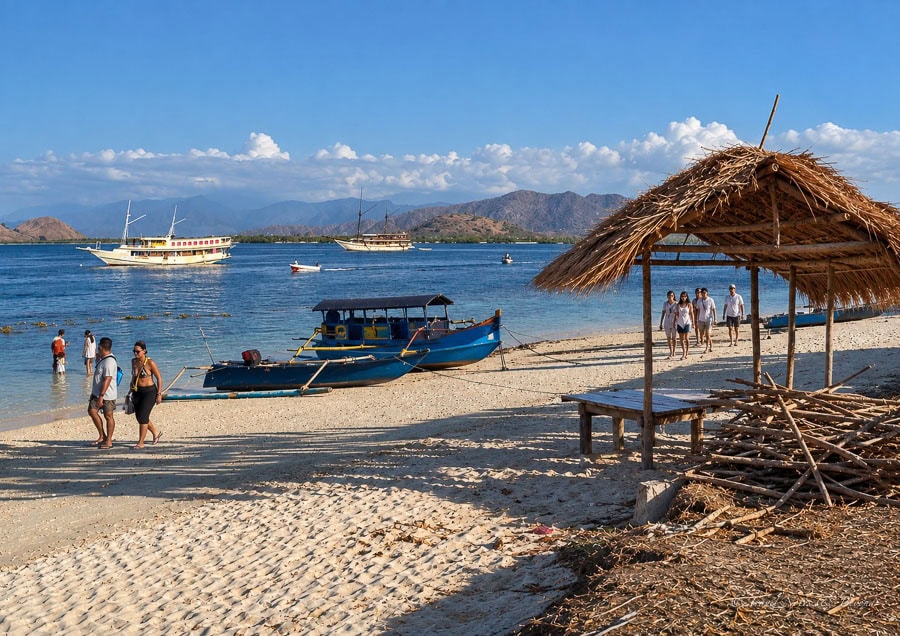
Our only activity on Day 1 was a sunset visit to Kenawa Island, a small uninhabited islet off the northwestern coast of Sumbawa, near Poto Tano port. We arrived around 4:30 pm and were dropped off on the beach for a short swim and a hike. The island is tiny, but it’s very popular with locals, who come over for the day or to camp. On the beach, a few locals were playing music, while their traditional wooden boats waited at the water’s edge.
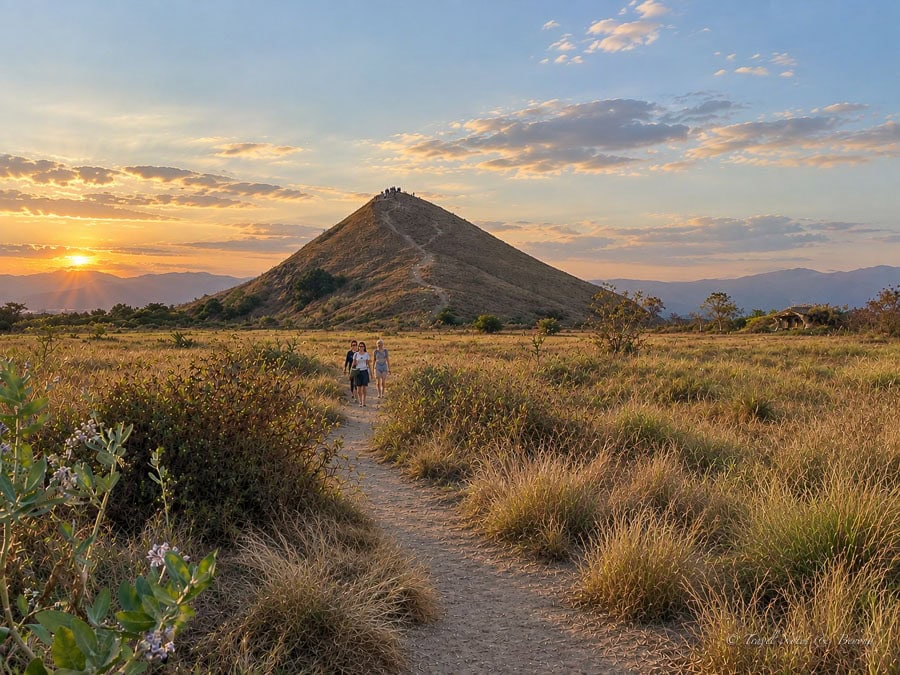
Towards 6 pm we began hiking up a small hill near the beach to watch the sunset. The climb is short and the view from the top is worth every step. From up there, we could see how little there is on Kenawa: just golden savanna, a handful of simple wooden huts where visitors shelter from the sun or spend the night, and a few small kiosks selling cold drinks and snacks. With no electricity or fresh water, the place feels truly remote.
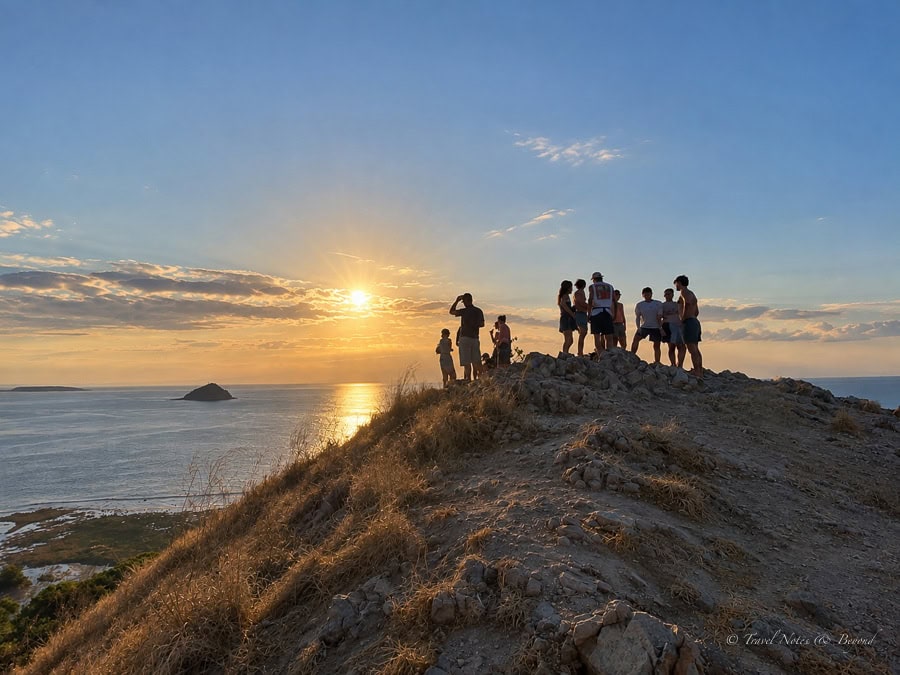
As the sun slipped below the horizon, the sky turned orange and pink, the water went still, and even the chatter around us faded to a whisper. When the last light was gone, the tender boats took us back to the Alfathran III for dinner.
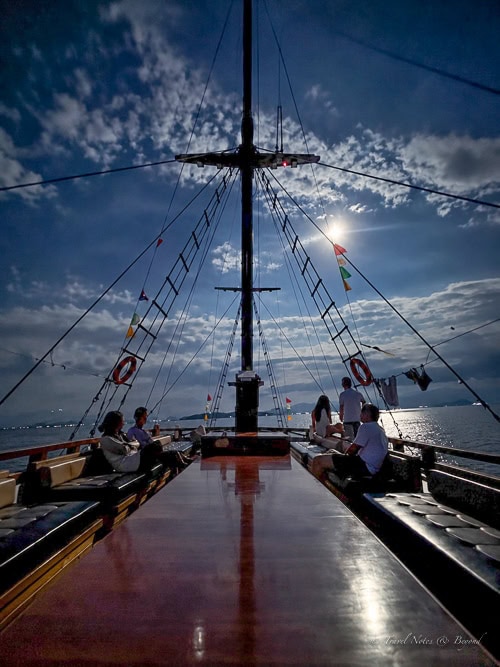
After dinner, we stretched out on the lounge chairs on the upper deck. With no city lights around us, the sky was full of stars, more than we had seen in years. The only sounds were the waves and the soft hum of the engine. It was the perfect end to our first day at sea.
Day 2: Whale Sharks in Saleh Bay and Snorkeling at Doropeti
Day 2 of our Lombok to Labuan Bajo boat trip started early and not exactly gently. The wake-up call came at 5 am, and before the sun was fully up, we were already jumping into the water. For my husband, this was the moment he had been waiting for. Swimming with whale sharks was the main reason he wanted to take this trip, and he could hardly hide his excitement.
The whale sharks were feeding on the starboard side of our boat, right next to a bagan — a traditional floating fishing platform. The fishermen work these platforms through the night, using bright lamps to attract small fish and shrimp. At dawn, they keep the whale sharks close by tossing small fish into the water and pouring buckets of seawater over their heads. The sharks stay near the surface with their mouths wide open, waiting for an easy breakfast.
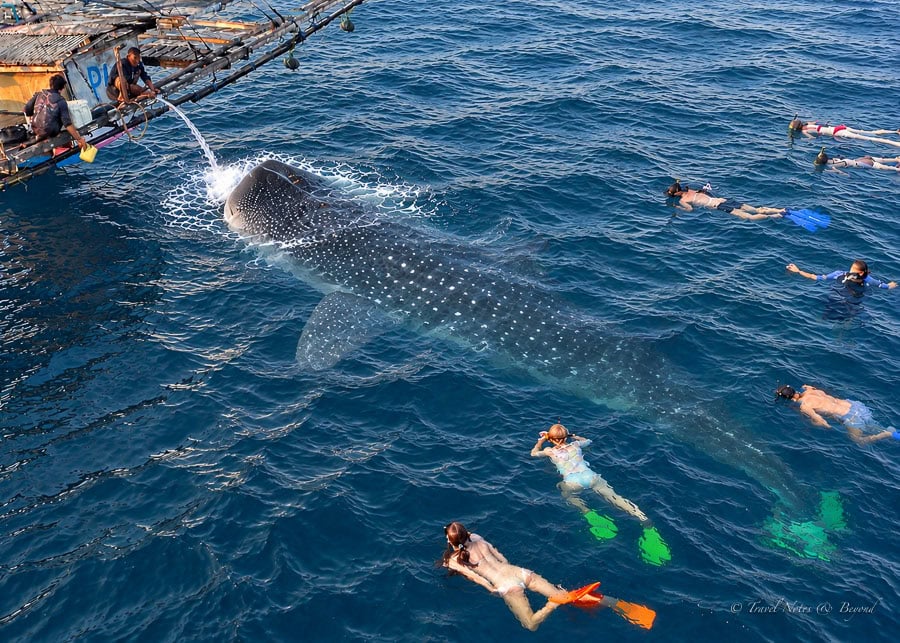
Within minutes, a crowd of snorkelers had gathered around the first shark, cameras in hand. Everyone was in awe of its size. Up close, these gentle giants look even bigger than you imagine, and they move with surprising calm.
Sadly, I didn’t get to enjoy it as much as I had hoped. The current was strong that morning, and after a few attempts to swim closer, I gave up and headed back to the boat. I watched the rest of the action from the deck, which turned out to be a pretty good seat after all. The entire experience lasted about 90 minutes, after which we gathered on the boat for breakfast.
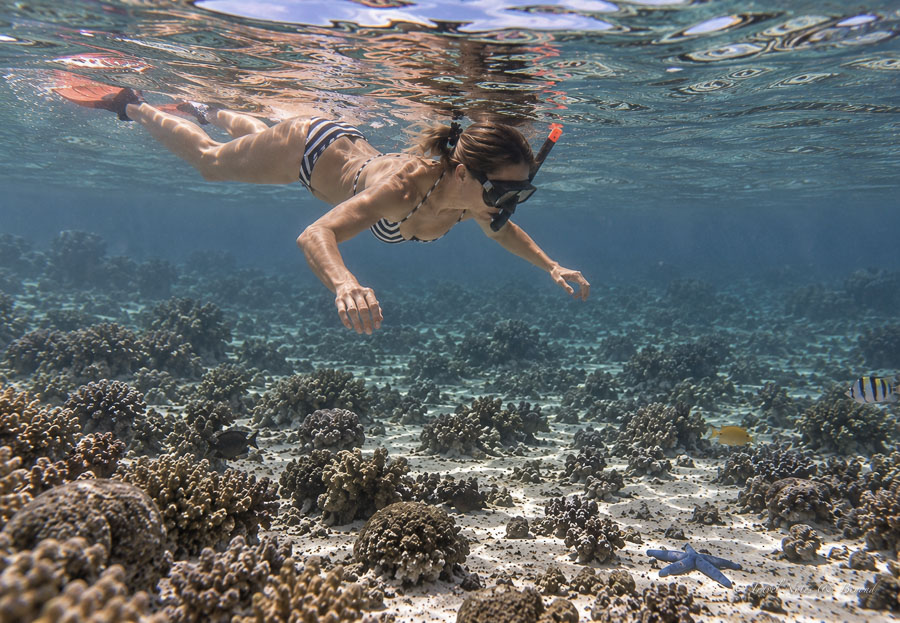
After breakfast, we left Saleh Bay and sailed to Doropeti, off the coast of Sumbawa, for our next snorkeling stop. Here the water was calm, warm, and so clear that we could see the bottom from the boat. A few small, rocky islets rose straight out of the sea around us. There were no beaches, just low, almost vertical walls of rock. But right below them, the water was shallow and full of life. We swam among schools of tropical fish, colorful coral, and bright blue starfish resting on the sandy bottom.
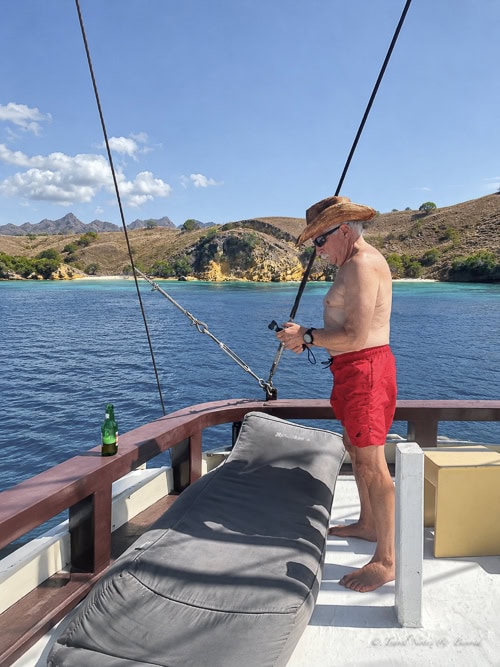
In the afternoon, we began the long crossing toward Komodo National Park. The rest of the day was all about the sea, the breeze, and the quiet rhythm of life on board. We sailed on through the night, and when we woke up the next morning, we were already in Komodo National Park.
Day 3: Manta Point, Komodo Island, Pink Beach, and Padar Island
Day 3 was the busiest and, for me, the most exciting day of the trip. Our schedule was packed, and we didn’t waste a minute.
Manta Point
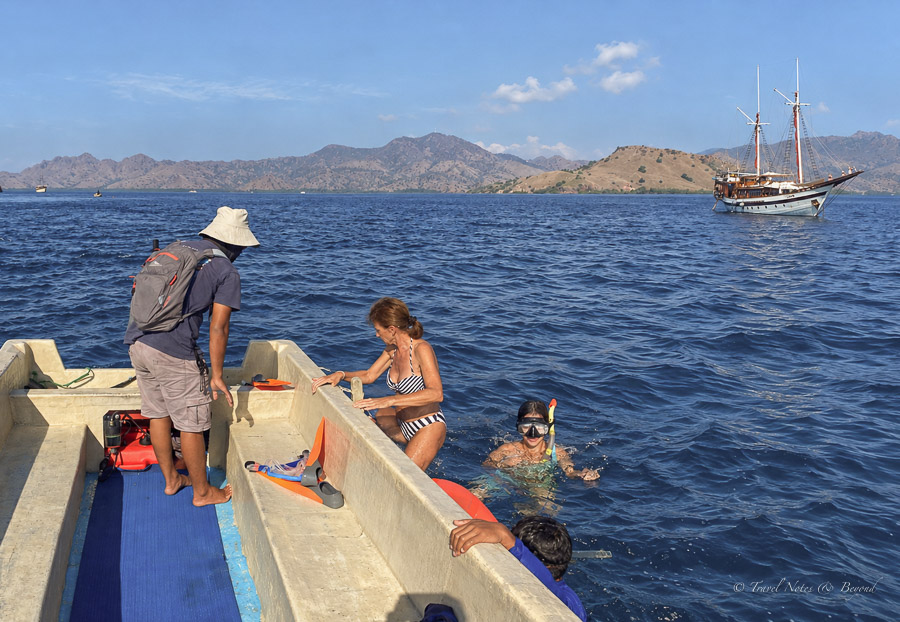
The morning started at Manta Point. The small boats took us out to the middle of the sea and dropped us into the water, then followed close behind. The current was strong, almost like a river, and it carried us at a surprisingly good speed back toward the Alfathran III. All we had to do was float and look down. Below us, manta rays glided by, sea turtles swam lazily along the bottom, and fish of every color moved in and out of the coral. Ninety minutes passed in the blink of an eye, but it was time to move on.
Komodo Island
Next, we stopped at Komodo Island, which is part of the Komodo National Park and home of the famous Komodo dragons. A park ranger met us at the dock and led us along a shaded trail through a dry forest, where the dragons rest in the heat of the day.
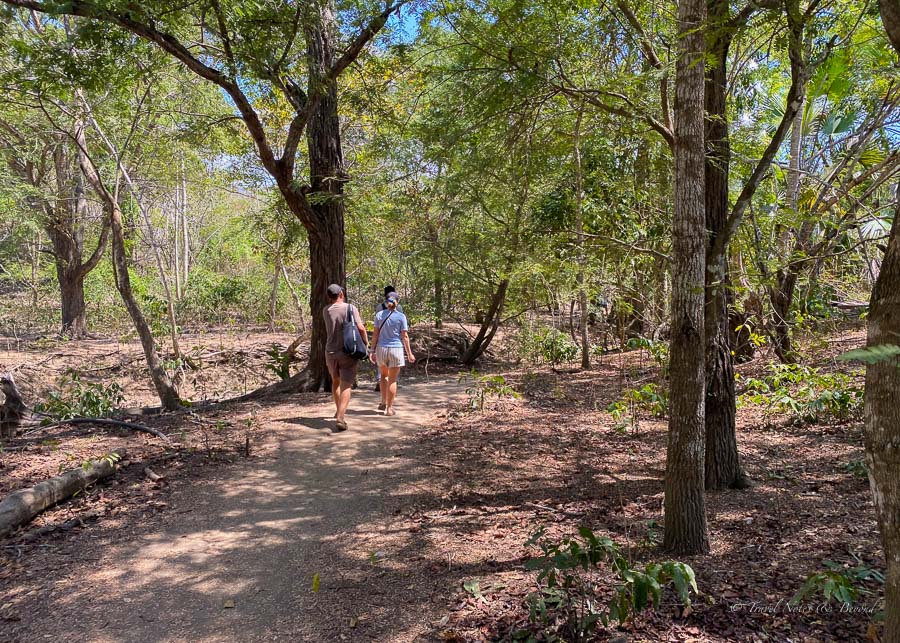
Following the rangers is mandatory for your safety. They carry forked sticks to keep dragons at a distance. While attacks are pretty rare, they do sometimes happen when a dragon feels cornered or disturbed. So it’s not a good idea to wander alone.
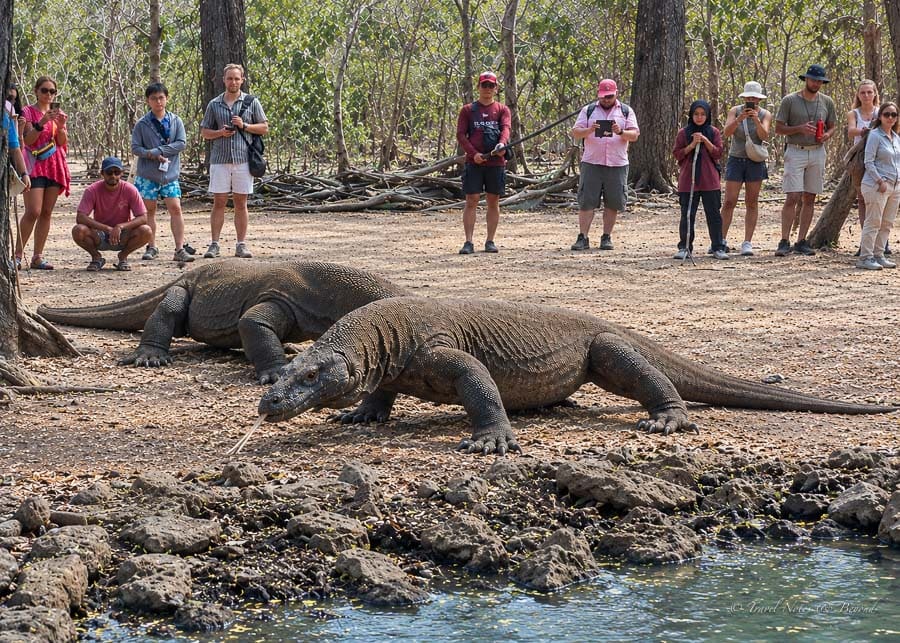
Our guide was very knowledgeable, and we learned many interesting things about the habits of these giant lizards. Komodo dragons are the largest lizards in the world, and their bite carries venom that keeps the blood of their prey from clotting. Their mating season runs from about May to August, so we visited right at the end of it. When a female is ready, she leaves a scent for the males to follow.
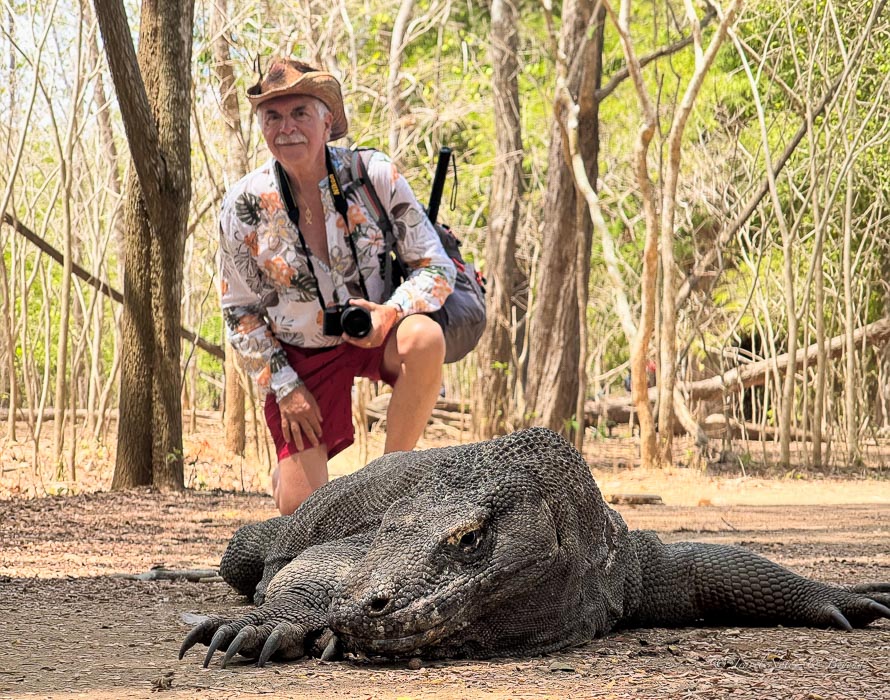
Males sometimes wrestle each other for the right to mate. The females lay their eggs in September, often in old scrubfowl nests, and the babies hatch about eight months later. Even more surprising, a female can lay fertile eggs without a male at all, and those babies are always males.
Pink Beach
After the walk, we returned to the boat and sailed to the famous Pink Beach. In case you are wondering whether the pink is real, it is, and it’s completely natural. The color comes from foraminifera, tiny single-celled organisms with bright red shells that live on the surrounding reef. When they die, their shells break apart and wash ashore with fragments of red organ-pipe coral, mixing with the white coral sand. The result is a soft blush rather than a bright pink. It looks strongest at the waterline, where the wet sand deepens the color. The color also appears stronger in the early morning or late afternoon.
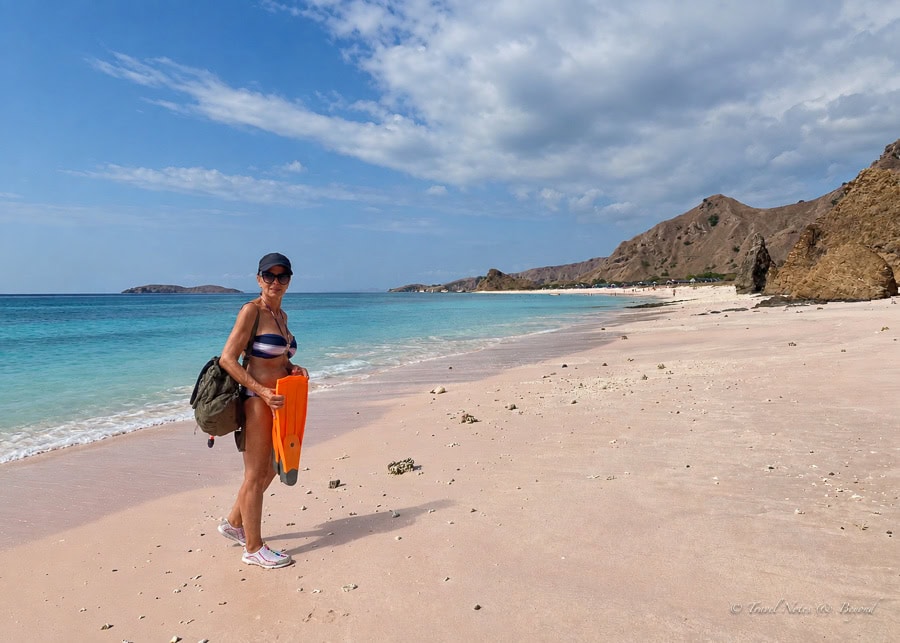
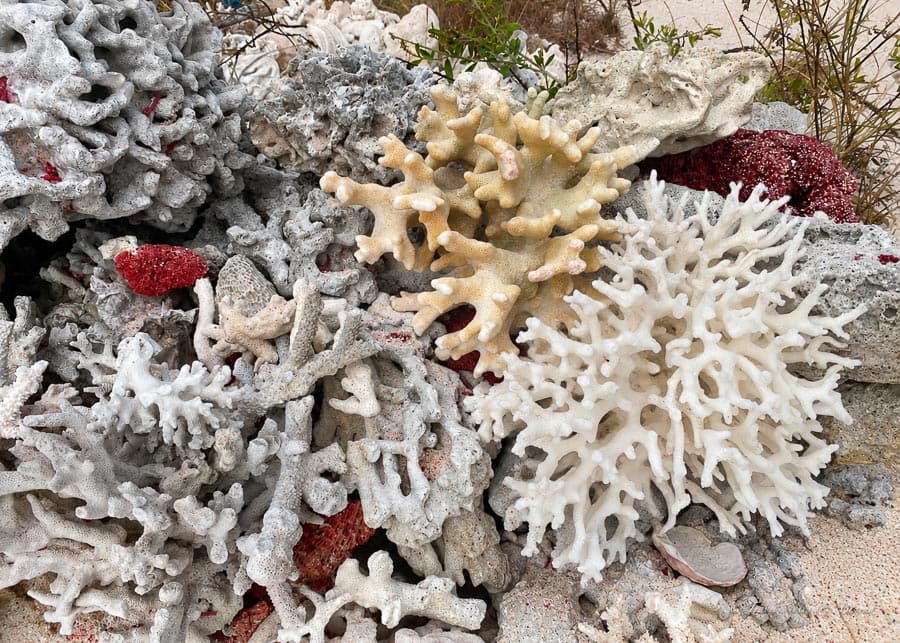
The crew dropped us off and let us explore on our own. We strolled along the shore, swam, and took more photos than I care to admit. We spent the rest of the afternoon on a pink, empty beach scattered with pieces of white and red coral. They were most likely washed ashore by a storm, and they were really beautiful. I would have liked to take a few home as souvenirs, but taking sand, shells or coral from Komodo National Park is forbidden.
Padar Island
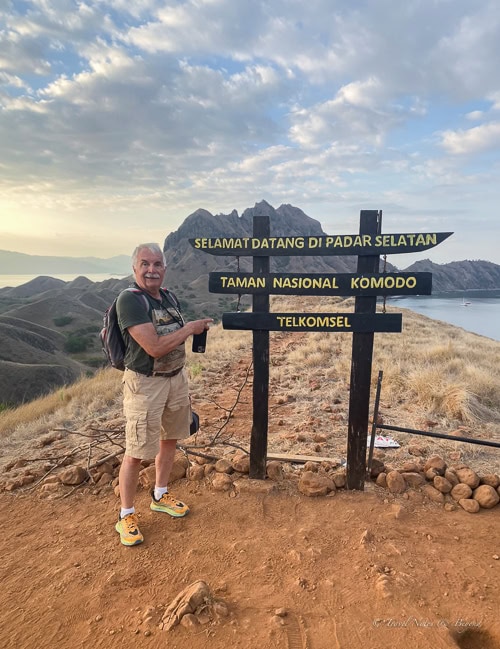
In the late afternoon, we stopped at Padar Island for sunset and the hike to its famous viewpoint. It was a long climb, about 800 steps up a steep ridge, and the heat didn’t make it any easier. Every stop to catch our breath, though, came with a better view than the last.
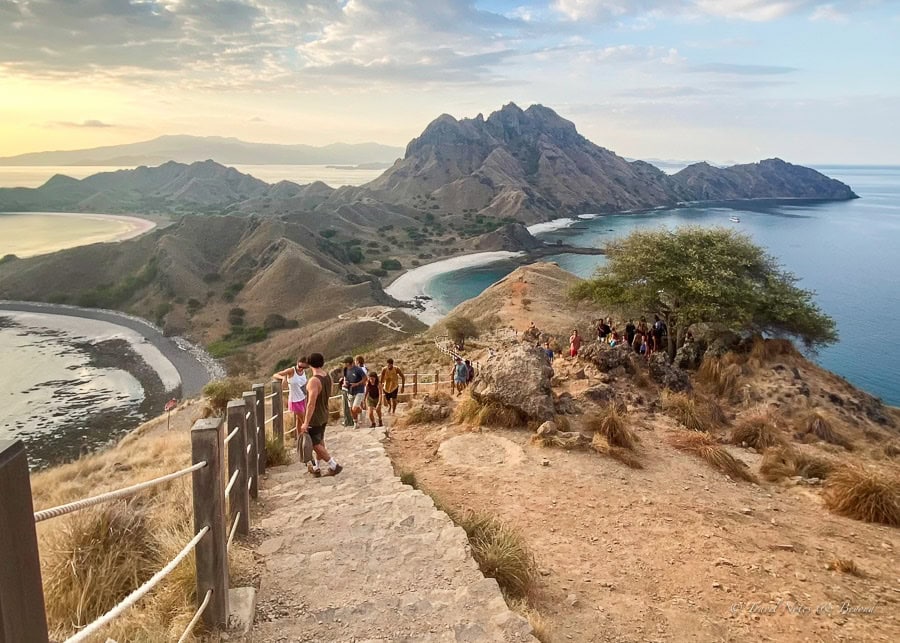
From the top, we could see the whole bay, with three curved beaches of white, pink and dark volcanic sand. All around us, small islands were scattered across the turquoise sea as far as we could see. As the sun went down, the hills turned gold and then purple. Standing up there, we agreed it was the most memorable moment of our Lombok to Labuan Bajo boat trip so far. Back on board, we had dinner and sailed through the night toward our final destination.
Day 4: Kelor Island and Arrival in Labuan Bajo
Day 4 was short. We stopped early in the morning for one last hike and a swim with baby sharks at Kelor Island. On paper, the hike is way shorter than Padar, but in reality it’s much more strenuous. It’s an extremely steep climb up a loose, slippery path with no steps and nothing to hold on to. On top of that, the trail was crowded with hikers going up and down in every direction. Each one was squeezing past wherever they could find a gap. On a path so narrow and steep, every step meant watching our footing and the people around us.
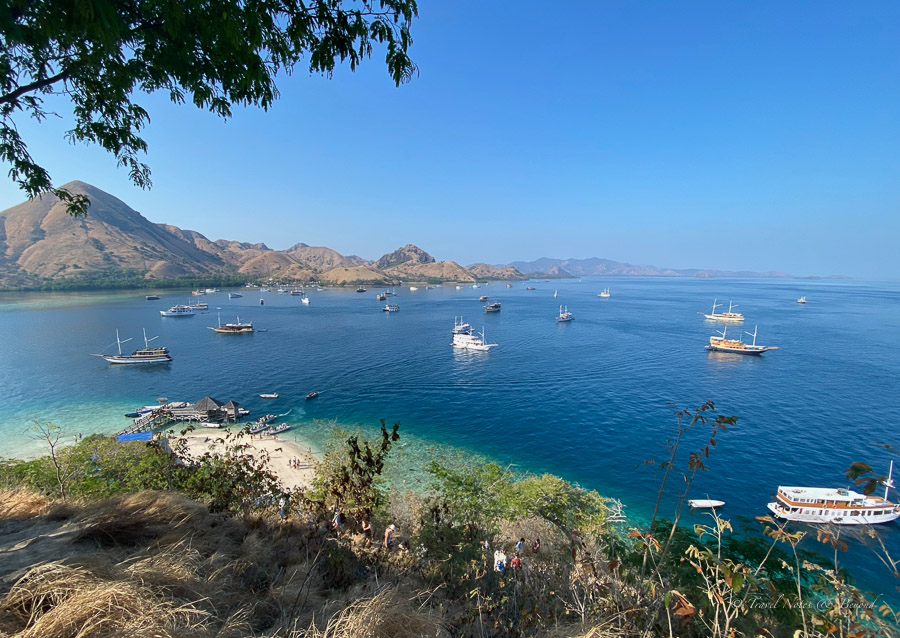
It took all our strength and concentration to get up to the viewpoint. But once up there, we were rewarded with a 360° view over the bay and the surrounding islands. The horseshoe-shaped bay of turquoise water was right below us, with boats anchored in the shallows. Coming down was equally difficult.
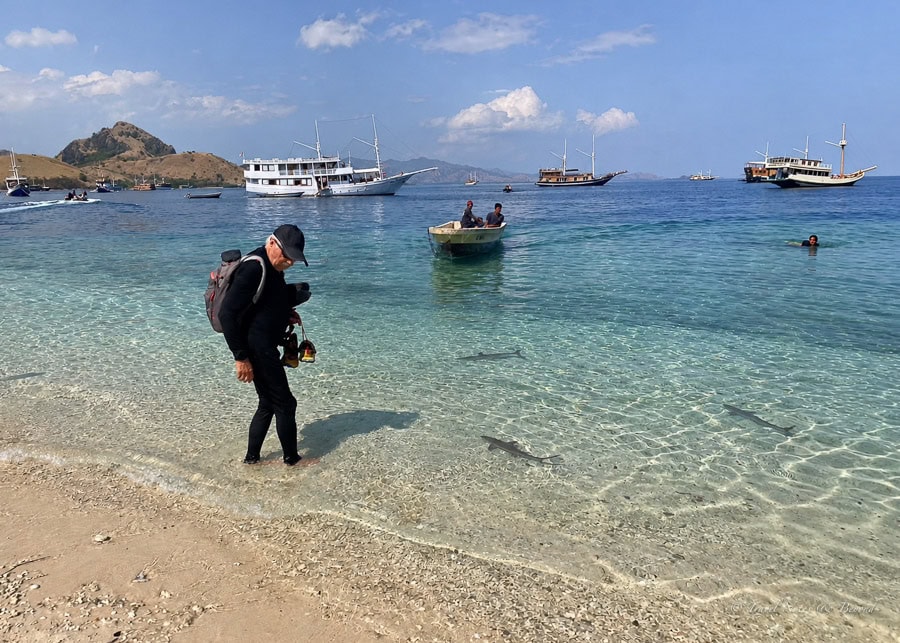
After the hike, we walked over to the bay on the other side of the island, away from where our boat had landed. This is where we were supposed to see the baby sharks. We put on our snorkels and swam out, scanning the water in every direction. But there wasn’t a shark in sight. Eventually we gave up and started wading back to shore. Just as the water reached our knees, we found ourselves surrounded by them. A whole group of small reef sharks was darting around our legs, right in the shallows. We couldn’t have asked for a better way to end our four days at sea.
Our Experience Aboard Alfathran III
There are several phinisi boats sailing this route from Lombok to Labuan Bajo, so before choosing one I did a lot of research. As I mentioned in the beginning, for this kind of trip, the boat you choose can make or break the whole experience. Therefore, I spent hours looking at photos of different boats and comparing cabins before booking. In the end, we booked through Michael at Ocean Earth Travels, and I’m so glad we did. He was kind, quick to reply and never once made me feel like I was asking too many questions (and believe me, I asked a lot).
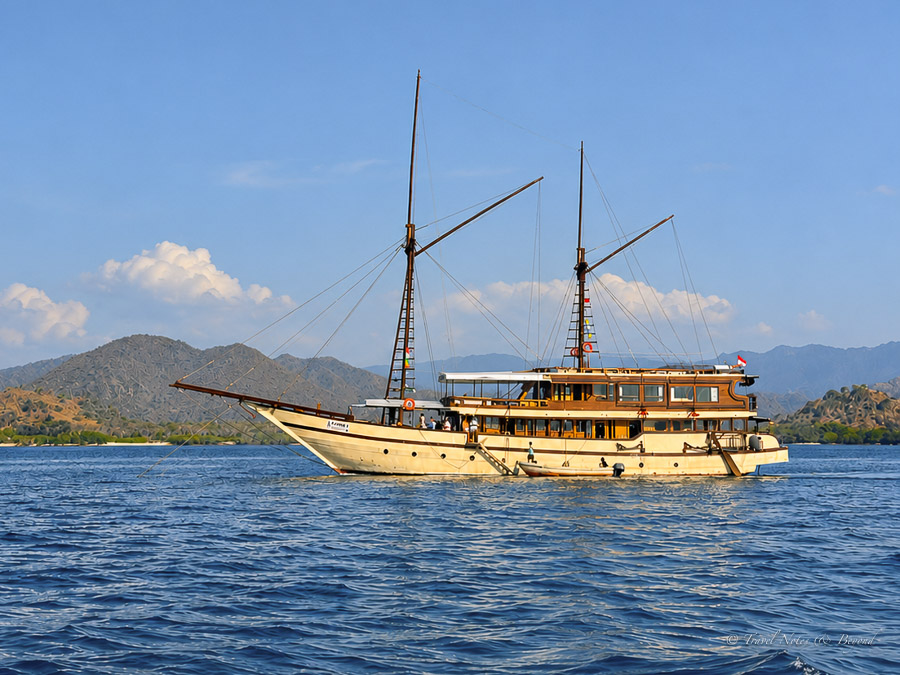
In the end, we chose the Alfathran III because, of all the ones we looked at, it seemed to offer the highest level of comfort. I would gladly have paid more for something even better, but there simply wasn’t anything more comfortable available. Sadly, the next level up was not only way beyond our budget, but it also required more days than we could spend on this trip.
The Common Spaces
The Alfathran III is described as a deluxe, or even luxury, phinisi. But it’s not. It is, at best, a comfortable mid-range boat, with a few nice extras, but nothing that comes close to real luxury. It is a traditional wooden boat almost 30 meters long, with twelve air-conditioned cabins, three decks, and both an indoor and an outdoor dining area.
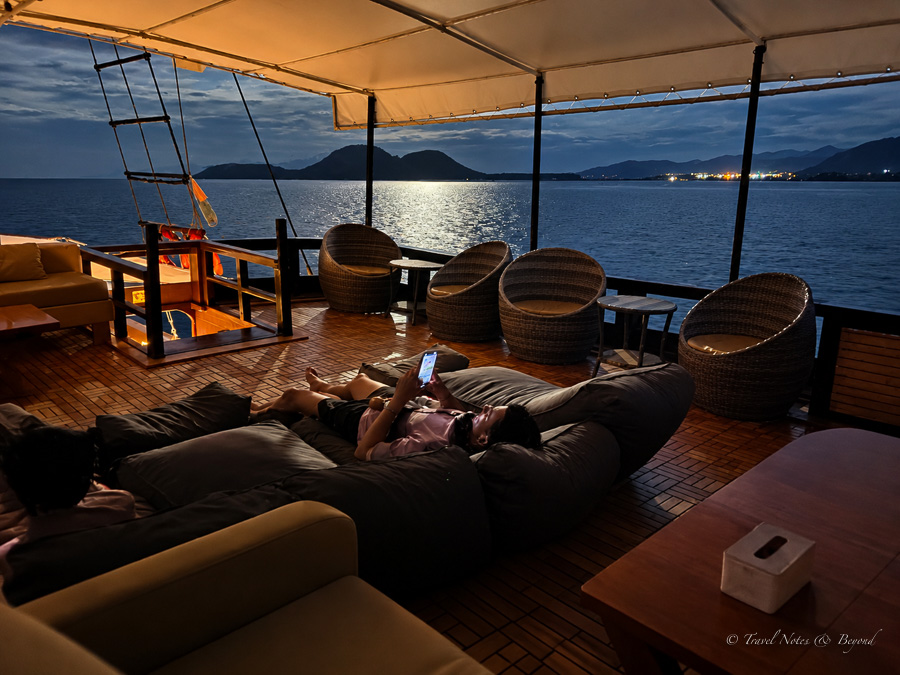
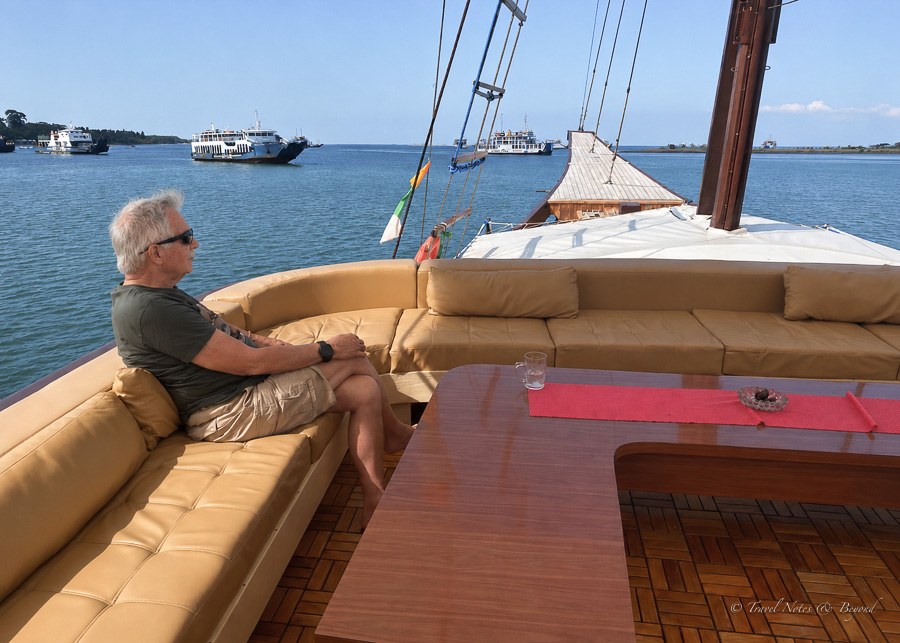
The decks were what caught my eye, because on a trip like this, you spend most of your time outside. The main lounge deck is shaded by a large canopy and furnished with a cream leather corner sofa, a row of big bean bag loungers and a couple of wicker egg chairs. A smaller leather sofa wraps around the back of the boat, which was our favorite spot for watching the islands drift by.
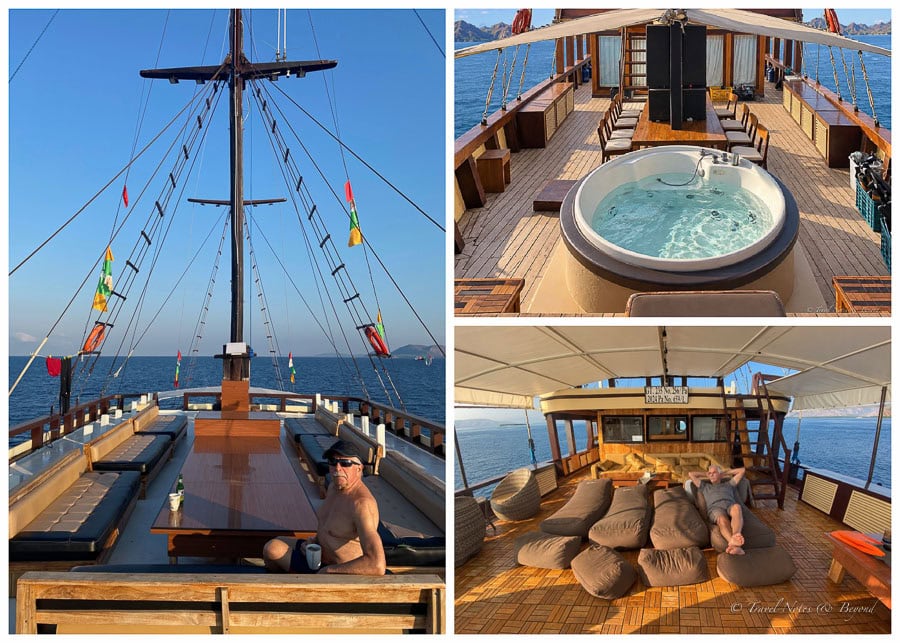
At the top, an open sundeck with long cushioned benches and tables gives you nothing but sky and sea all around. In the evenings, everyone drifted up to the lounge deck with a cold beer, stretched out on the bean bags and watched the last light fade over the water.
The Cabins
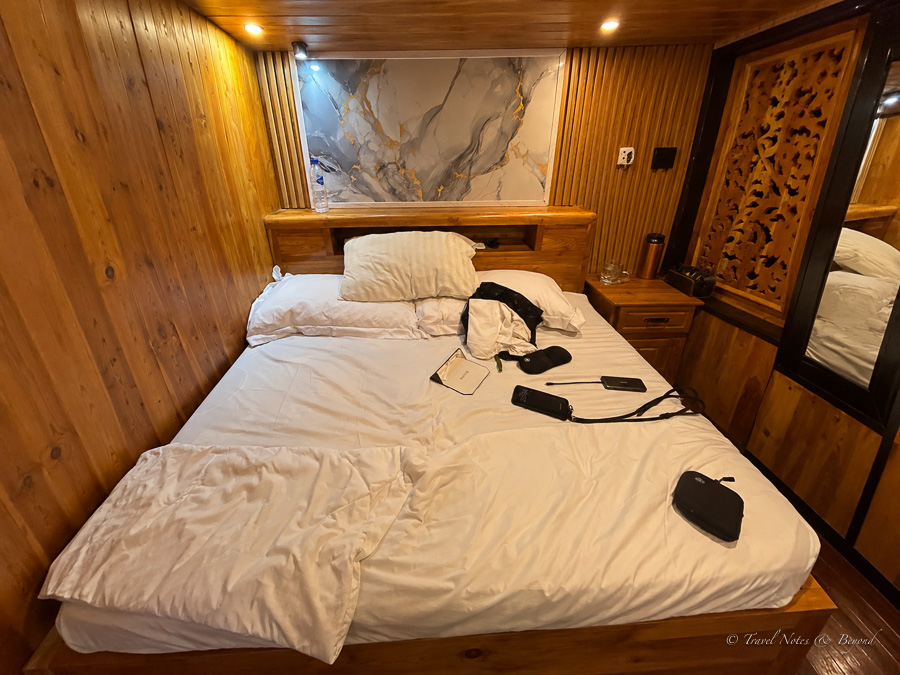
In reality, though, the boat turned out to be a bit of a mixed bag, and the cabins were the biggest disappointment. Ours was one of the better ones because it was on the main deck, but it was still no bigger than a few square meters. There was just enough room to sleep, change and squeeze past each other, and nothing else. The two best cabins are the Senggigi rooms on the upper deck, which come with access to a terrace, so they’re the ones to book if you can. Either way, the photos on the operator’s website make the cabins look more spacious than they really are, and some drawbacks only became obvious once we were on board.
You could argue that small cabins are to be expected on a boat, and you’d probably be right. What we hadn’t realized from the photos was how tiny and impractical the bathroom would be. It measured no more than 2 meters by 1 meter, about 2 square meters (21.5 square feet) and that included the toilet, the shower and the sink. There was no shower tray, so the water simply ran across the floor, and even the sink drained straight onto it. That was what grossed me out the most. On top of that, there was a strong, putrid smell in the bathroom that we never managed to get rid of.
Life Aboard
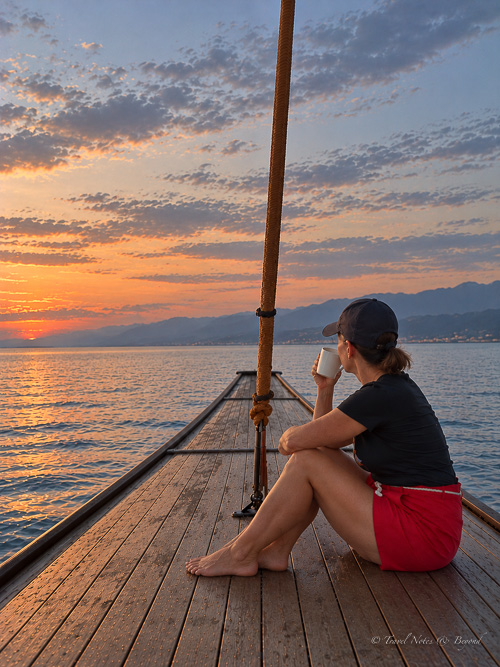
But the boat had its good sides too. Mornings and evenings on board were lovely. We started every day with a cup of coffee at the bow of the boat, watching the night fade away and the first light creep over the horizon. Every evening after dinner, we climbed up to the upper deck with a cold beer in hand and watched the stars.
The meals were fine too. The food was simple, authentic Indonesian home cooking, but the crew always made it fresh, and there was plenty for everyone. After a long day of hiking and snorkeling, that was all we needed.
The crew were helpful from start to finish. They were always there to lend a hand, whether that meant getting us in and out of the tender boats, sorting out the snorkeling gear or making sure dinner was ready when we came back on board.
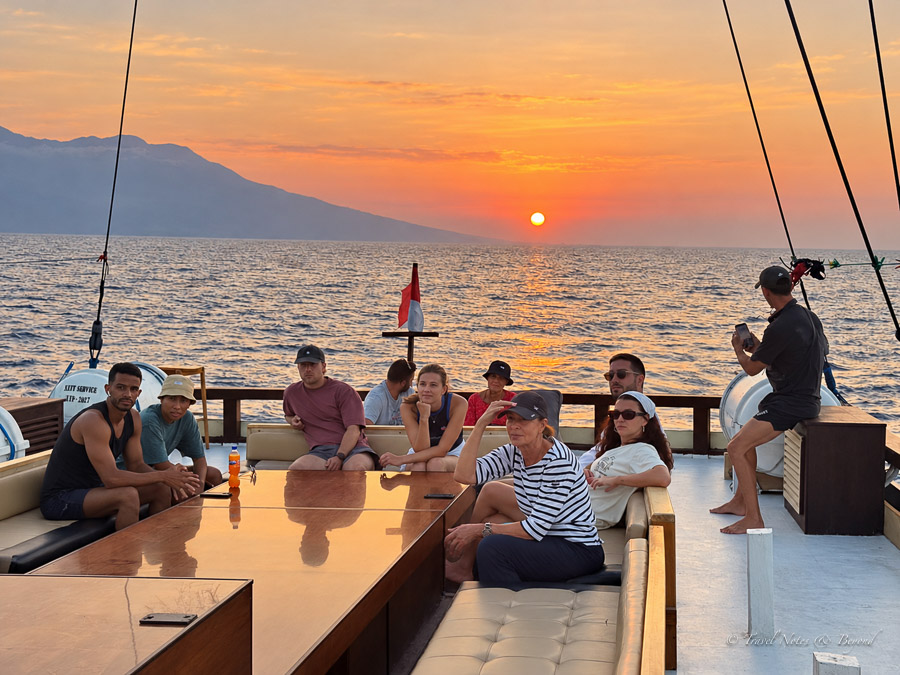
We were also lucky with our fellow passengers. Most of them were much younger than us, with one couple closer to our age, but everyone was easygoing and pleasant. There were no loud partygoers or late-night noise, just a relaxed group of people who had all come for the same thing: the islands, the sea and the sunsets. On a boat this small, where you share every meal and every deck for four days, that makes a big difference.
Is the Lombok to Labuan Bajo Boat Trip Worth It?
Absolutely, yes! Looking back on our two weeks in Indonesia, this boat trip was easily the highlight and no other part of our itinerary was nearly as exciting.
What made it so special was the variety. In just four days, we swam with whale sharks, drifted over manta rays, walked among Komodo dragons, relaxed on a pink beach, climbed to some of the most spectacular viewpoints we’ve ever seen and found ourselves surrounded by baby sharks in knee-deep water. Every day brought something new, and the trip delivered on every promise.
The Alfathran III isn’t a luxury boat, and I knew that long before we booked. But in the end, it didn’t matter that much. We spent our days on the water and on the islands, our mornings at the bow with a cup of coffee and our evenings under the stars with a cold beer, and we had a wonderful time both on board and on every excursion.
If you can live with basic comfort for a few nights, this is one of the most rewarding ways to see this part of Indonesia. I’d do it again in a heartbeat. Next time though, I would book far enough ahead to get one of the two best cabins. Not that I am convinced their bathrooms are any better, hahaha!
Frequently Asked Questions
1. How much does the Lombok to Labuan Bajo boat trip cost?
On the Alfathran III, prices run from about 420 USD per person for a shared cabin to 920 USD per person for a top cabin on the upper deck. Komodo National Park fees and tips cost extra.
2. Where does the boat depart from?
The Alfathran III sails both ways. From Lombok to Labuan Bajo it leaves every Thursday around 2:00 pm and arrives on Sunday around midday, after 4 days and 3 nights. From Labuan Bajo, it leaves every Sunday evening and reaches the Lombok harbor around 9:00 am on Thursday, after 5 days and 4 nights.
3. What’s included, and what isn’t?
Your cabin, three meals a day, snacks, coffee, tea, water, snorkeling gear, a local guide and transfers at both ends are included. Komodo National Park fees, tips and drinks, like beer, are not.
4. Is there Wi-Fi or phone signal on board?
Yes, we had Wi-Fi aboard the Alfathran III and it was excellent everywhere, including in the cabin. There were also enough plug outlets for charging our electronics.
5. Will I definitely see whale sharks and manta rays?
No, sightings are not guaranteed. These are wild animals, and the season matters too. Whale sharks are easiest to spot from May to October, while manta numbers tend to peak from December to February. Still, the crew does their best to find them, and we were lucky. Besides whale sharks and manta rays, we saw turtles, reef sharks, a lobster and an octopus.
6. What should I pack on a 4D/3N boat trip from Lombok to Labuan Bajo?
Pack light, a carry-on at most. You need very little on board, and the cabins are so small that most of what you bring will stay in your suitcase the whole trip. Bring the kind of clothes you’d pack for a beach trip to Hawaii: a few pairs of shorts, a few t-shirts, two swimsuits so you can change out of a wet one, reef-safe sunscreen, shoes for hiking Padar and Kelor, and something for seasickness. I used scopolamine patches, but the sea was so calm on our trip that I probably didn’t need them.
A Final Thought
Four days, three nights, one tiny cabin and lots of unforgettable moments. That was our Lombok to Labuan Bajo boat trip. It might not have been perfect, but it was exactly the kind of adventure we’d hoped for. If you have any questions about the trip, leave them in the comments and I’ll be happy to help. And if you go, I hope the whale sharks and manta rays show up for you as they did for us.
YOU MAY ALSO LIKE:
 2 Week Indonesia Itinerary: The Ultimate Journey Through Bali, Java & Komodo