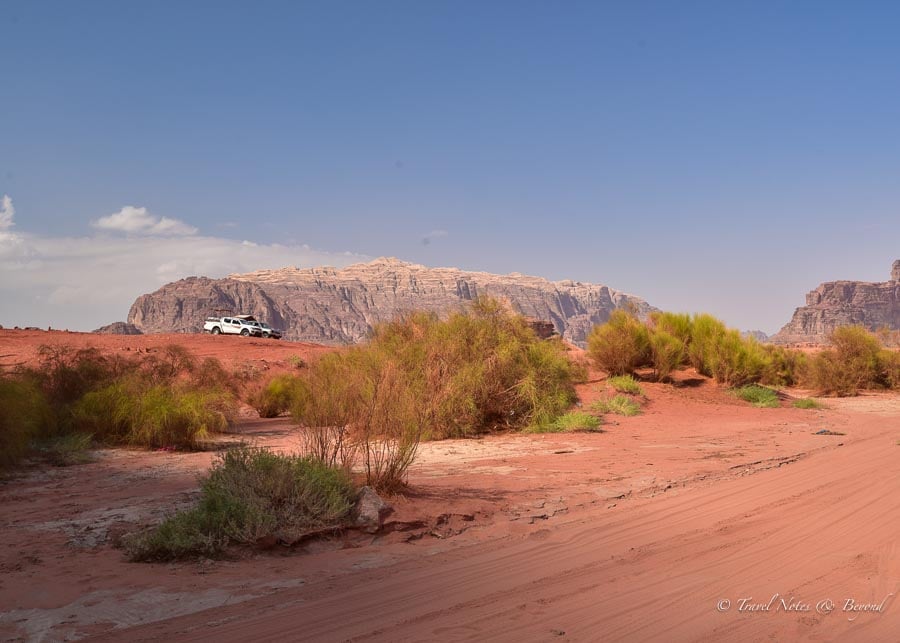
There are places that look better in person than in photos, and places that look exactly as advertised. Wadi Rum somehow does both. The desert is larger and more impressive than you would imagine, changing color throughout the day as the light shifts across the landscape. Of all the places we visited in Jordan, the Red Desert was the one that stayed with me the most. And it was not because of its history, but because of how it made me feel while I was there.
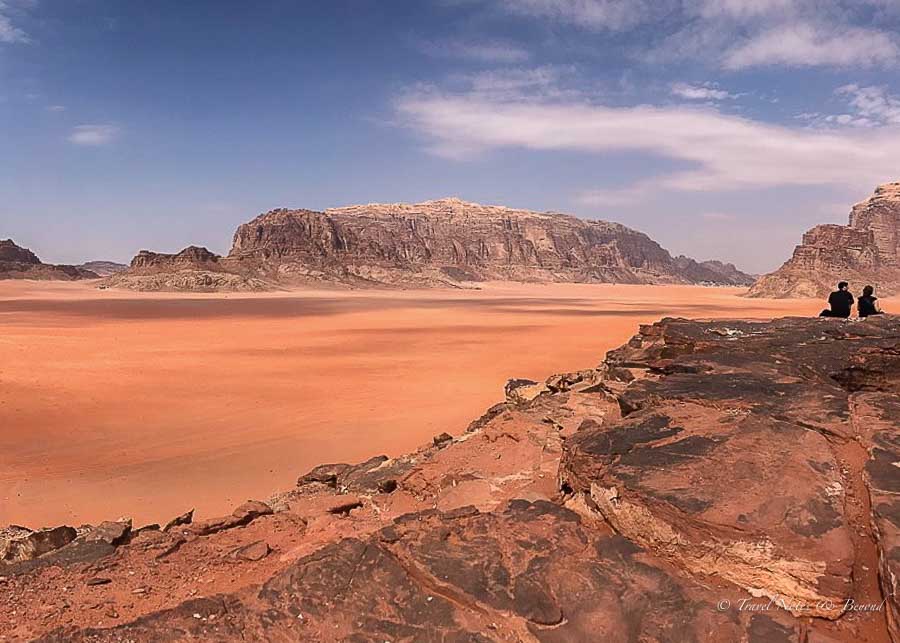
We spent one full day in Wadi Rum on a guided 4×4 tour, after two days in Petra and a stop at Jerash. Here is what we learned, and what I wish we had known before going. In this guide I’ll share with you all you need to know about visiting Wadi Rum, Jordan’s famous “Red Desert.”
What Is Wadi Rum?
Before planning a visit, it helps to understand what Wadi Rum actually is. Wadi Rum is often described simply as a desert in southern Jordan. But that description barely captures the scale and character of the place. The landscape is much larger and more dramatic than most people expect. You see sandstone mountains, red sand, narrow canyons, and huge open valleys stretching in every direction.
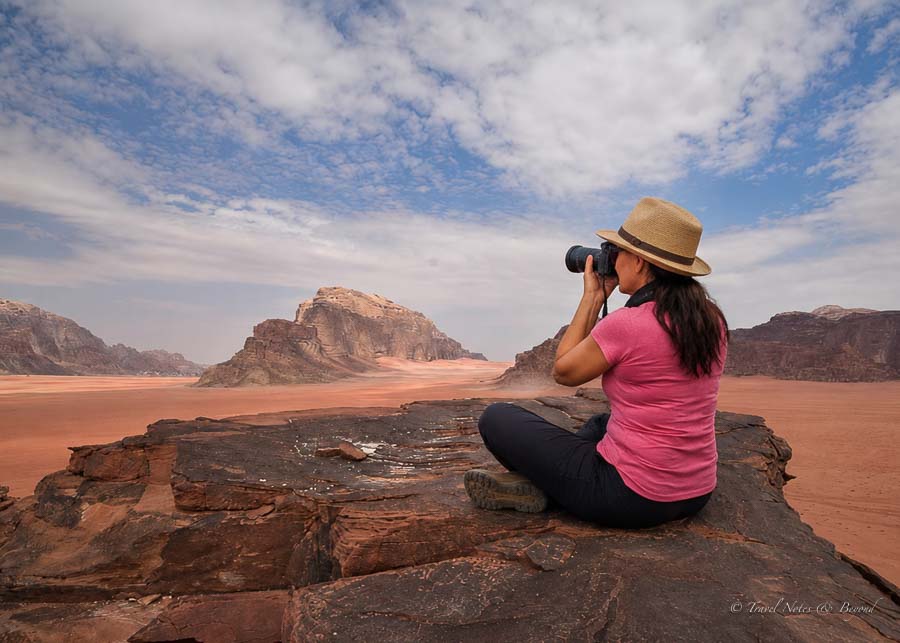
Wadi Rum is also a UNESCO World Heritage site recognized for both its scenery and its 25,000 petroglyphs, which trace 12,000 years of human presence in the desert. But calling Wadi Rum simply a desert does not really capture the scale, atmosphere, or character of the place.
How to Get to Wadi Rum
Wadi Rum sits off the Desert Highway, roughly 70 kilometers east of Aqaba, 110 from Petra, and 320 from Amman. Most people reach Wadi Rum by rental car, organized tour, or the JETT bus. Driving yourself is the most flexible option and is easy from Amman, Petra, or Aqaba. The roads are well maintained and clearly marked in Jordan. But if you don’t want to drive, you can book an organized tour. Or, you can use the bus which is budget-friendly and has good connections between Petra, Aqaba, and Wadi Rum.
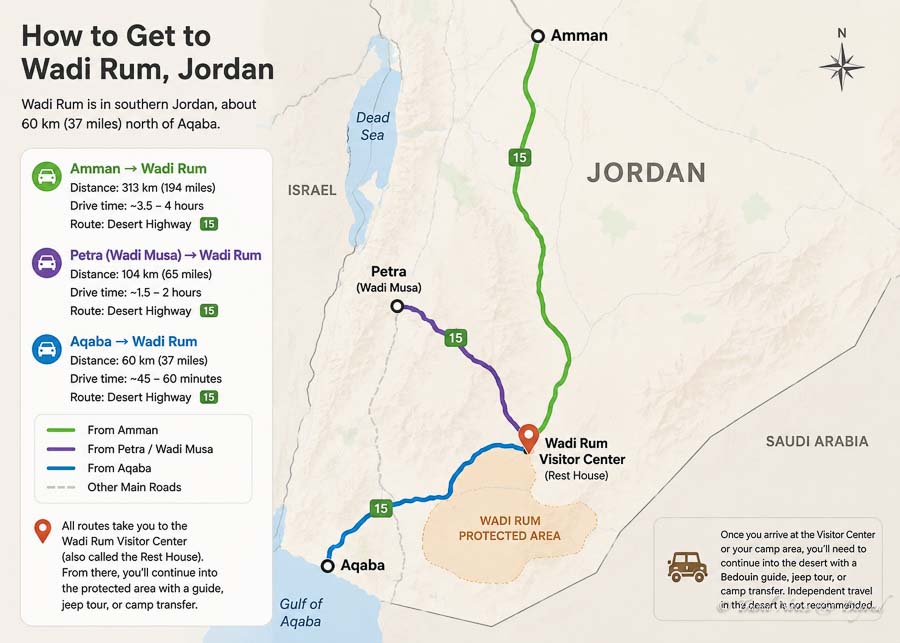
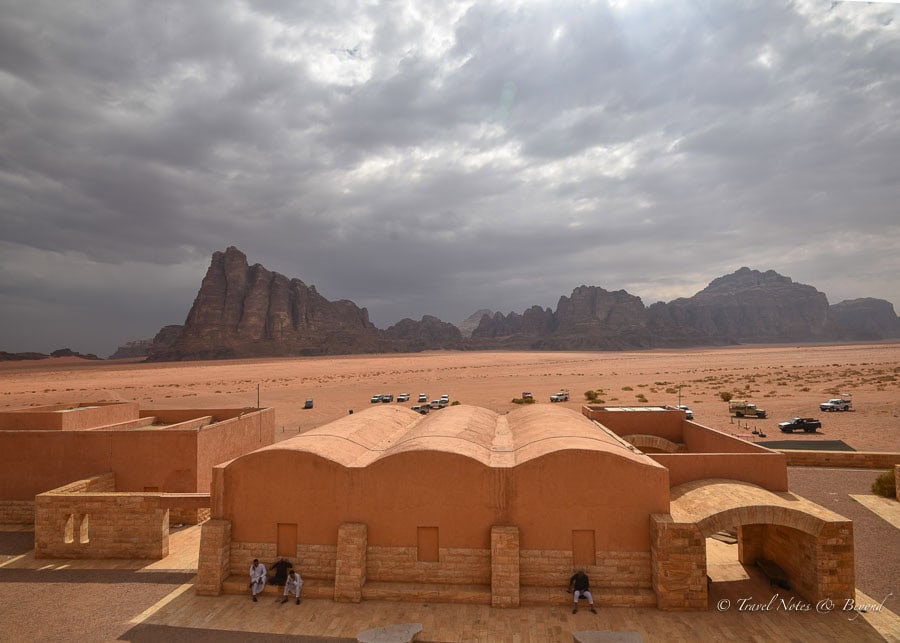
If you are driving, you’ll turn off the highway at the brown signs and follow the road straight to the Wadi Rum Visitor Center. Here you stop to leave your car and pay the protected area fee of 5 JD per person. This tax is included Jordan Pass if you have it. From here you continue into the protected area with a Bedouin guide, jeep tour, or camp transfer. Because the Wadi Rum desert is so large and remote, guided transportation is essentially part of the experience.
Ways to Visit the Wadi Rum Desert
We arrived at the Wadi Rum Visitor Center early in the morning, a little worried about the cloudy sky and our chances for good photos. When we got there we saw jeeps and camels at the entrance and assumed those were the two options. They are the main ones, but they are not the only ones.
The desert is quite large, and the Bedouin cooperatives are very flexible, so you can explore Wadi Rum in many ways. You can either go on foot, on horseback, in a hot air balloon, or in an ultralight aircraft. Each shows you a different version of the same place, and the right choice depends on how much time you have, how active you want to be, and what kind of memories you want to take home.
By 4×4 (the “Jeep Tour”)
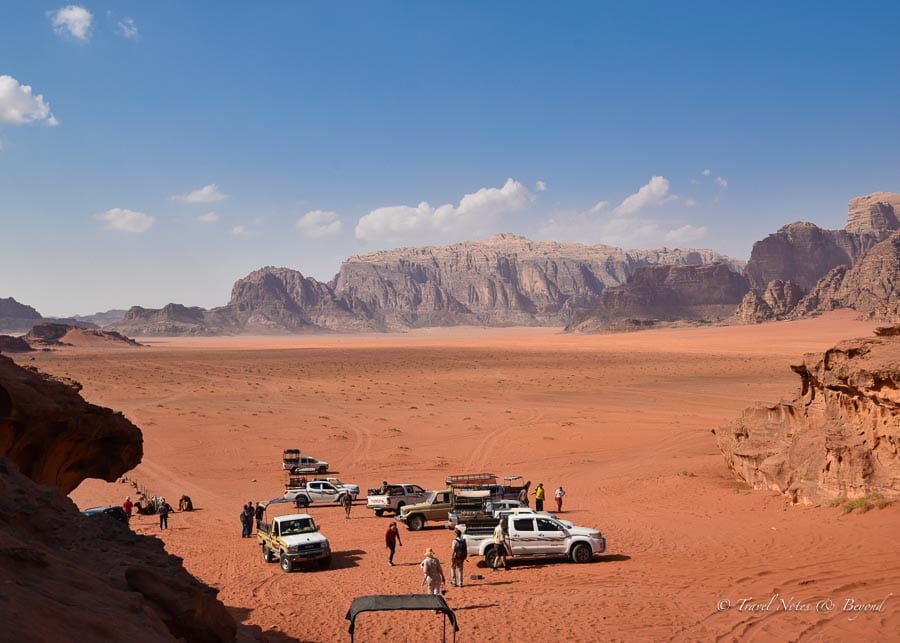
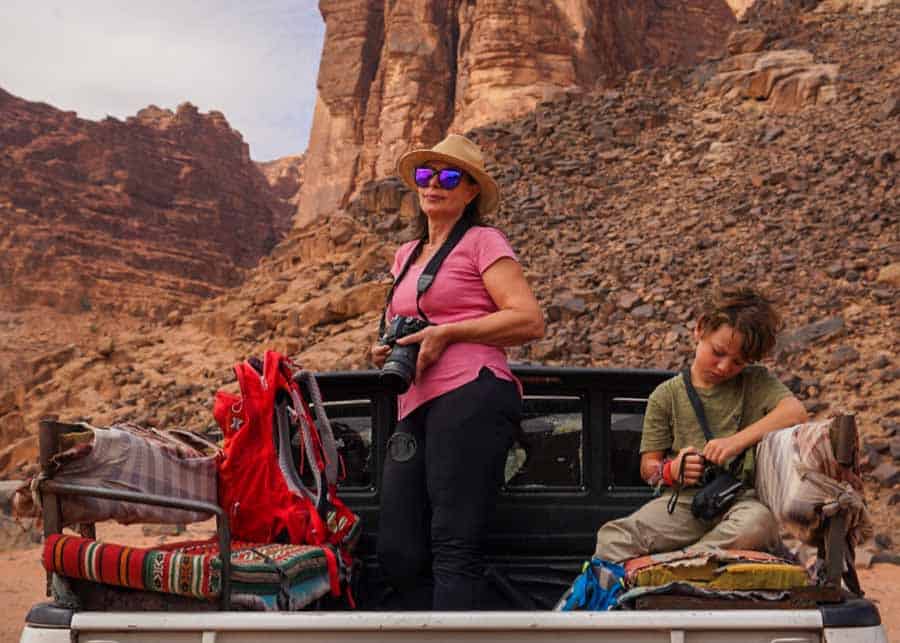
This is the most popular option, and also the one we chose. We had hired a driver for our entire Jordan trip, and he brought us early in the morning to the Visitor Center. Here a Bedouin tour driver was already waiting with a small group of other travelers. The “jeep” was not actually a jeep, but rather the back of a Toyota pickup with a padded bench welded in. That made the ride moderately comfortable, but we were still exposed to wind and dust.
You can choose between a half-day tour (2-4 hours) and a full-day tour (6-8 hours). The jeep ride is a good option if you don’t want to ride or hike for hours in the desert. It allows you to experience Wadi Rum at a relaxed pace while still covering vast stretches of its dramatic desert landscape.
A standard half-day tour runs about four hours and costs 35–55 JD per car (split between everyone in the vehicle, not per person). A full day costs 70–90 JD per car and adds the Burdah Rock Bridge. Prices are fixed by the cooperative and posted at the Visitor Center, so there is no haggling once you are inside. You cover a lot of ground, Khazali Canyon, Lawrence’s Spring, the Red Dunes, a rock bridge or two, the sunset viewpoint.
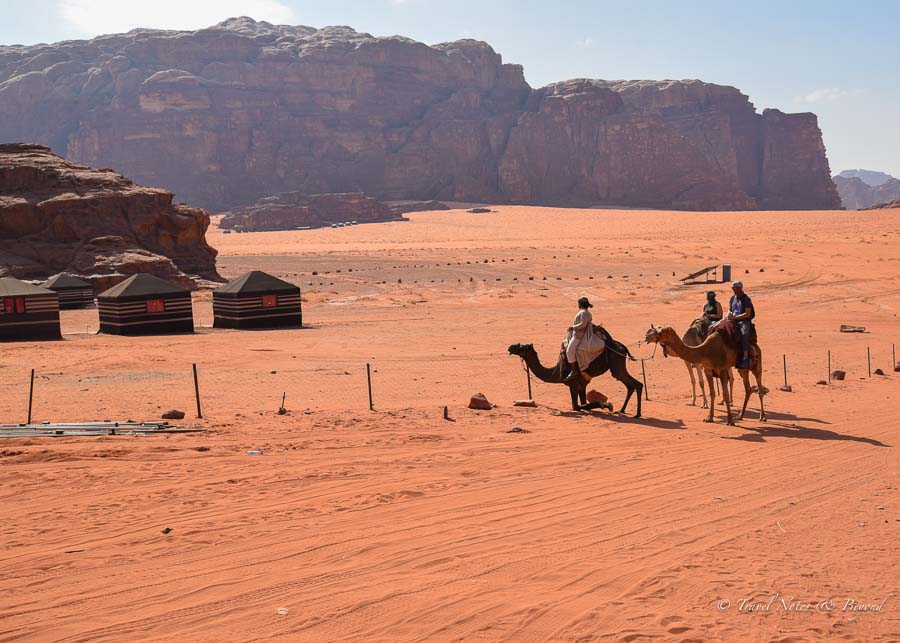
By Camel
Camel rides in Wadi Rum are run separately by the Bedouin guides who own them, and the pace is very different from the jeep. A one-hour ride to Lawrence’s Spring costs 20 JD per person; a two-hour loop to the Red Dunes is 30 JD; a four-hour half-day is 45 JD; a full day with lunch is 65 JD per person, plus a 45 JD surcharge per group because the guide rides his own camel on the longer trips (Real Bedouin Experience Tours).
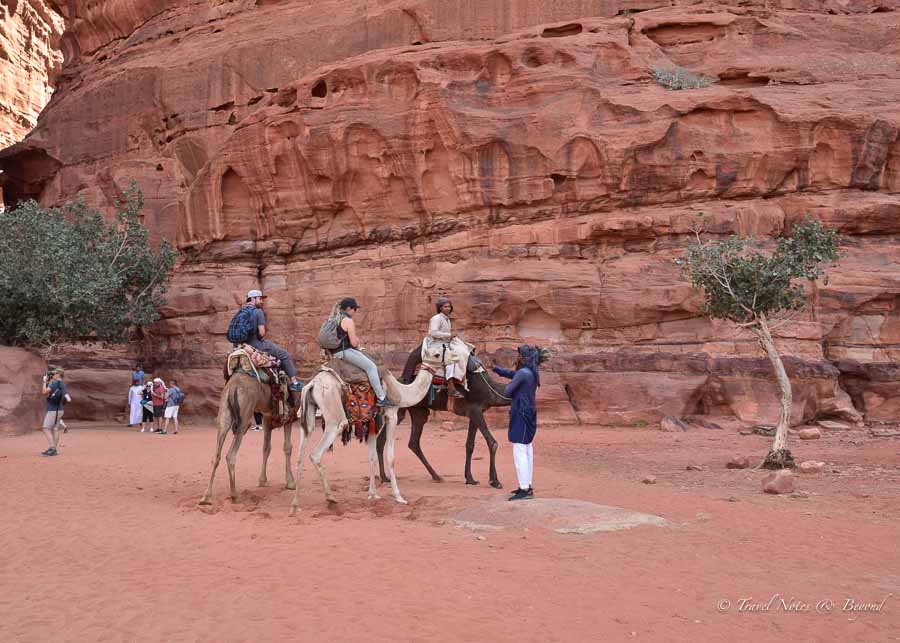
With camels you cover less ground but you feel the desert in a way no truck allows. The silence, the rocking pace, the shifting light, make the experience feel more authentic. The trade-off is comfort. I know because we tried riding camels on our trip in Morocco and totally disliked it. Camels are tall, the saddle is hard, and most people are sore after ninety minutes. The camel rides are good for sunrise or sunset, and should be avoided in summer midday heat.
On foot
Hiking is the least-known option, but for the right kind of traveler is the most rewarding. Bedouin guides offer all kinds of tours, from a half-day scramble up Jebel Khazali to multi-day trekking and camping itineraries. A reputable Bedouin-led hiking package runs around 50–80 JD per person per day including a guide, lunches, and overnight in a desert camp.
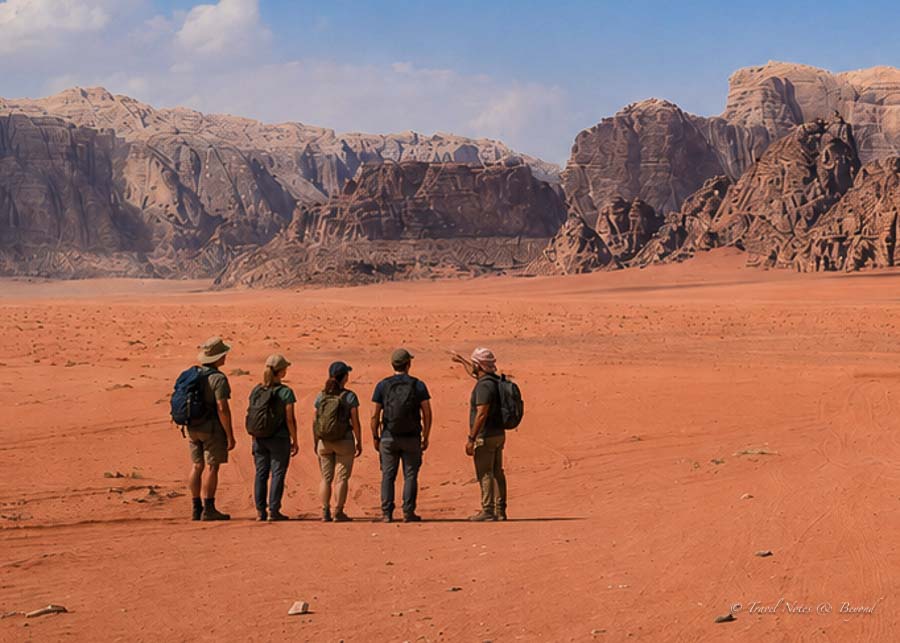
The single most popular day hike is the climb to Umm ad Dami, the highest point in Jordan at 1,854 meters, usually combined with a half-day jeep transfer to and from the base. One thing to keep in mind is that hiking doesn’t suit all travelers. You need to be in a good physical shape, be prepared for sun, and willing to trade landmark-checking for a slow, quiet immersion.
On horseback
This option surprised us because I didn’t expect to see horses in Wadi Rum. But apparently there is a small Bedouin operation that runs horseback rides into the protected area.The experience is somewhat similar to camel riding.
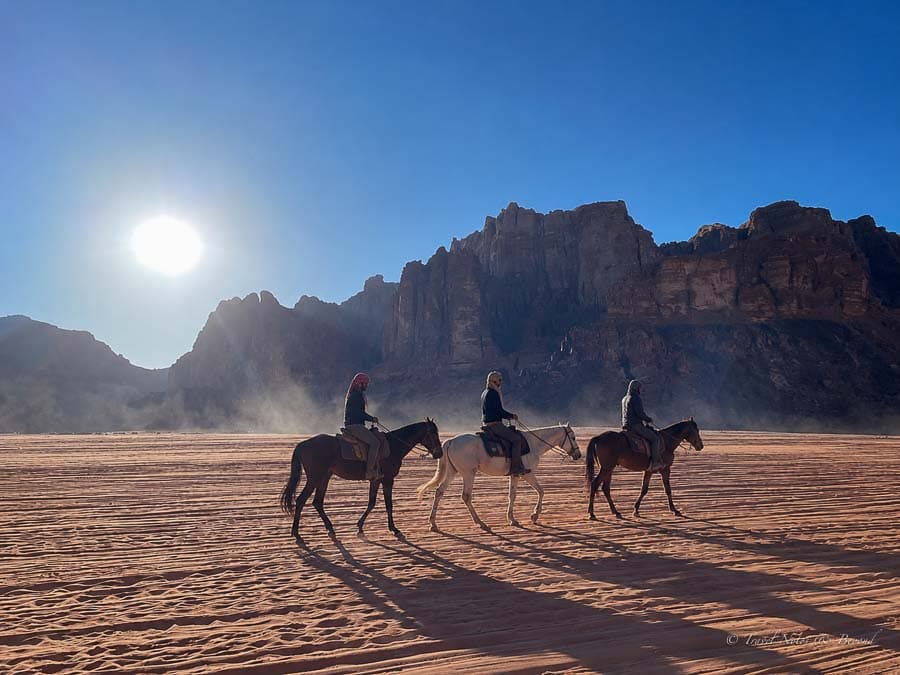
The ride takes you on a three-hour loop covering the Red Dunes, Khazali Canyon, and the Small Arch. Like with the camels, you can opt for a full day of five to six hours that adds Lawrence’s Spring. They also offer multi-day rides up to six days for experienced riders.
Prices vary by length and group size. Expect to pay similar to or slightly more than the equivalent camel tour. The difference is that horses move faster than camels and feel more familiar to most riders. If you like this option, you should book it in advance because the operation is much smaller and it’s not always available.
By Hot Air Balloon
If your budget allows it (and are not afraid of hot air balloons, like I am), this is the view that does Wadi Rum’s scale justice. The balloon launches before sunrise from the desert floor and floats for roughly an hour over the dunes and sandstone, landing somewhere your support vehicle finds you.
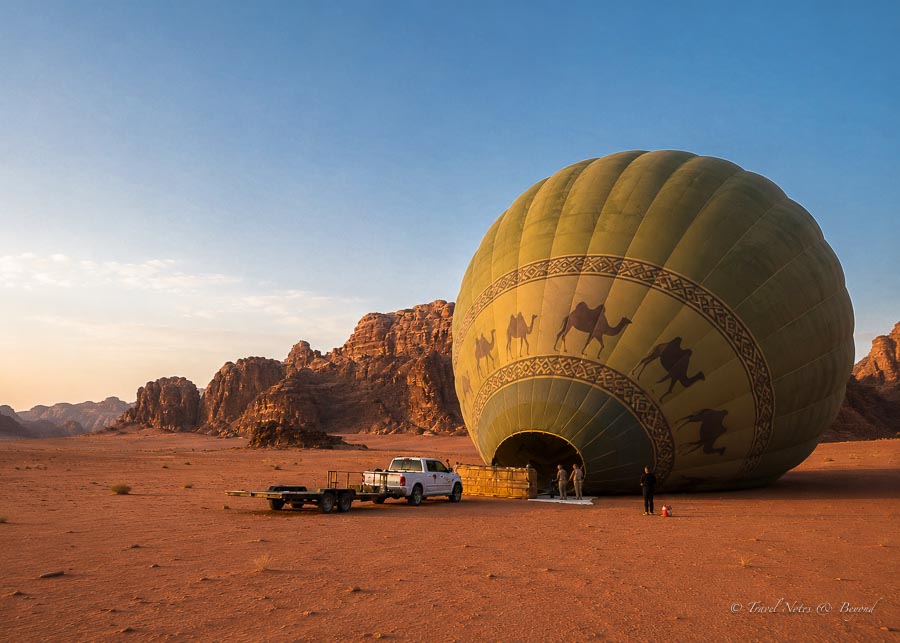
The current price is 130 JD per person, cash only, with free pickup from any camp inside the protected area. Flights may cancel on short notice for sandstorms or wind conditions. For this reason, it’s wise to build a buffer day into your plans if you have your heart set on it. You need to book at least two weeks ahead in high season, sometimes more.
By Ultralight Aircraft
Yes, we were surprised by this option too and far fewer travelers even know about it. The Royal Aero Sports Club of Jordan operates ultralight flights from Wadi Rum, taking one passenger at a time over the Seven Pillars of Wisdom, Lawrence’s Spring, and the so-called Crop Circles formation.
A thirty-minute flight runs roughly 130–150 JD per person, with the option to remove the doors for unobstructed photography. Not for me, for sure! The flight is louder and more exposed than the balloon, but I imagine for aerial photographers it is hard to beat.
Which Option to Choose
If you only have a half-day, take a jeep tour and add a one-hour camel ride from your camp at sunset for 20 JD. You will see the landmarks and also enjoy the end the day in a slow, quiet way.
If you have a full day, choose the long 4×4 jeep tour, or do the camel tour in the morning and finish with a jeep ride to a sunset viewpoint.
If you have two days or more, you can add a hike to Umm ad Dami or a sunrise balloon ride. Both are the kind of experience that justifies the extra night.
And if you came specifically for photography, the ultralight aircraft tour gives you something none of the others can.
Sleeping in the Wadi Rum Desert
This is the part of the trip we wish we had planned for. Our itinerary was tight, and by the time we realized how much an overnight would have added, the better camps for our dates were full. If you can give yourself even one night here, do it. The desert empties out after the day-trippers leave, and the silence and the night sky are what you’ll most likely remember long after the photos fade.
There are three broad categories of camps in Wadi Rum desert, at very different price points.
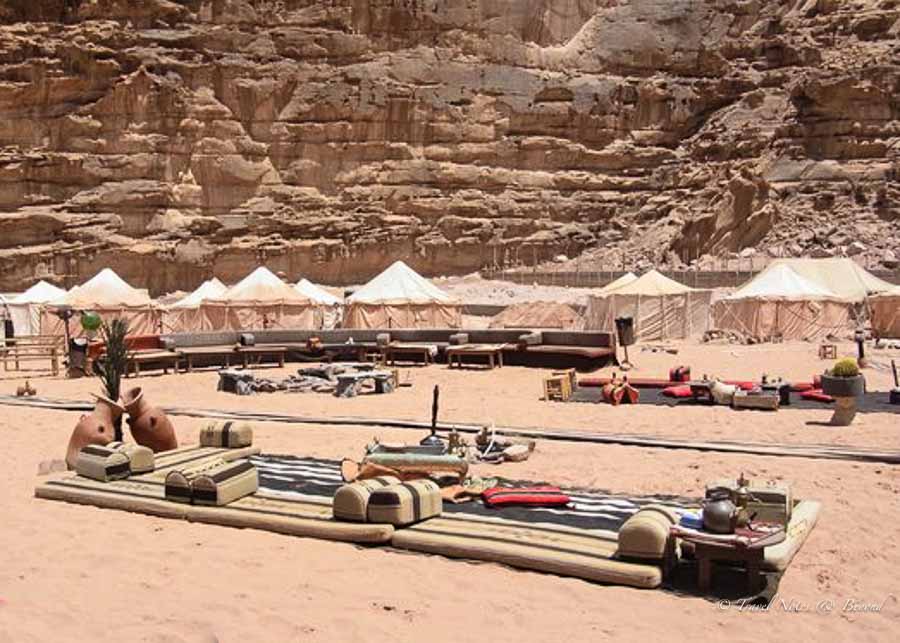
Traditional Bedouin Camps
These are the most authentic and the most affordable ones, pitched tents around a communal fire, with shared bathrooms and dinner cooked underground in the zarb pit. The price runs between 25 to 45 JD per person and it usually includes dinner, breakfast, and pickup from the Visitor Center. This option is best for travelers who came for the culture rather than the comfort.
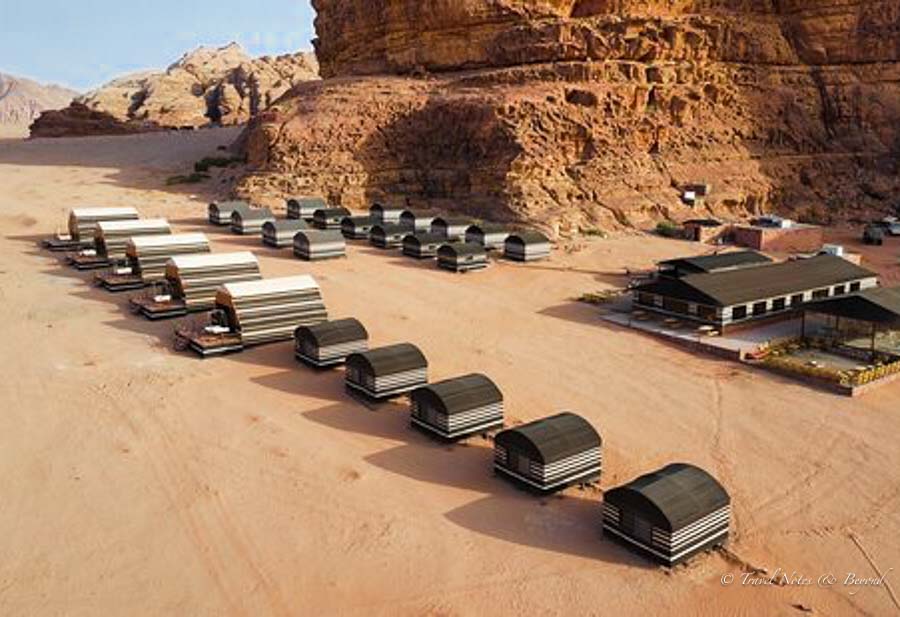
Mid-Range Desert Camps
These are already a step up in terms of comfort, from the Bedouin camps. They add private bathrooms and slightly better beds, often in small cabins styled to look like a tent. The communal fire and dinner are shared. Prices run 60 to 100 JD per person, meals and transport included. Mid-range desert camps are a good middle ground for a quieter night and a proper shower without losing the desert atmosphere.
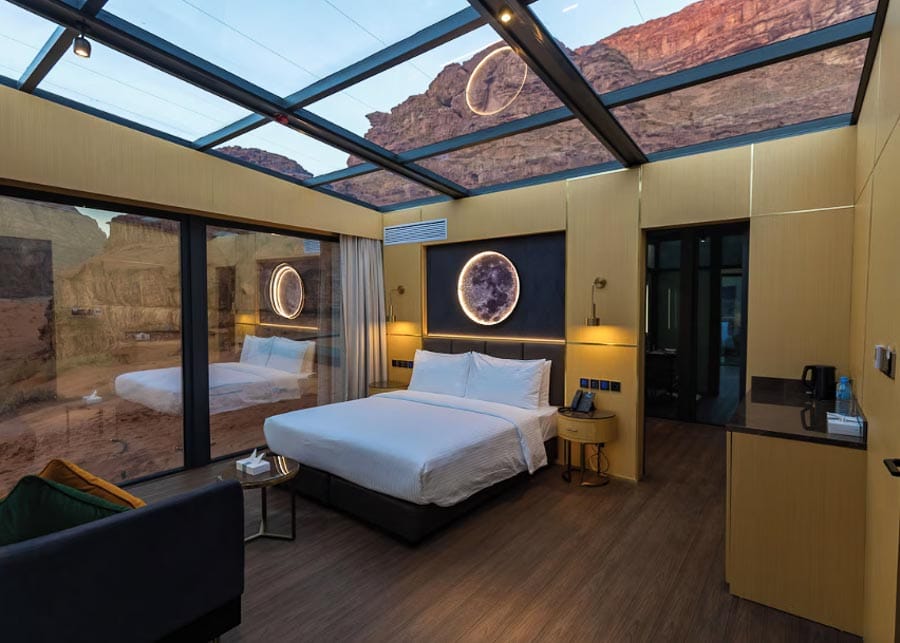
Bubble and Panoramic Camps
This is the Instagram option — transparent domes designed for stargazing from bed, with heating, en-suite bathrooms, and Western-style breakfast. Some are beautiful, but others sit too close to a road to feel like the desert. Even though the price is pretty high, (150 to 300 JD per person), many people seem to like this option so you need to book at least a month ahead in high season.
How to Pick One
Most camps look almost identical online, and prices for a bubble dome can vary by 100 JD between two camps within sight of each other. Read recent reviews rather than top-rated ones, look at guest-uploaded photos instead of the staged shots, and email the camp directly before booking. A good host should reply within hours and tell you honestly where the camp sits inside the protected area.
One thing worth confirming: a few of the cheaper “desert camps” are actually outside the reserve, and that is where the silence and the stars are best.
How to Choose a Guide in Wadi Rum
The kind of guide you choose can make or break the day. Two travelers can take the same jeep tour and come away with completely different experiences depending on who is driving. One returns with stories about Bedouins and rock inscriptions, the other with a memory card full of photos and not much else. To be honest, I can’t say there are bad guides in Wadi Rum, but there are different kinds.
Every guide working inside the protected area in Wadi Rum is a Bedouin registered with the local cooperative, and they all know the terrain by heart. What varies is personality and English level. Some are natural storytellers who will stop the truck somewhere with no name on the map and tell you about the petroglyph their grandfather showed them.
Others are quieter and treat the day more like a driving job. Neither is necessarily wrong, but knowing which one to choose can make a big difference. We were lucky in this respect because although we didn’t know what to ask for, we ended up with a driver and a co-guide who kept us laughing throughout the entire trip.
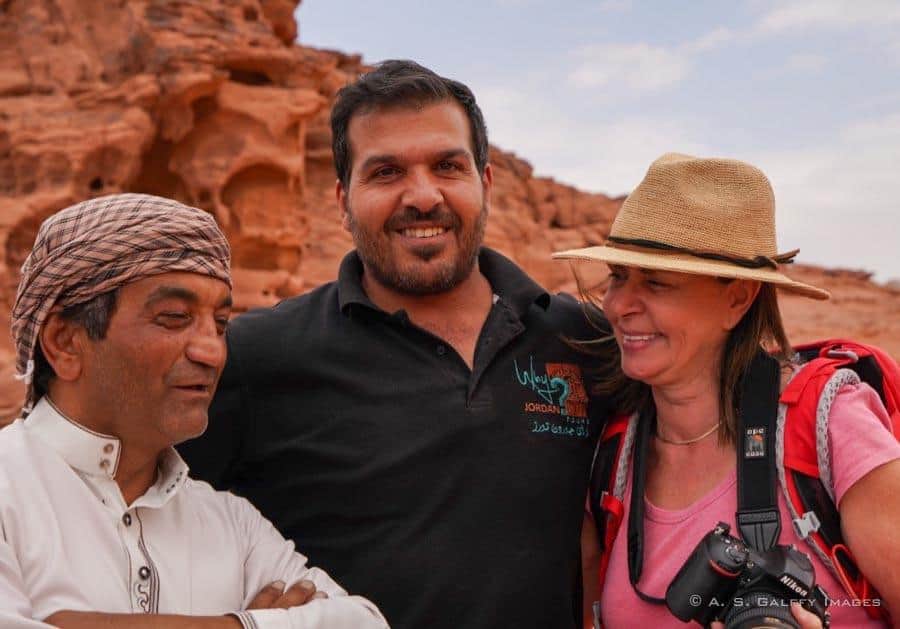
At one point during the day, our Bedouin guide turned to my husband and asked, half-seriously, whether he would sell me to him for a camel. My husband laughed considering it a joke, but the guide kept going, raising the price, until he was offering two. I never quite figured out if it was a joke, a compliment, or a traditional bit of Bedouin humor, but it became one of the moments we still joke about whenever we tease each other.
If you Book Through a Camp
Email the camp before you decide on the tour and ask two things: whether your guide speaks English well enough, and whether he is the talkative type. A good host will answer honestly, and many will adjust the assignment if you ask for someone who likes to chat.
Ask also whether your tour will have a tea stop, where the guide brews Bedouin tea with sage over a small fire. Tea stops are usually included in the half-day tours.
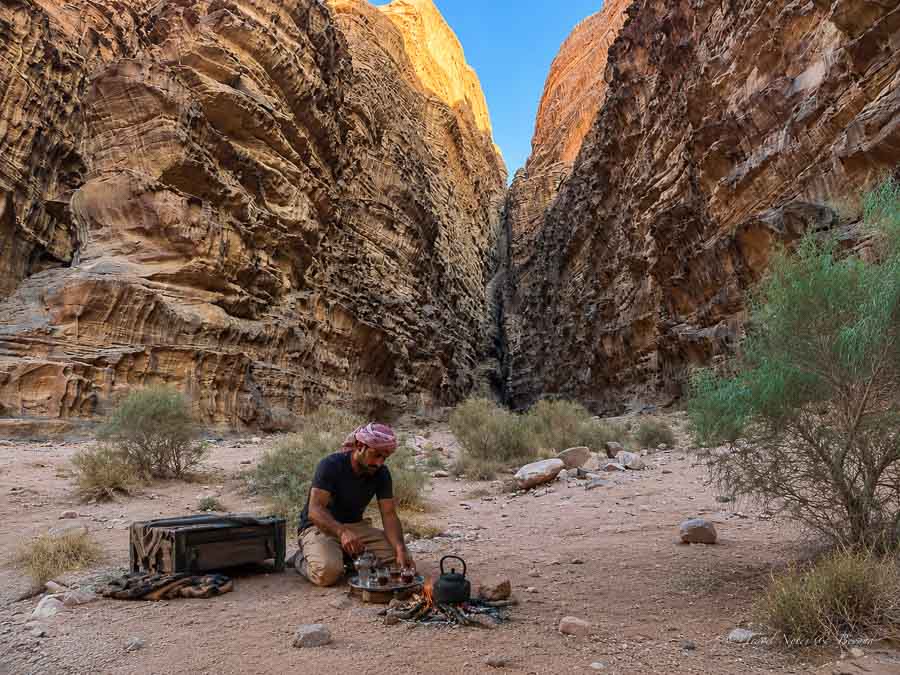
The full-day tours include a cooked lunch, usually grilled chicken or lamb with rice, or vegetables, prepared in the desert by your guide. This in itself is an experience that you’ll remember for a long time.
If you Arrive Without a Booking
At the Visitor Center, drivers are assigned on rotation, which keeps the work shared fairly. You do not pick, but you can ask the desk clerk to match you with a guide who likes conversation, and they will usually try.
Should You Negotiate?
No. Rates are not bargained at the gate the way they are in a souk. Most operators publish their prices openly and they are broadly consistent across the cooperative. They are roughly 30 to 50 JD per person for a half-day jeep tour with two to four people in the vehicle; 40 to 60 JD for a full day, and 60 to 90 JD per person for a one-day, one-night package with meals. The 5 JD protected-area entry fee is on top, unless you have a Jordan Pass.
What you can do is compare camps before booking. Prices vary by 10 to 20 JD per person between operators offering similar experiences. What you should not do is try to talk a guide down at the gate. The rates are set to share work fairly across the community, and a guide who undercuts them is usually working outside the cooperative. Tip well at the end of the day instead. These guides don’t earn much money.
One thing worth doing either way: Ask your guide early whether you can stop somewhere off the standard route. The usual tour hits the same five or six sites every truck visits, and they are crowded by mid-afternoon. That single request, made friendly and not pushy, is what turns a sightseeing tour into the kind of afternoon you actually remember.
Movies Filmed in Wadi Rum
If Wadi Rum looks oddly familiar even before you arrive, it is because you have almost certainly seen it on screen. The desert has stood in for other planets so often that locals joke it has a second career in Hollywood. Ridley Scott shot most of The Martian here, using the red sand of the Khazali area to play the surface of Mars.
Denis Villeneuve filmed long stretches of Dune and Dune: Part Two in the wider valleys, where the dunes are tall enough to suggest Arrakis without any digital help.
Star Wars came twice: the first time for Rogue One, where Wadi Rum played the holy moon of Jedha. The second time for The Rise of Skywalker, where it doubled as the desert planet Pasaana.
While none of those movies resonate with me personally, my all time favorite remains Lawrence of Arabia which I first watches when I was about 10 years old. The movie is a classic and was filmed here in 1962, in some of the same valleys T. E. Lawrence had actually ridden through forty-five years earlier.
Other movies filmed in Jordan’s Wadi Rum desert were: Prometheus, Aladdin, and Theeb. So when your guide stops the truck somewhere with no name on the map and tells you “this is where they filmed Dune,” he is usually right. The production crews worked closely with the Bedouin tribes who still run the protected area, and as such the Bedouins still remember the locations.
What to See in Wadi Rum – Impressions From Our Guided Tour
Most full-day jeep tours follow a fairly standard route, with small variations depending on the guide and the season. We did a full-day version that hit most of the highlights, and what surprised us was how different each stop felt. The desert is not one landscape but several, and when you move between them you won’t believe how diverse Wadi Rum really is.
Before the tour: the Seven Pillars of Wisdom
You can see the Seven Pillars of Wisdom before the tour even starts. The rust-red rock formation, which towers directly above the Wadi Rum Visitor Center, bears the name of T. E. Lawrence’s memoir, even though there is no actual connection between the two. Lawrence was a British military officer who played a vital role in the Arab Revolt against the Ottoman Empire in this area. Nowadays, many landmarks in Wadi Rum carry his name — Lawrence’s Spring, Lawrence’s House, and the Seven Pillars themselves.
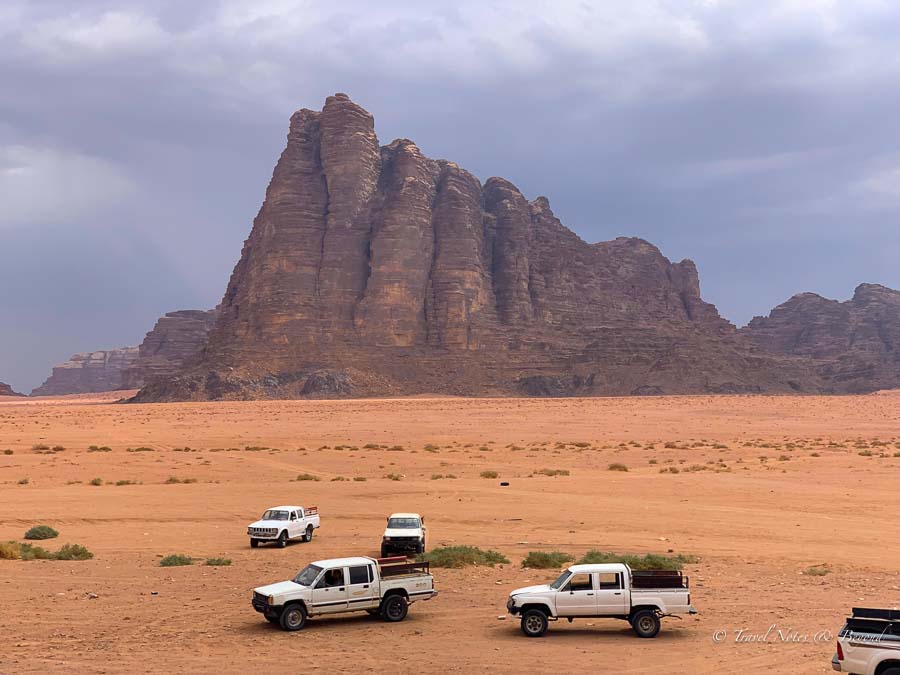
Our guide took us there briefly when he picked us up. We stayed just long enough to walk closer to the base, take a few photos, and look up at the five visible pillars . It is not an official stop on your tour itinerary, but our guide paused here on the way in to let us see it close up.
Lawrence’s Spring
The first official stop on almost every tour is Lawrence’s Spring, a natural water source tucked into the base of a cliff about two kilometers southwest of Wadi Rum Village. Bedouin families used it or centuries and supposedly even Lawrence visited it himself during the Arab Revolt.
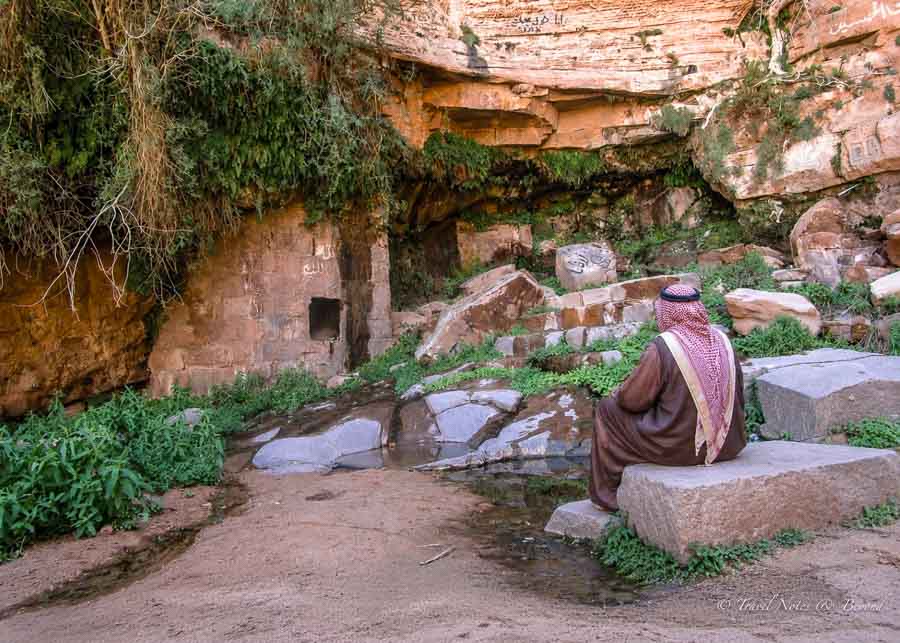
You can scramble up the rocky path to the spring itself, but the real reward is the view back down across the valley from halfway up — the kind of wide, quiet panorama that explains why he wrote about this place the way he did.
The Red Sand Dunes
These are the dunes you most likely have seen in many photos — vast, smooth, almost impossibly red, rising against the dark sandstone of Jebel Umm Ulaydiyya behind them. We stopped here for a while to enjoy the site.
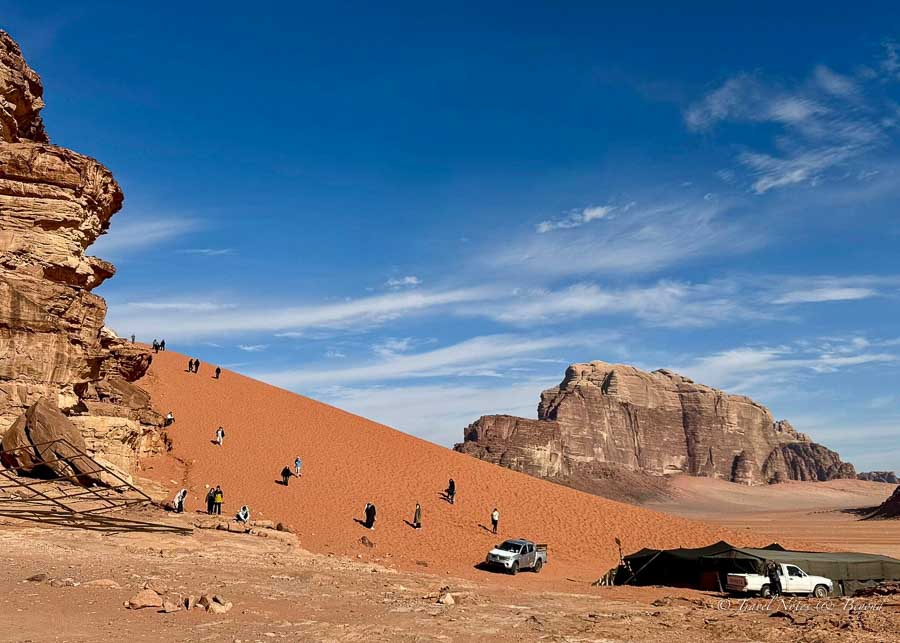
The climb to the top takes five sweaty minutes; the run back down takes only five seconds! Our guides provided a sandboard and let us try it on the slope. We skipped the boarding and chose to climb to the top to enjoy the view across the valley. This is a great spot to photograph the desert.
Khazali Canyon
A narrow slot canyon with walls just close enough to keep a permanent shade, Khazali is the cultural stop of the tour. The walls are covered in petroglyphs and inscriptions, some Thamudic, some Nabatean, some Islamic. They seem to be dating back as far as 350 B.C.
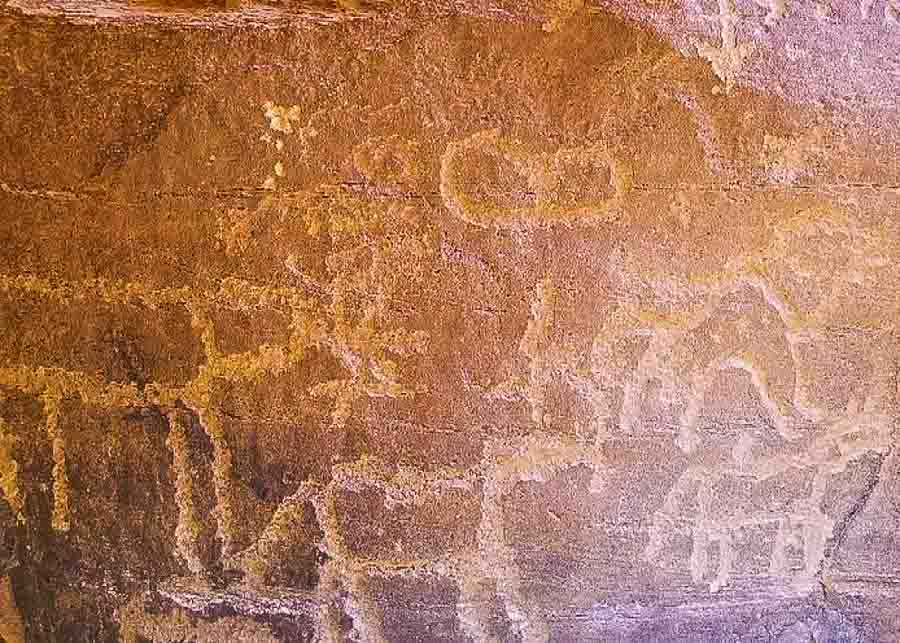
About a hundred meters after you walk in, the path tightens and the contrast between the cool, dim interior and the open desert outside is striking. This is the stop where a talkative guide makes the biggest difference, because the carvings need someone to explain them.
The Little Rock Arch
A small natural arch you can walk through and climb in a couple of minutes, with sweeping views from the top. It is a quick stop, more of a photo break than a destination, but it sits in a pretty stretch of open desert and makes for a good warm-up before the bigger arches later in the day.
Lawrence’s House
The remains of an old stone building set against a cliff, supposedly used by Lawrence as a base during the Arab Revolt — though the structure is actually Nabatean, predating him by nearly two thousand years. Whether he stayed there or not is unclear, and most historians think the connection is loose at best.
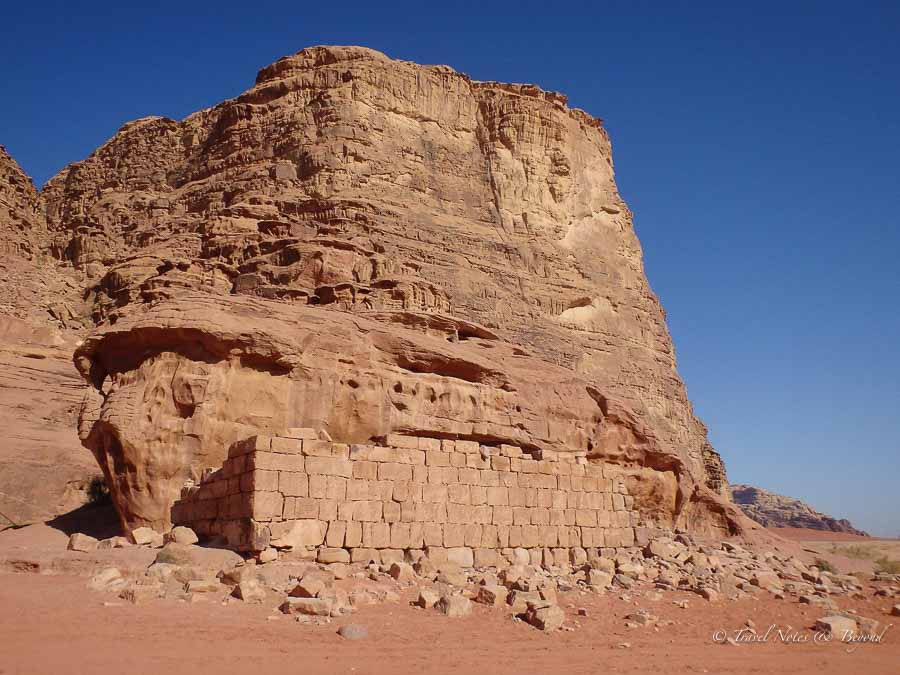
The ruin itself is modest, but the views across the wide valley behind it are some of the best on the morning loop.
Mushroom Rock
This is exactly what it sounds like — a wind-eroded sandstone formation balanced on a narrow stem, looking very much like a giant mushroom. It is a five-minute stop, but the geology around it is interesting and the photos are good.
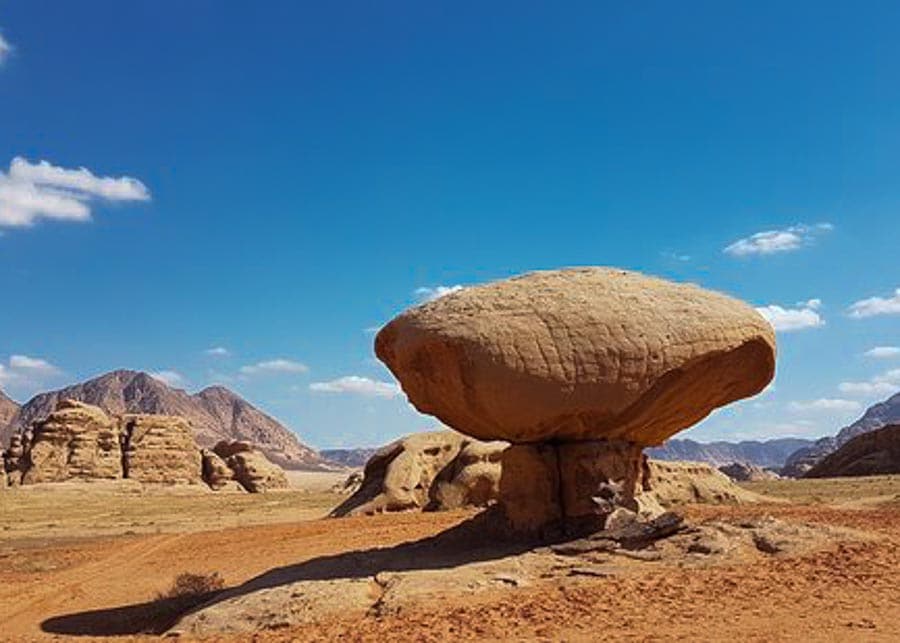
Our guide joked that the desert had been sculpting it for thousands of years just so tourists would have something to pose next to.
Abu Khashaba Canyon
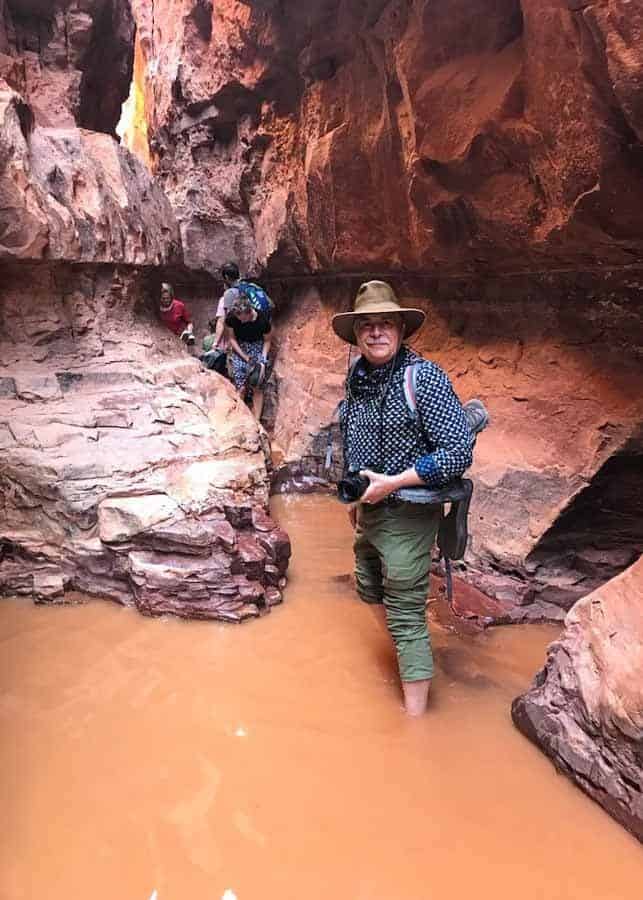
In the afternoon we stopped at Abu Khashaba, a long, narrow canyon about a kilometer in length and at one point only two meters wide. The canyon is shaded by tall sandstone walls.
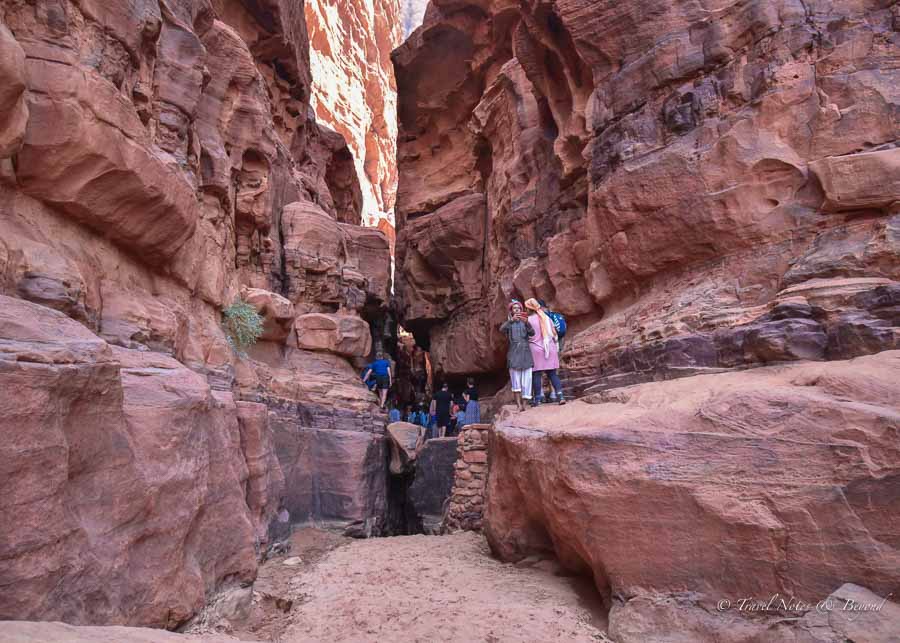
Here we walked for about 30 to 45-minutes through a canyon pinched in the middle. At one point there is a tighter section where you have to scramble over a few boulders. The canyon is dotted with shrubs and small trees with green tones that come as a surprise amidst the red.
Um Fruth Rock Bridge
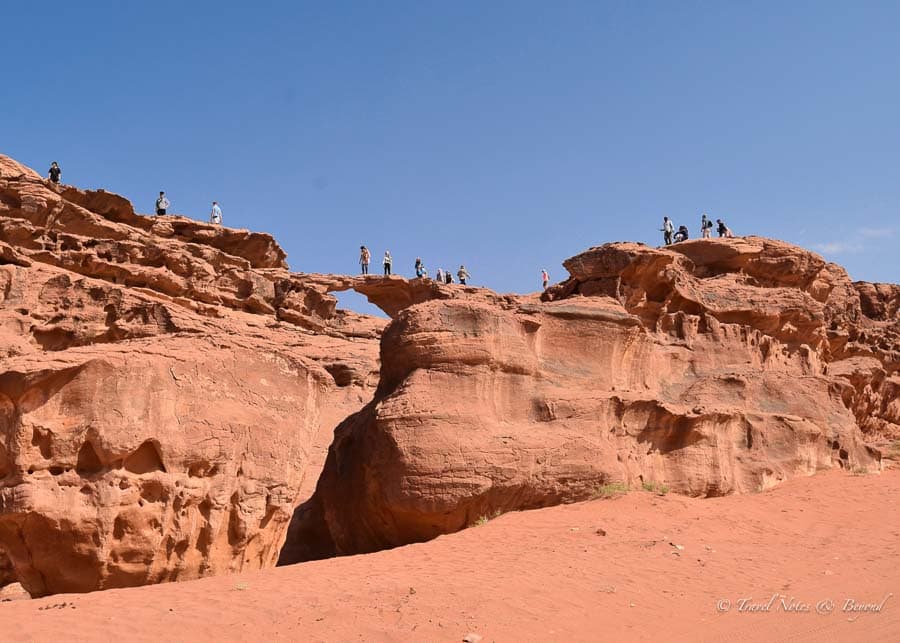
Wadi Rum has several natural rock bridges. Of the two we saw on our tour, Um Fruth was the one I liked the most. This is the most photographed arch in Wadi Rum, rising about fifteen meters above the desert floor. It takes only a few minutes to climb, but you need to have a head for heights to get up there.
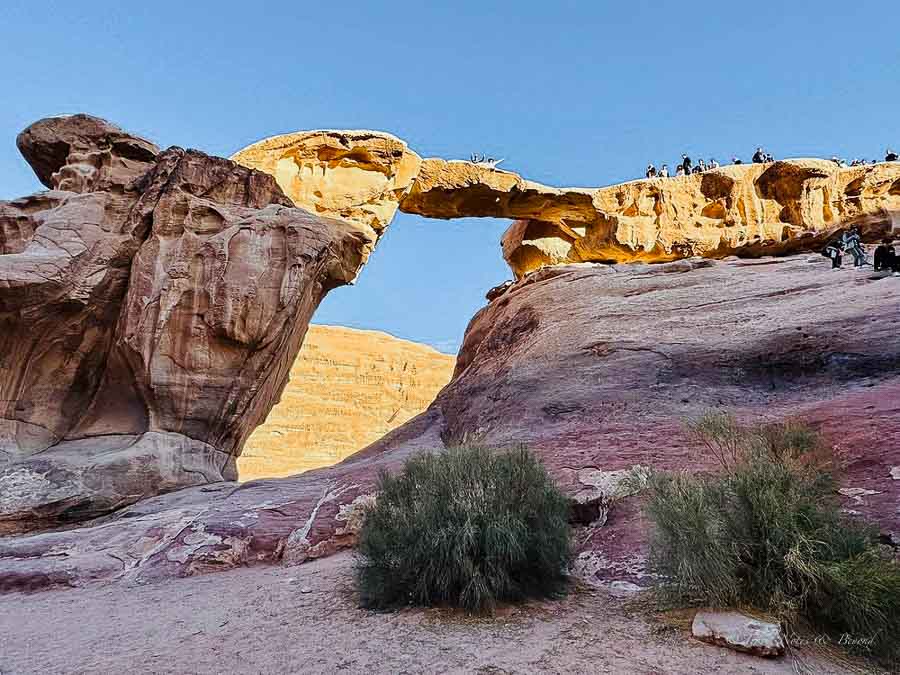
By the time we got there it was late in the afternoon and none of us had the energy to climb up the arch, though there were plenty of daredevils already at the top.
The Sunset Viewpoint
Toward the end of the day, every guide starts heading back in the direction of the Visitor Center, and along the way each one pulls over at a nice viewpoint overlooking the open desert. The spots probably differ from group to group, but that doesn’t mean one is more beautiful than another.
The result is the same: you find yourself on a quiet rock platform with just your driver and the few people who rode with you, watching the sun go down and the light fade away. This is your last chance to take a good look at the red desert and take your final shot of the day.
What to Wear in Wadi Rum
A quick guide on what to wear in Wadi Rum, because the desert really does punish you for getting this wrong. Depending on when you visit, it may be very hot or cold. Even in summer, it is hot and exposed during day and surprisingly cold at night. You also need to account for the wind factor. At any rate, Lightweight long sleeves, breathable pants, closed shoes, scarf, sunglasses, hat, sunscreen, and one warm layer. Those were the things that ended up mattering most for us in Wadi Rum. Here are my suggestions, based on our experience:
Cover up rather than strip down. It sounds counterintuitive, but loose long sleeves and light pants are more comfortable in the desert sun than shorts. They keep the sun off, the sand out, and the wind from chapping your skin. Cotton and linen breathe well; synthetic athletic wear traps heat.
Closed shoes, not sandals. This is the one I would not negotiate on. The sand around the rocks gets hot enough to burn through flip-flops, and you will be climbing in and out of the truck on uneven ground all day. Sneakers would have been fine for our jeep tour, but I brought hiking boots and felt perfectly fine in them.
Bring a scarf. It may come in handy if it’s windy or dusty in the back of the truck. If you forget yours, you can buy a red-and-white shemagh near the visitor center for 5–10 JD. Some people buy them anyway, as souvenirs.
Pack one layer warmer than you think you need. Even in spring and fall, the temperature drops sharply once the sun goes down. A fleece is usually enough; in winter, bring a real jacket.
Sunglasses, sunscreen, and a hat that covers your neck. The light bounces off the sand and the pale rocks, and we both burned in places we did not expect.
As a general rule, be respectful and keep in mind that Joran is a Muslim country. It’s important to know what locals consider an “appropriate attire” and respect the cultural norms. Tank tops, shorts and very fitted clothes are an absolute NO for women.
Wadi Rum Frequently Asked Questions
Is Wadi Rum safe for solo travelers and women?
Yes, and reassuringly so. Wadi Rum is one of the safest places in Jordan, and Jordan itself remains a stable, welcoming country despite the regional tensions you may read about in the news. The protected area is run by a tightly-knit Bedouin community where everyone knows everyone, which makes it harder for anything to go wrong without being noticed.
Solo female travelers consistently report feeling comfortable both on tours and at the camps, though dressing modestly and using a guide or camp with strong reviews are always sensible choices. The usual common sense applies, but you do not need to worry about visiting alone.
Can you visit Wadi Rum without a guide?
Not really. The protected area is too large, too remote, and too easy to get lost in to explore on your own. As a result, independent driving inside the reserve is not allowed. Every visitor enters Wadi Rum with a guide, either as part of a camp package, a jeep or camel tour from the visitor center, or a hiking arrangement. This is not a tourist trap, it is how the area is managed and how local Bedouin families earn a living from it.
Is Wadi Rum suitable for kids and families?
Yes, and it is one of the more memorable family stops in Jordan. We had a 7-year old in our group who had a lot of fun on this tour. Kids generally love the open desert, the dunes you can run down, and the camel rides.
A few practical notes: the jeep tour is bumpy and not ideal for very young children or anyone prone to motion sickness. If you travel with children, bring extra water, sunscreen, and snacks because you can’t buy anything once you leave the visitor center. Most camps welcome families and several offer dedicated family tents.
Is there phone signal or Wi-Fi in Wadi Rum?
Patchy. Phone signal works in parts of the village and at the visitor center but disappears once you are deep in the protected area. From what we researched, most camps offer Wi-Fi only in the communal tent, and even then it is not very good. We could not use our phones at all in Wadi Rum — probably an issue with our carrier.
How many days do I need in Wadi Rum?
One full day is enough to see the main sites and feel the place. Two days, including an overnight at a camp, is the sweet spot. You get the day tour, the sunset, the night sky, and a quiet morning before the day-trippers arrive. Three or more days is for hikers, photographers, or anyone who wants to genuinely slow down.
A Final Thoughts
Looking back at our trip, one full day was enough to get a sense for Wadi Rum, but not nearly enough to feel I had really seen it. Jordan’s red desert is the kind of place that quietly rearranges your expectations of what a desert landscape can be, and the more time you give it, the more it gives back. If you can stay overnight, do it. If you cannot, a single day in good light, with a guide who likes to talk, is still one of the best things you can do in Jordan. And yes, the red sand will stay on your shoes long after you leave — but somehow you won’t mind it.
YOU MAY ALSO LIKE:
 Netflix’s “Nobody Wants This”– Filming Locations to Visit in Los Angeles