
Some links in this post earn me a small commission, at no extra cost to you.
If there is one temple that truly impressed me during our two-week trip to Indonesia, it’s Prambanan. The tall spires of carved volcanic stone, the detailed wall carvings, and the sheer size of the complex left me speechless. But beyond its beauty, there was something else I particularly appreciated about Prambanan: the freedom to explore it at your own pace, without unnecessary restrictions.
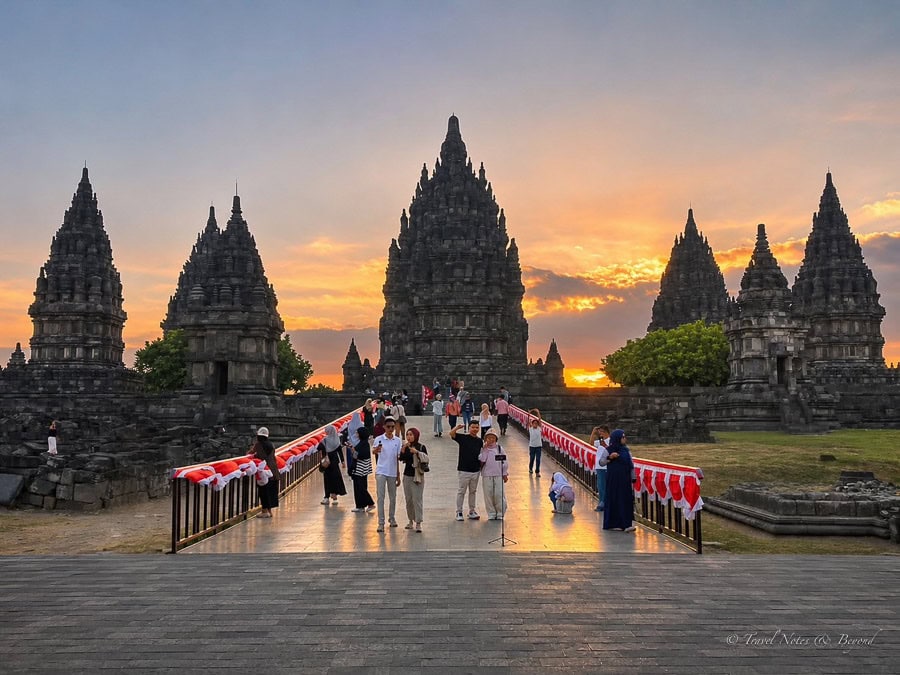
Unlike its famous counterpart, Borobudur, where visitors are ushered along in groups and kept to a strict schedule, Prambanan lets you enjoy what you’re seeing without constantly watching the clock. You can linger over the stonework, take as many photographs as you like, or simply stop for a moment to take it all in.
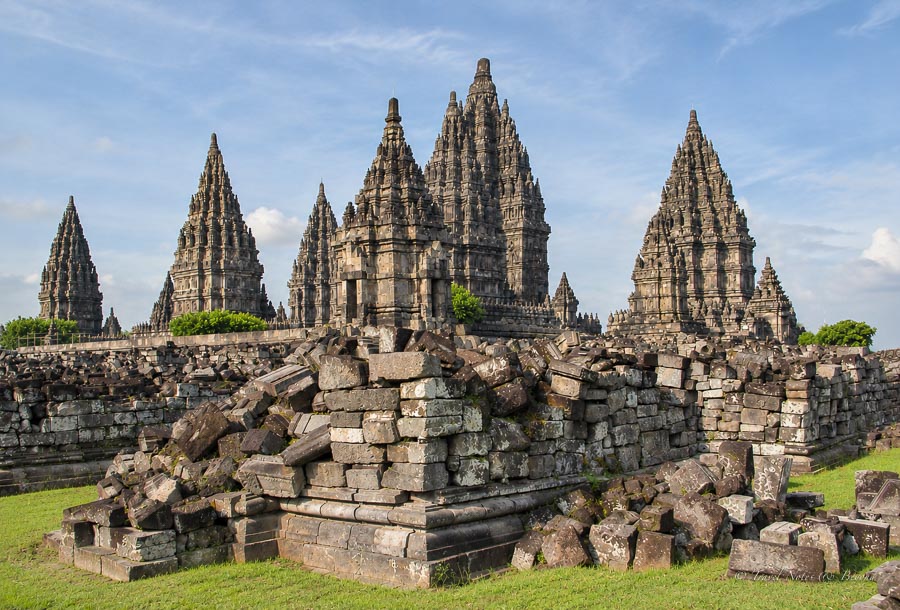
The Story Behind the Stones
If you skip the dry, textbook dates, Prambanan’s history is really a tale of royal rivalry, natural disaster, and a massive jigsaw puzzle.
A 9th Century Power Move
Around 850 AD, a Hindu king named Rakai Pikatan wanted to make a bold architectural statement. Though married to a Buddhist princess from the rival Sailendra dynasty, he wanted to match the nearby colossal Borobudur. So, he went all out and managed to build this huge complex that honors Brahma, Vishnu, and Shiva. At the center, a massive tower stretches 155 feet into the air to announce Hindu prominence. Hundreds of smaller temples originally packed the area around it, covering the plains in carved volcanic rock.
Swallowed by the Jungle
Building a stone masterpiece in Java carries serious geological risks, and the complex wasn’t used for long. So, less than a century later, in the 930s, the royal court abruptly had to pack up and move to East Java. What drove them out was most likely a massive volcanic eruption along with mounting political pressure. Left behind, Prambanan Temple slowly crumbled. Over the next thousand years, major earthquakes shook the towers down, and the jungle eventually swallowed the ruins whole.
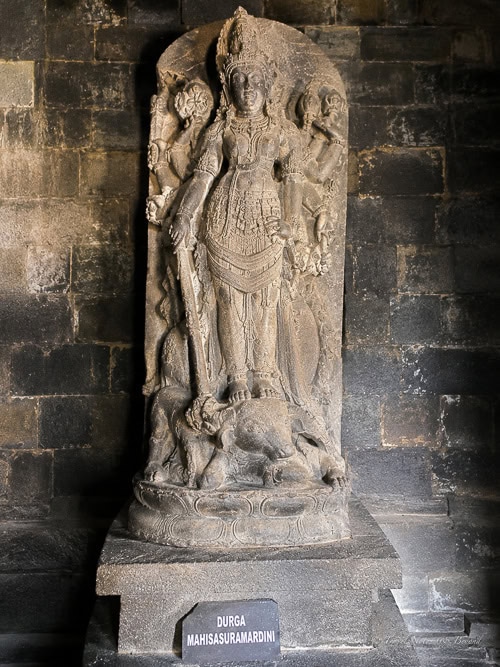
A Cursed Princess
Because locals eventually forgot who built the ruins, they invented a much better story: the legend of Roro Jonggrang. The tale goes that a prince with supernatural powers wanted to marry a princess, but she didn’t love him. Hoping to trick her way out of the unwanted marriage, she challenged him to build 1,000 temples before sunrise. The clever prince called on an army of earth spirits and almost pulled it off. But when the princess saw he had already finished 999, she panicked and tried to stage a fake sunrise by lighting fires in the east and getting villagers to pound rice so the roosters would crow, scaring the spirits away before they could lay the final stone. When he realized he had been played, the prince turned her to stone to complete the last temple. Locals still point to her statue inside the main Shiva shrine.
The Ultimate Jigsaw Puzzle
When archaeologists began restoring the ruins in the early 20th century, they were faced with a field of scattered stone blocks, but no blueprints to guide them. Rather than guessing what the missing parts looked like, they followed a strict restoration rule: a temple could only be rebuilt if at least 75% of its original stones were found.
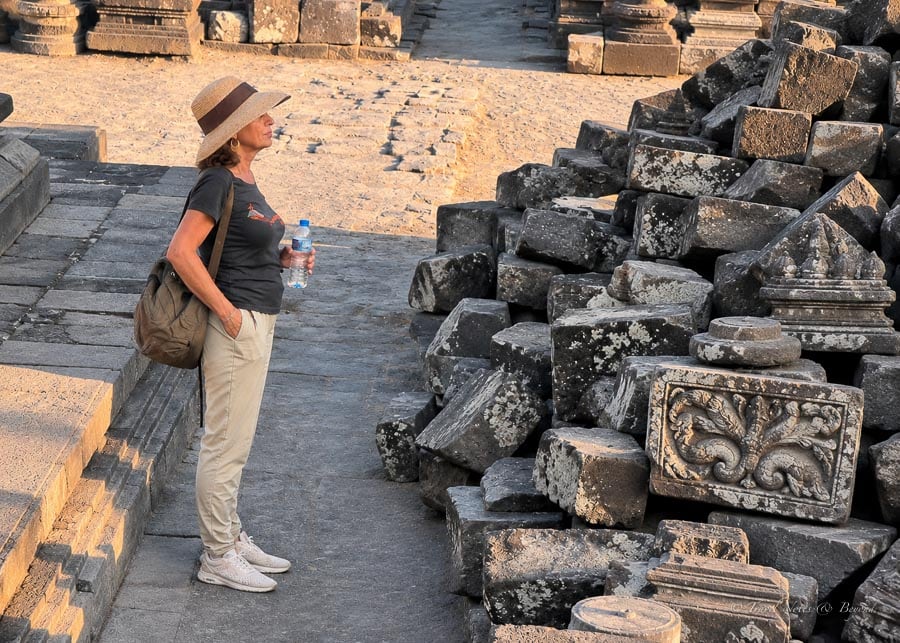
That explains why only the main spires stand tall today, while dozens of outer shrines still sit as neat piles of rubble. Much like the Valley of the Temples in Sicily, Prambanan leaves much of its original grandeur to the visitor’s imagination.
What You Can Actually Explore Inside the Prambanan Complex
Much like Petra in Jordan, Prambanan is one of those archaeological sites where the most photographed monument is only a fraction of what there is to discover. While Borobudur is a single massive monument, the entire Prambanan Archaeological Park stretches across nearly 200 acres.
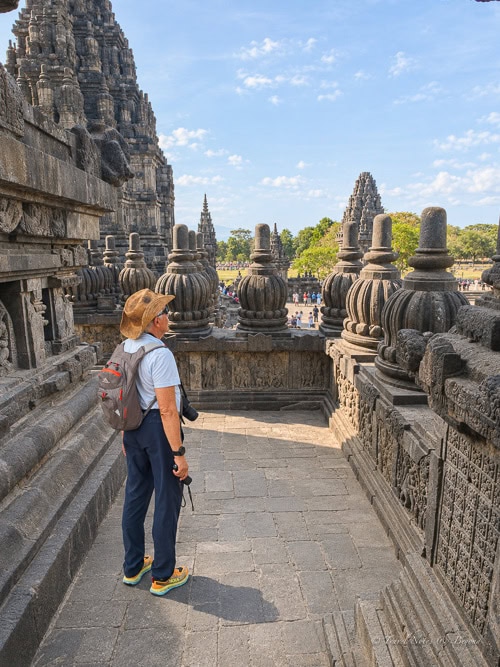
The main Hindu complex sits inside three square courtyards, one inside the other, with the most important temples standing on a raised terrace in the center. This is where you’ll probably spend most of your time, and for good reason.
The Main Temples: Shiva, Vishnu, and Brahma
At the heart of Prambanan Temple stand 16 stone structures, dominated by three large temples dedicated to Shiva, Vishnu, and Brahma. Shiva’s temple takes center stage, with Vishnu and Brahma on either side.
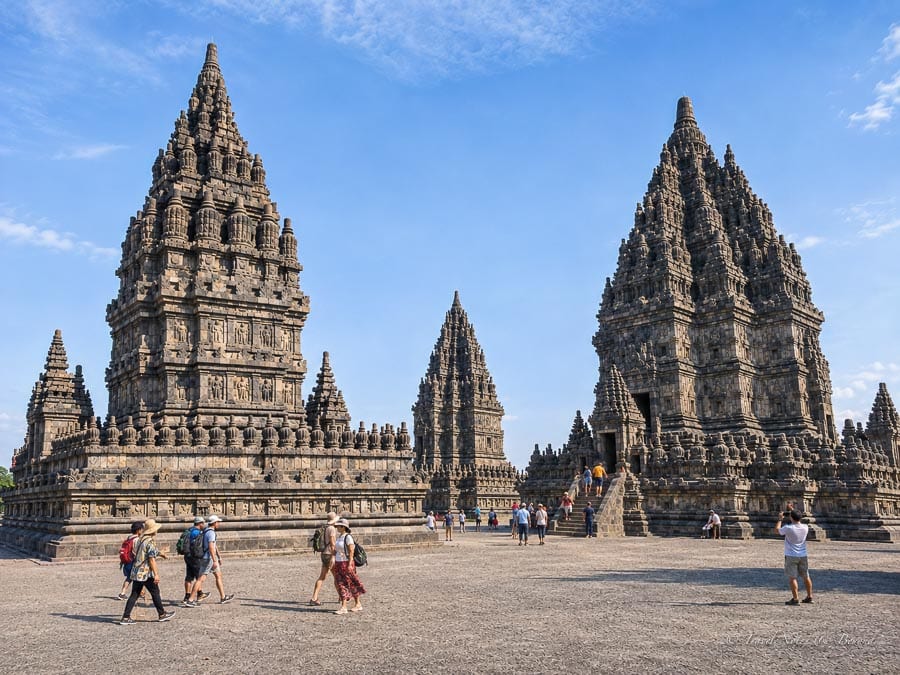
Facing them are three smaller temples dedicated to the animals associated with these gods: Nandi the bull, Garuda the mythical bird, and Angsa the swan. There are also two smaller temples at the ends of the central walkway and eight little shrines near the corners and entrances.
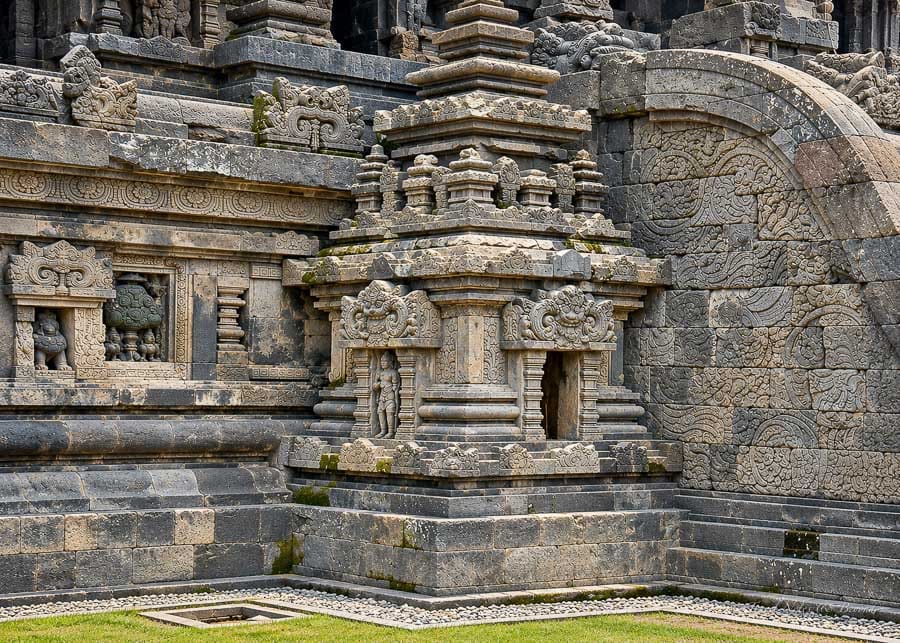
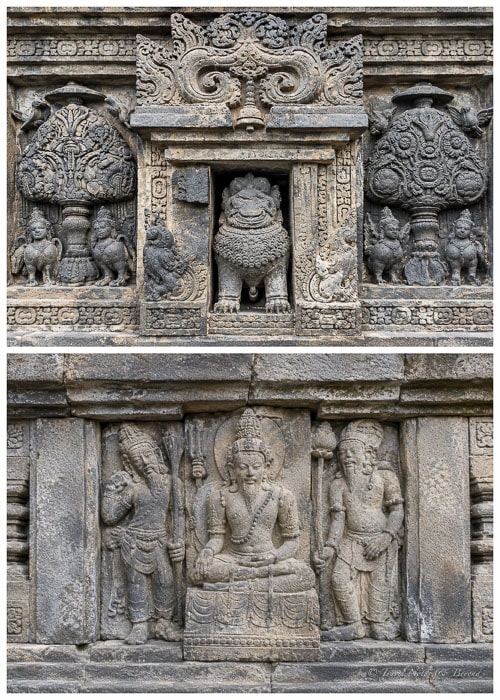
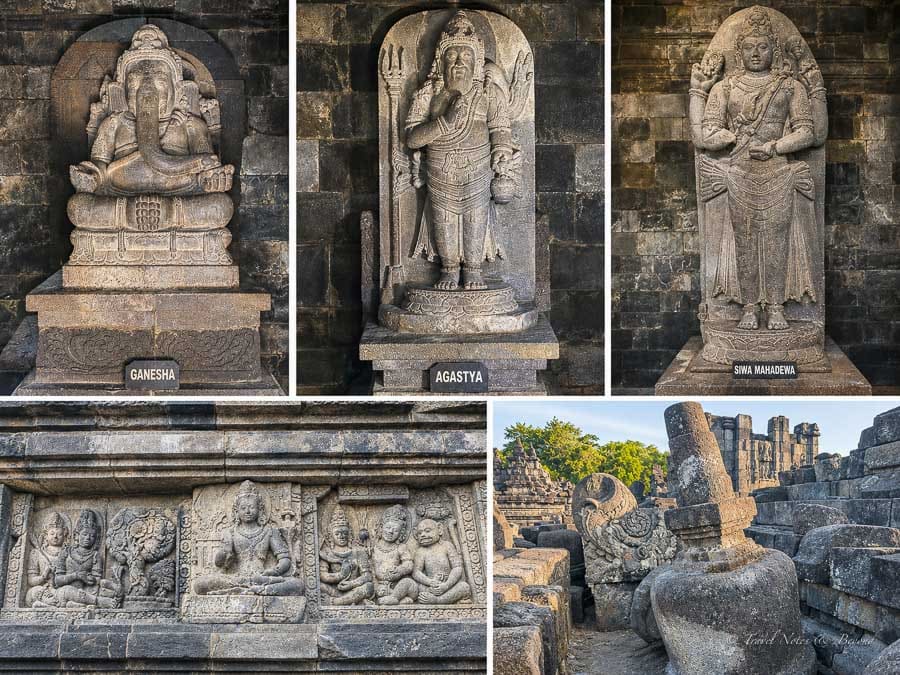
But the interesting part isn’t just looking at these buildings from the outside. You can actually climb the steep stone steps into the main temples and see the statues inside. And if you enjoy ancient art, take some time to walk around the galleries. The walls are covered with detailed carvings, including scenes from the Ramayana, and you can get close enough to appreciate the workmanship.
The Surrounding Courtyard: The Remains of 224 Hindu Shrines
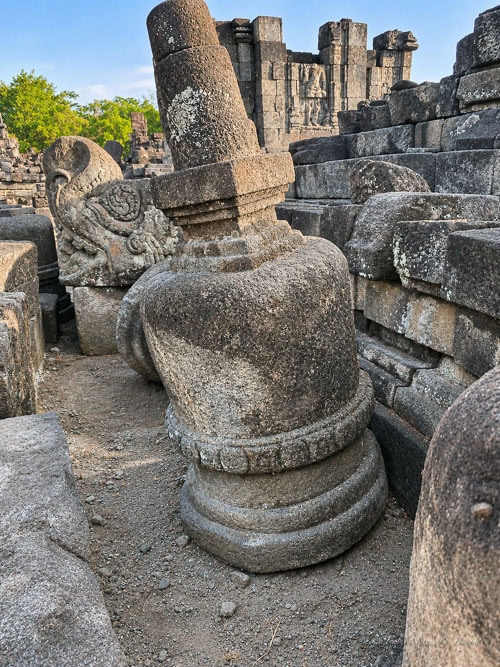
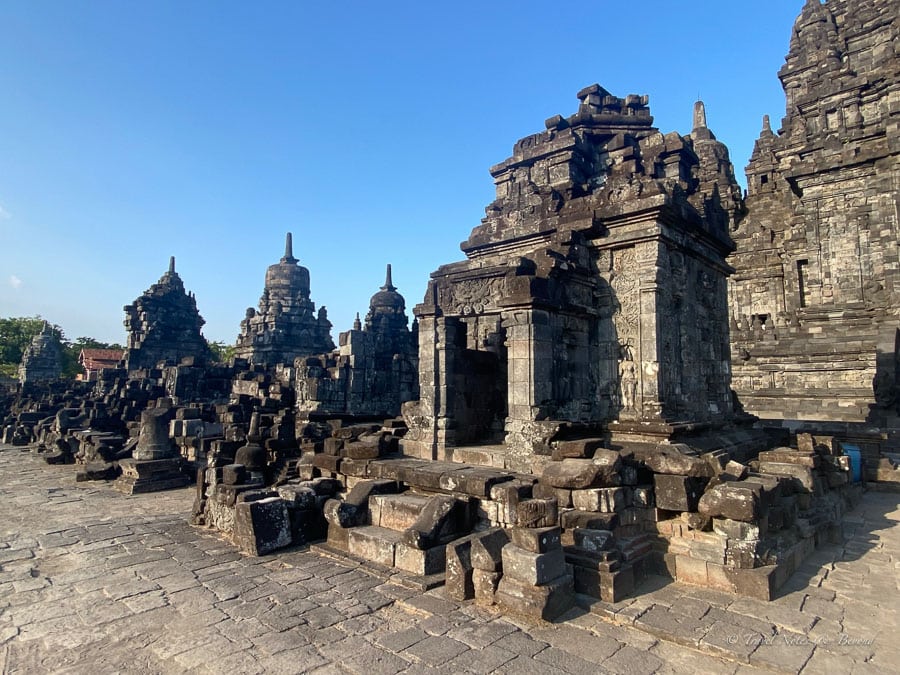
As you step down from the central terrace, you’ll see rows of grey volcanic stones scattered across the courtyard. These aren’t random piles of rubble, but the remains of 224 smaller, collapsed shrines. Together with the 16 temples in the center, that made 240 structures in the Hindu complex alone.
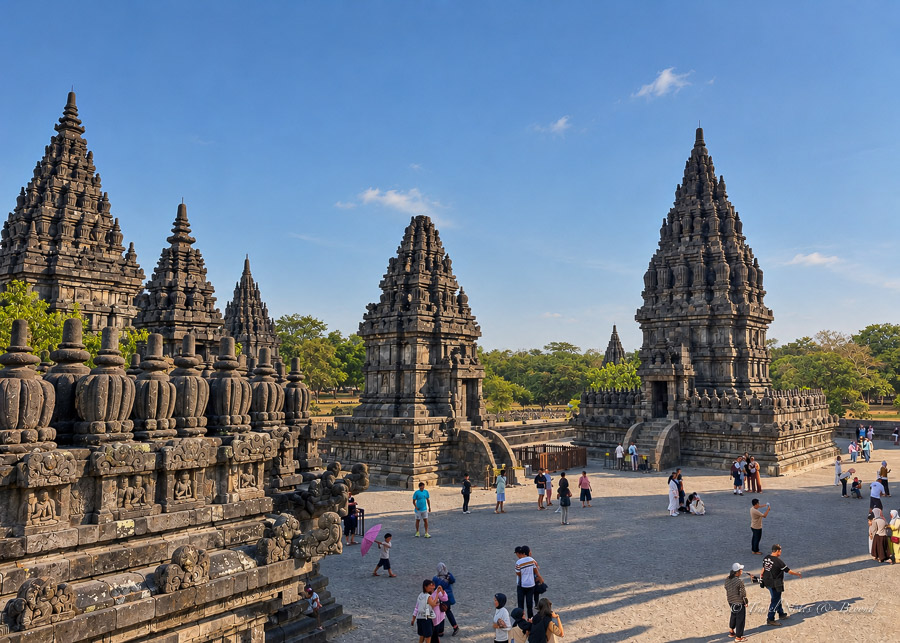
Most of those smaller temples are still in ruins, while only a handful stand fully restored among them. They are quite a contrast to the beautifully restored towers in the center. Nonetheless, they give you a better idea of just how much of Prambanan has been lost.
There’s More Than Just Hindu Temples at Prambanan
Once you finish exploring the central terrace where the three main temples sit, you might want to head out, thinking you’ve seen all of Prambanan. But don’t leave just yet. Beyond this courtyard, the park still holds plenty to see. And unless you know to look for it, you can easily miss a huge part of the complex.
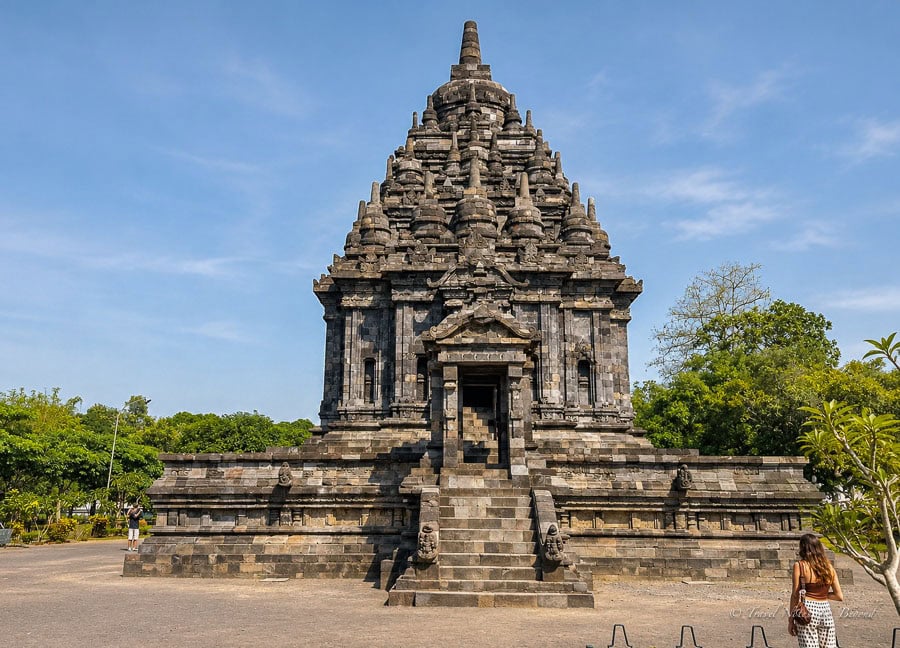
Just a ten-minute walk north brings you to three Buddhist temple complexes already included in your ticket. If you don’t feel like walking, you can easily hop on the park’s mini-train instead. Along this northern stretch, you’ll pass Candi Lumbung and Candi Bubrah, before reaching the real surprise: Candi Sewu.
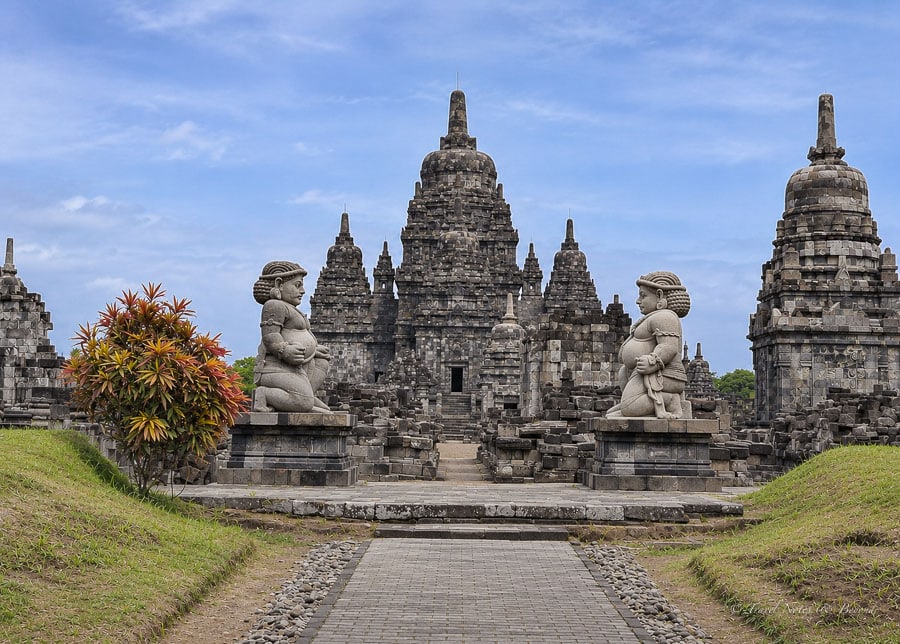
Sewu is the second-largest Buddhist temple complex in Indonesia, after Borobudur. It originally had a large central sanctuary surrounded by 248 smaller shrines. Although much of it remains in ruins, there’s still plenty to see, and it’s well worth walking out to the northern park rather than turning back as soon as you’ve photographed the famous towers.
Practical Tips for Visiting Prambanan Temple
Visiting Prambanan is pretty straightforward, especially when compared to the strict rules at Borobudur. Still, knowing a few practical details ahead of time will make your experience more enjoyable and ensure you avoid some common rookie mistakes.
When to Visit (And One Big Catch to Avoid)
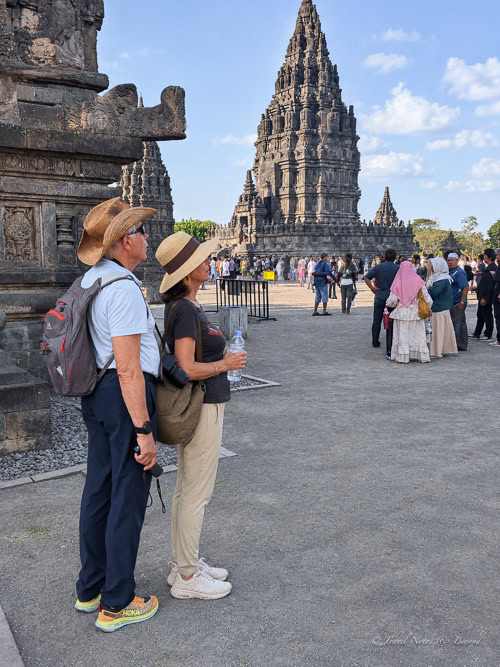
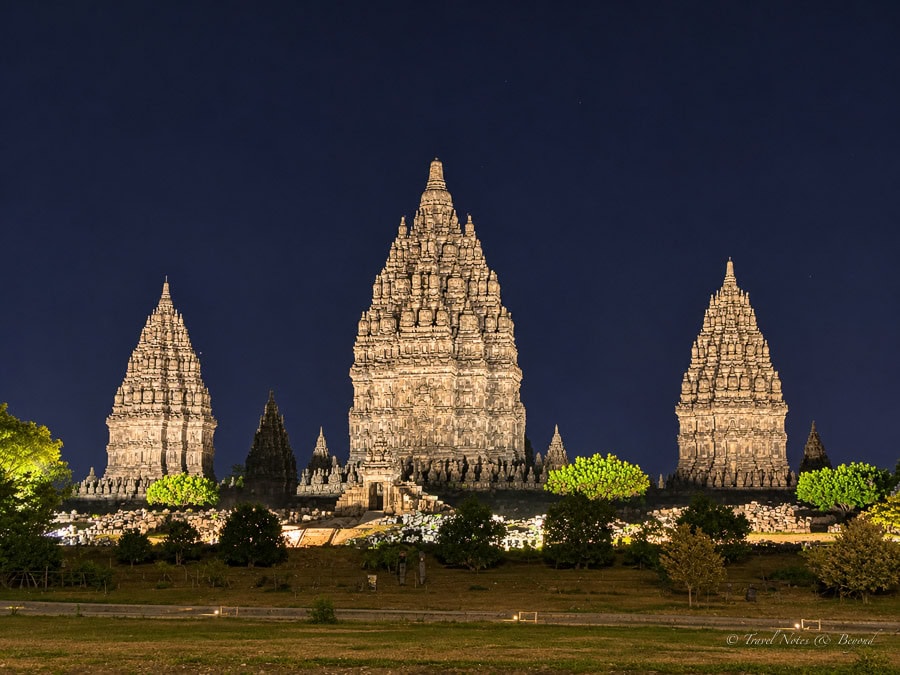
Prambanan’s ticket counters are open daily from 6:30 AM to 5:00 PM, and the temple grounds stay open until 5:30 PM. If you don’t want to feel like you’re walking inside a giant stone oven, show up right when the gates open or wait until after 3:00 PM. Keep in mind that the central courtyard has almost zero shade, and the midday heat in Java can be brutal. We came around 3:30 PM and the afternoon heat already felt like it was cooling down. Staying late also lets you catch the sunset. Watching the dark silhouettes of the temple towers stand out against the glowing evening sky is unforgettable.
There is one mistake you definitely want to avoid: don’t plan your visit for a Monday. While the outer park stays open seven days a week, staff close the raised inner courtyard around the three main towers on Mondays for maintenance. You can still walk the outer paths and check out the Buddhist temples, but you won’t get anywhere near the famous spires.
Don’t Miss the Ramayana Ballet
Even if ballet isn’t usually your thing, this performance is well worth staying for. The show blends traditional Javanese dance with theatrical pantomime to act out the love story of Rama and Sita. Live gamelan music, dramatic gestures, and real fire bring every scene to life. Best of all, the illuminated temples glow right behind the open-air stage.
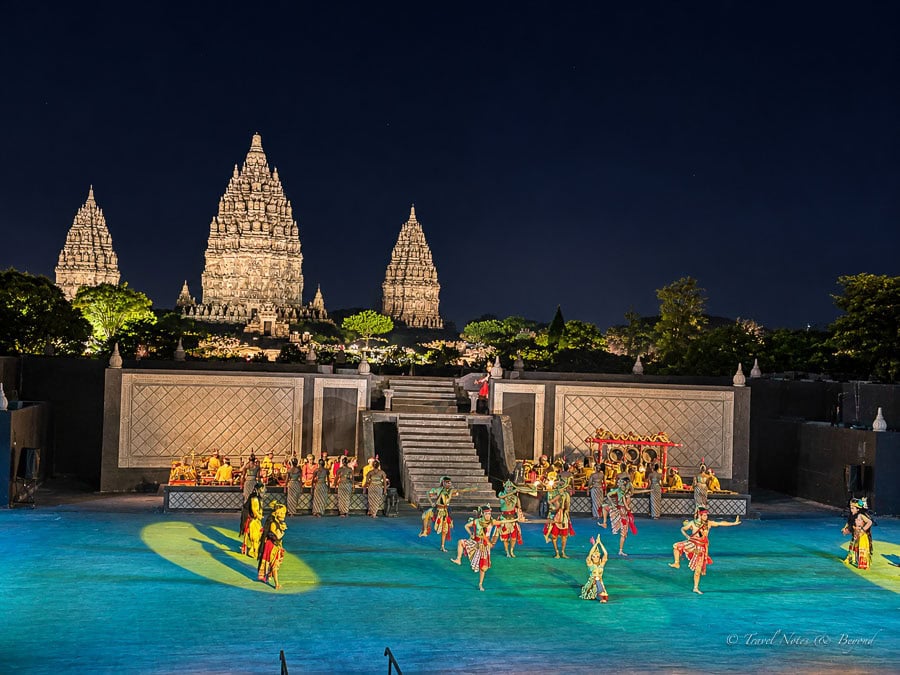
Performances run Tuesday, Thursday, and Saturday at 7:30 PM. From May to October, they take place on the open-air stage. From November to April, the show moves indoors to the Trimurti Theater.
If you’re at the open-air stage, bring something soft to sit on. Outdoor seating is really rough, literally bare stone benches built at a rigid 90-degree angle. Sitting upright on hard stone for two hours gets pretty tough on your back, so pack a folded jacket or scarf for extra padding, or book one of the cushioned VIP seats.
Prambanan Temple Ticket Prices
Foreign visitors pay a higher entrance fee than locals, so the ticket price for us was IDR 400,000 for adults and IDR 250,000 for children (ages 3-10). The ticket covers the entire archaeological park, including Candi Lumbung, Candi Bubrah, and Candi Sewu.
If you plan to visit both monuments, you might spot the Borobudur and Prambanan combo ticket and think you’re saving a few bucks. Skip it, because it’s simply not worth it. That combo pass only covers Borobudur’s outer grounds, meaning you aren’t allowed to climb the temple itself. And honestly, who travels all the way to Java just to look at Borobudur from the grass? Instead, buy your Prambanan ticket separately, and book a dedicated Borobudur structure ticket with a timed entry slot and mandatory guide first. Then fit Prambanan around it.
What to Wear when Visiting Prambanan Temple
Prambanan is an active sacred site, so the dress code requires you to cover your shoulders and knees. If you wear lightweight long pants or a below-the-knee skirt, you can walk straight through the gate without needing a sarong. But if you show up in shorts or a short skirt, the staff will hand you a batik sarong at the entrance to wrap around your waist. Respecting local customs and religious traditions is one of the simplest aspects of responsible and sustainable travel.
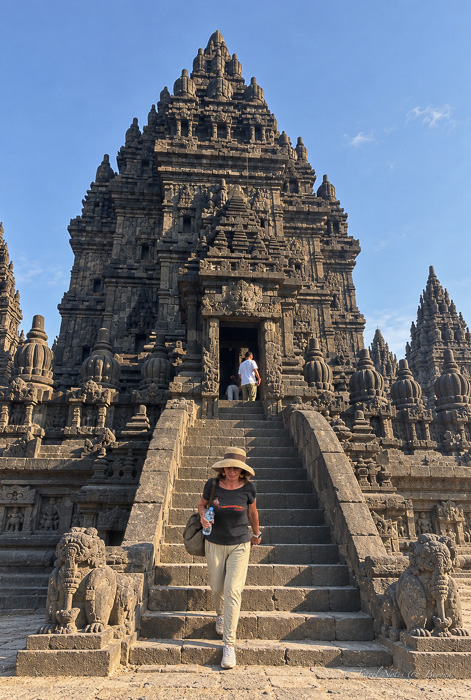
Beyond the dress code, you should dress for serious sun and steep climbs. Wear sturdy, comfortable shoes with good grip for the narrow, uneven stone stairs leading up into the temples. Pack plenty of water, sunscreen, sunglasses, and a hat, since the central courtyard offers almost no shade. Visitors receive one small complimentary bottle of water (pick it up at the visitor center just past the entrance), but you should still bring extra water.
How to Get to Prambanan Temple from Yogyakarta
Prambanan sits about 17 kilometers east of central Yogyakarta, which makes it super easy to reach on your own without having to pay for an organized day tour.
If you want the easiest door-to-door ride, use Grab or Gojek. The trip takes roughly 30 to 40 minutes depending on traffic, and the driver drops you right near the entrance gate. Or you can hire a car and driver for half a day, just like we did, since we stayed late for dinner and the ballet.
If you’re traveling on a tight budget, catch the TransJogja Bus (Line 1A) from Jalan Malioboro. It costs just a few thousand rupiah, runs frequently throughout the day, and drops you at Prambanan Terminal, about a ten-minute walk from the ticket counter.
Prambanan vs. Borobudur: Should You Choose One Over the Other?
Having to choose between these two majestic structures would be a very difficult decision, as each offers an unforgettable window into ancient Java. Let’s first see what makes them alike before discussing how they differ.
What Connects Them
Although artisans built them decades apart during Java’s classical golden age, both monuments feature extraordinary volcanic-stone artistry assembled entirely without mortar. Both temples have UNESCO World Heritage status, and honestly, they earned it. They survived centuries of volcanic ash, earthquakes, and encroaching jungle before being brought back to life. They sit roughly 90 minutes apart on opposite sides of Yogyakarta. Because they share this cultural hub, you can easily visit both in a single trip.
Where They Differ
Beyond their shared history, they differ not only in architectural style and size, but also in religious purpose. One is a massive, unified structure with 9 stacked platforms and 504 Buddha statues. The other is a sprawling compound of 240 original temples and shrines. The visitor experience is also very different.
Borobudur makes you swap your shoes for clumsy slippers and follow a guide who won’t stop talking, turning a bucket-list climb into a rigid routine. I understand the need to protect these ancient monuments from the effects of overtourism, but Prambanan seems to have struck a better balance between conservation and visitor experience.
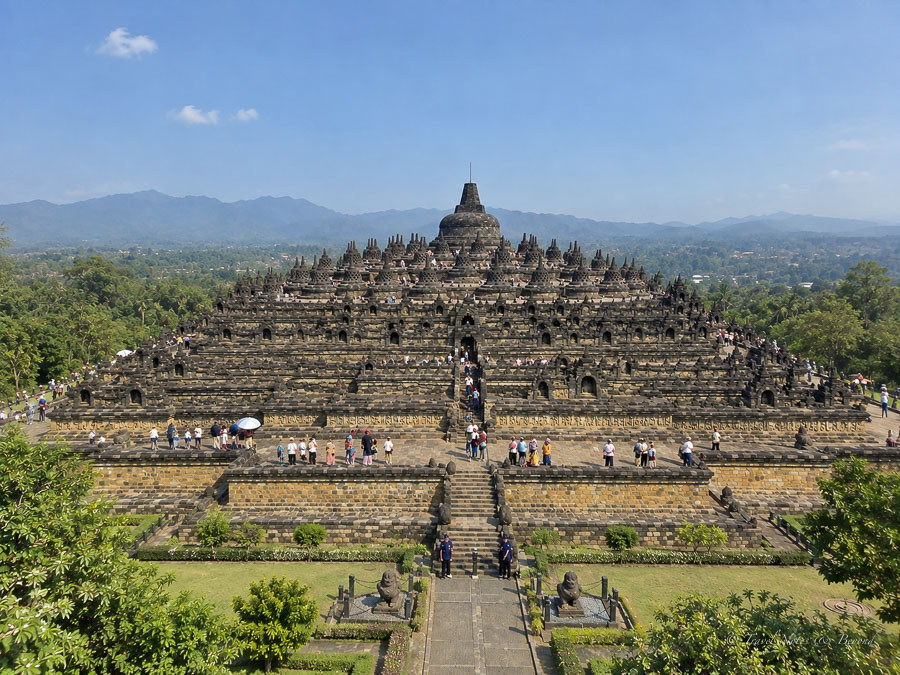
At Prambanan, you simply walk in, keep your sneakers on, and explore the spires freely at your own pace. Nobody keeps you from climbing into each temple and spending as much time as you want there.
Which One Should You Choose?
Choose Borobudur for its unmatched scale and sweeping views across the Kedu Plain, and Prambanan if you want towering Hindu architecture, unhurried exploration, and evening cultural performances. But honestly, you don’t actually have to choose. Start at Borobudur in the morning (while your patience for guided tours is still fresh), take a midday break in Yogyakarta, and head to Prambanan in the late afternoon. You’ll catch golden hour on the spires, wander entirely at your own pace, and finish the day with the open-air ballet, with no agonizing decision required.
You May Also Like:
anda
Enjoyed this guide?

Get my new travel guides and stories in your inbox. No spam, and you can unsubscribe anytime.