
Some links in this post earn me a small commission, at no extra cost to you.
If you are wondering whether Romania is worth visiting, you probably heard a thing or two about my country of birth. Sadly, for most westerners, Romania is this former Eastern Bloc country of Nadia Comaneci – the famous Romanian gymnast who scored the first perfect 10 in Olympic history at the 1976 Montreal Games. But there is so much more to Romania than just the name of a great gymnast.
There are many reasons to visit Romania. For one thing, it’s a very beautiful country, blessed with dramatic scenery, medieval towns, painted monasteries and genuinely welcoming people. It also has a recent history that explains why so few travelers have it on their list.

Why Romania Stayed Off the Tourist Map
I lived in Romania through the Communist era, and back then there was almost nothing to visit. Not because the country lacked beauty. The scenery was there, the citadels were there, the painted monasteries had been standing for five hundred years. But the infrastructure was terrible: bad roads, slow and crowded trains, hotels barely existed outside a handful of Black Sea resorts, and most fortresses and monuments were crumbling with no money and no interest in fixing them. Tourism was not a priority for a government that preferred foreigners didn’t wander around too freely.
After Communism fell, that changed slowly at first, then all at once. Historic centers got restored, guesthouses opened in villages that had never seen a tourist, and the roads eventually caught up. Romania is a completely different country to travel in than the one I left.
11 Reasons to Visit Romania Now
If you’re still not sure Romania belongs on your European itinerary, here are several reasons I think it does.
1. Beautiful, Old Architecture
You’ll find beautiful old architecture throughout the country, but especially in Bucharest, where you’ll encounter a lot of elegant structures built between the First and Second World Wars. At that time, Bucharest was nicknamed Little Paris and you can still see why. Walk down Calea Victoriei and you’ll pass the Romanian Athenaeum, the CEC Palace and a run of Belle Époque mansions with wrought-iron balconies.

Sadly, among the city’s great art-deco and 19th century buildings you’ll also see some new modern blocks of flats. Those blocks aren’t an accident. In the 1980s, Ceaușescu demolished entire neighborhoods to build them, along with the Palace of Parliament, still the heaviest building in the world.

Many of the historic buildings downtown have since been restored, while others are crumbling behind scaffolding that hasn’t moved in years. Bucharest is a mixed bag and I won’t pretend otherwise, but it has a charm you can’t deny.

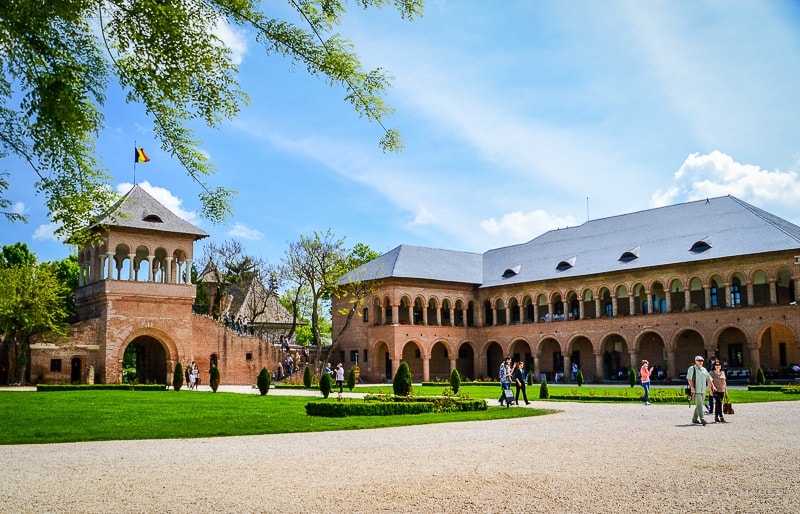
The rest of the country holds its own. Oradea has some of the finest Art Nouveau in Europe, Timișoara’s Habsburg squares could pass for Vienna, and Iași has its neo-Gothic Palace of Culture. For something purely Romanian, look for the Brâncovenesc style, a blend of Byzantine, Ottoman and Renaissance, at Mogoșoaia Palace outside Bucharest.
2. Amazing Churches
From wooden churches and painted monasteries, to synagogues and grandiose cathedrals, Romania has a multitude of beautiful worship places. They also vary in style by region. In Maramureș they’re built entirely of oak, with spires so thin and tall they look like they shouldn’t hold. In Transylvania they’re fortified, with walls the whole village hid behind during Ottoman raids, while in Moldova they have the famous painted monasteries.

During the Communist era, many of the old, historic churches in Bucharest were demolished. But a good number of them survived only because an engineer put them on rails in the 1980s and rolled them out of the path of Ceaușescu’s bulldozers.

The European Union invested serious funds into rebuilding some of the historic areas in the country. As a result, most of these beautiful religious monuments regained their initial glory.
3. It’s easy to visit
Romania joined the Schengen area fully in January 2025, so you can now cross in from Hungary or Bulgaria without stopping at a border, and fly in from anywhere in Europe with no passport control. For most visitors, including Americans, all you need is a passport.
Tourist attractions in Romania are easy to visit because you won’t encounter as many restrictions and limitations as in other countries. You can walk just by yourself in a castle without having to wait for a guided tour. Also, you can take pictures in an old church, as long as you are not disturbing the worshipers.

Historic sites aren’t overcrowded, though that’s changing. Every year there are more people in the places that used to be empty.
4. Gorgeous Scenery
Romania packs a lot into a small area. The Carpathians curve through the middle of the country, topping out at 2,544 metres on Moldoveanu, and within a few hours’ drive you go from alpine ridges to rolling Transylvanian hills, then down to the plains, the Danube Delta and the Black Sea. There is a great abundance of unique places to visit in Romania.

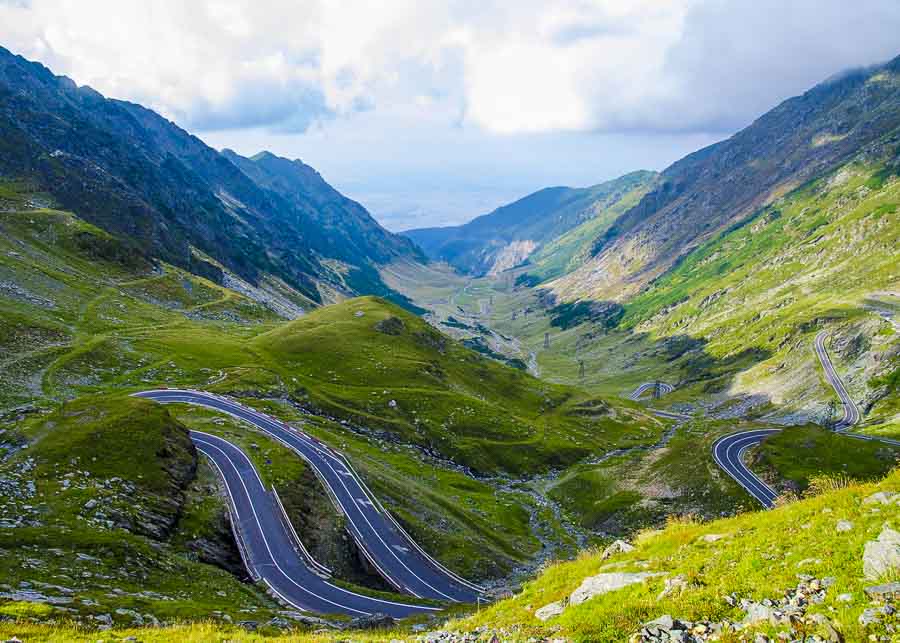
Two mountain roads cross the Carpathians and both are worth planning a trip around: Transalpina and Transfagarasan. They both run at very high altitudes, with twists and turns and deep ravines, equally beautiful and dangerous. Both close for winter and open as late or as early in the spring as the weather permits.
5. Beautiful Castles and Fortresses
Romania has an unusual number of castles and fortresses for a country its size, and no two of them look the same. Some of them, like the elegant Peleş, Bran, or Corvin Castle, are famous throughout Europe. Others are less known but equally impressive. Sadly, most of these castles and fortresses suffered tremendous neglect over the centuries and remained in a dismal state until the fall of Communism. But in more recent years, Romanians began rebuilding and restoring many of these historical buildings.

If you have a few days to spare, a road trip in Transylvania will get you to the most famous ones. But if you have more time, you can easily put together an itinerary that takes you to royal residences, fairytale fortresses, eccentric folly castles, and aristocratic estates that will truly impress you.
6. It’s affordable
Romania is still one of the cheapest countries to visit in Europe. Within the EU only Bulgaria is cheaper, with Romanian prices sitting at about 65% of the EU average, and Romania is the cheapest country in the union for both food and anything in the culture category, from museums to concerts. On a mid-range budget you can travel here comfortably on €30 to €50 a day, and a meal in an ordinary restaurant, not a tourist one, runs €8 to €12.
It isn’t the bargain it was ten years ago, though. Inflation ran above 10% this year, with services up nearly 14% and restaurants and hotels around 12%. Bucharest, Brașov and Sibiu have caught up the fastest, so if you want your money to stretch, spend more of your time in smaller towns and villages.

Getting around is cheap too. Admission fees and public transport cost very little, and trains reach most of the country for a few euros. Although the cheapest way to travel in Romania is by rail, trains don’t always run on time or at a very high speed. So if you want to get somewhere faster, buses and low-cost airlines connect the bigger cities to the rest of Europe for very little.
Romania is also great to visit if you are backpacking through Europe. With so many low cost accommodations and restaurants, you’ll not have to dig deep into your pockets in this country.
7. Delicious Food and Historic Restaurants
Tasty food has always been a part of the Romanian culture. Almost anywhere you eat the food is really good – even in the small hole-in-the-wall eateries, or cantinas. Despite having some Hungarian, Germanic and Turkish influences, Romanian cuisine still maintains its identifiable character. An example would be the classic sour soup (“ciorba“) made with “borş” (a sour liquid made from fermented wheat bran). Or the fried mutton pastrami with polenta. So if you like to eat, chances are you’ll most likely gain a few pounds when you visit Romania.

But besides tasty food, Romania is also home to many excellent restaurants that specialize in traditional Romanian dishes, but also fine-dining restaurants that specialize in international cuisine.
Some of the best restaurants in Romania are in Bucharest, like Caru’ cu Bere, Hanu’ lui Manuc, Hanu’ Berarilor, etc. There are also several good vegan restaurants in Bucharest for those interested in eating vegetarian food.
8. Beautiful Cities, Medieval Towns and Old, Authentic Villages
Romania is home to many beautiful cities. While they don’t hold the glam of their counterparts in Western Europe, they are equally fun to visit. There are also many beautifully preserved medieval towns, like Brasov, Sighisoara, Sibiu, Cluj, or Alba Iulia. Visiting these citadels makes you feel like you’ve stepped back in time.

Throughout Transylvania and Maramureş there are villages that remained almost unaffected by modern civilization and still look like they did three centuries ago. Like for instance the villages of Viscri, Biertan, or Vişeu de Sus, where you can ride the Mocānița, one of those nostalgic steam engine locomotives.

9. The Danube Delta
Where the Danube finally reaches the Black Sea it stops behaving like a river. Instead, it spreads out into 1.5 million acres of channels, lakes, reed islands and willow forest. There are no roads, so you can only get there by boat from Tulcea. And once you are on the water, the only sounds are the boat engine and the birds. This is the best preserved delta in Europe and the second largest after the Volga. Plus it’s home to hundreds of species of birds, particularly two species of pelicans, herons, storks, cormorants and terns. It holds the biggest reed bed in the world, and UNESCO put it on the World Heritage list in 1991.

You don’t have to be a bird-watcher to want this. People live out here in a couple dozen villages you can only reach by water. They fish and live the same way they have for generations. Spending a slow two or three days in the Delta is a very unique travel experience.
10. The Painted Monasteries of Bucovina
Among the most picturesque churches in Romania is a group of 8 Painted Monasteries located in the northeastern part of Romania, in Bucovina. The churches date back to medieval times (15th to 16th century). In most cases they have been founded as burial places for the noble families in the area.
These churches are extremely well preserved and absolutely unique. There is no other place in the world where you can find such a group, with such high quality interior and exterior frescoes. The frescoes represent biblical scenes from the Old and New Testament.

The painters (most of them unknown) gave the biblical scenes their own interpretation. Also, they used colors that are specific to each monastery. Like the famous Voronet blue, the red of Humor, the yellow of Moldovita and the green of Arbore.
The Byzantine frescos covering the churches’ façades have an inestimable artistic value. In 1993, eight of the Painted Monasteries of Bucovina were declared World Heritage sites.

READ NEXT: Curtea de Arges Cathedral: from Legend to History and Back
11. Friendly people
In the end, no matter how beautiful a country is, it is its people that will make the difference. Romanians have the reputation for being very hospitable and friendly. The best part is that almost everywhere you go you’ll find someone who speaks English, especially the young generation.
And even if they don’t, they will do their best to accommodate you or point you in the right direction. In fact they may even offer to accompany you to where you need to get if that’s not very far.
FAQ About Visiting Romania
No. Romania uses the leu, and being in the EU and Schengen doesn’t change that. Cards are accepted almost everywhere in cities, but carry cash for villages, small guesthouses and rural churches.
Very. The US State Department puts Romania at Level 1, exercise normal precautions, the same tier as Germany and Japan, and Bucharest’s crime index of 28.5 is well below London’s 55.7. Pickpocketing in train stations and taxi overcharging are the realistic risks. The genuine danger is the roads: Romania has the highest traffic fatality rate in the EU, about 77 deaths per million people against an EU average of 44. Drive defensively and avoid long stretches of rural road at night.
Seven to ten days covers Bucharest, Brașov, Sibiu, Sighișoara and the main castles at a reasonable pace. Two weeks lets you add Maramureș, the painted monasteries in Bucovina or the Danube Delta. Anything under five days and you’re picking one region.
No, but it’s no longer dirt cheap. Prices sit at about 65% of the EU average, second lowest in the union after Bulgaria, and €30 to €50 a day covers mid-range travel. Inflation has been running above 10%, and Bucharest, Brașov and Sibiu have caught up fastest.
May and June, or September. You get warm weather without August crowds or August prices. If your trip depends on driving the Transfăgărășan or the Transalpina, wait until July, because the high sections often don’t open until mid or late June.
Not for short stays if you’re American, British, Canadian or Australian. Romania joined the Schengen area fully in January 2025, so you can also cross in from Hungary or Bulgaria without a border stop. ETIAS, the new €20 EU travel authorization, is expected sometime after late 2026 and has already slipped several times, so check before you book.
Why You Shouldn’t Postpone Visiting Romania
Romania is one of the least expensive countries to visit in Europe, but this is changing. One thing to keep in mind is that Romania’s popularity is rising fast. After the collapse of Communism in Europe, its tourist industry started developing fast and the country began catching up with its neighboring competitors.
Romania was once underestimated destinations, but not any longer. So in a near future, you’ll be seeing higher prices, like almost everywhere else in Europe. My advice would be to include this beautiful destination in your travel plans while it is still cheap to visit.
YOU MAY ALSO LIKE:
anda
Your article perfectly captures why visiting Romania now is a fantastic idea. Romania offers beautiful architecture, stunning churches, ease of travel, gorgeous scenery, castles, affordability, delicious food, charming cities, the Danube Delta, painted monasteries, and friendly locals. Don’t delay your visit; Romania has it all!
Best regards,
A Romania Enthusiast
These photos are breathtaking! Thanks for sharing your experience!
Thank you, Renee.
Great post about my home country. Like you, I grew up there, and left about 25 years ago. We grew up in a magical place, and it took me years after I left to realize it. Thanks for the reminder. Beautiful photos!
How nice, I didn’t realize you you are from Romania. So good we found each other.
I recommend you to visit: Bigar cascade, mud volcanoes, Turda Salt Mine, The Danube Delta, Transfagarasan.
Thanks for your suggestions, Alex. I’ve been on the Transfagarasan and in the Danube Delta. Don’t forget I was born in Romania. However, I didn’t see the Bigar waterfall, Turda salt mine or the Mud Volcanoes, but I’d love to.
I’m so excited to be visiting this country soon as part of our honeymoon! We’ll be spending about 4 days there beginning of June!
Hope you’ll have a good time in Romania, Lolo. Can hardly wait to hear your impressions about it.
This seems really cool, I’m flying in soon on a business trip, I’ll make sure to check it out. I usually travel with Bucharest Transfers. I hope they will know how to get there, they have not let me down so far.
Vlad’s been making a really great case for Romania for the last couple of years, and now you’re helping too! It’s creeping farther and farther up on my list, mostly because of the castles and the bucolic countryside.
I’m glad to hear you’d love to visit Romania, Anna. It’s a beautiful country.
Hey, I couldn’t help thanking you for the way you described our country. I am romanian and I’m proud to see other people notice what a beautiful country we have and actually seeing the good not just the bad. Greetings from Danube Delta.
You are welcome, Paula. Don’t forget, Romania was my country too and although I left for political reasons, I can’t deny its beauty.
I loved Romania, it was just beautiful. I will definitely head back one day 🙂
Thank you, Jess. Romania is beautiful indeed and it’s still very inexpensive.
Couldn’t agree more! Went to Romania for the first time this year and have my next trip already booked 🙂
Glad to hear you liked Romania, John. Is my birth place.
Hi, Anda,it’s so nice to see you show others that there are some very beautiful places worth visiting in Romania. Asides from medieval towns, the charming countryside and everything else, it’s also very easy to for a swim in the Black Sea and then hiking on the mountains in the same day (depending on the traffic, as we all know too well). I’m certain that Romania will become a more and more popular travel destination.
Thank you, Luminita. I appreciate you taking the time to read my post. I’m sure Romanian tourism will pick up in the near future. After all, this is such a beautiful country!
Thanks for your comment, Dan. “Small country” in this case was used a term of endearment rather than a reference to the size of the Romania.
Anda, I haven’t realized that you are from Romania until today:) I visited a couple of times when I lived in neighboring Moldova and then spent a month there about 20 years ago. I loved it. if you hadn’t include the people as one of the reasons, I would have! they were this country’s most prominent feature for me- so friendly and well cultured. I stayed in Buchurest, Sinai, and Neptun on the Black Sea. I hope I return one day with my kids.
So glad to hear you like Romania, Victoria. It seems we were neighbors for a long time, while we both lived in Europe. You know that Romanians still claim Moldova is theirs…
Romania is well known all over the world for its rich natural beauty as well as stunning heritage sights. Its villages and valleys are breathtaking and awesome. It is also very famous due to its amazing castles and churches. I have been there about a year ago after completing my USA trip with my family. Peles Castle is my favorite attractions there. It was built at the command of the first Romanian king.
I am really glad you enjoyed your trip to Romania. This country had a very sad and tumultuous history that kept it behind for centuries. Its beautiful sites have been neglected for a long time too but now things started to change for the better. Thank you for your beautiful comment.
Hi Anda, I feel the same way about my hone country, the Philippines. I have so much appreciation of it now then when I was still living there. Thank you for sharing the beauty of yours. I look forward to visiting Romania someday. Those old authentic villages that are frozen in time truly interest me. I’d love to see its beautiful landscapes, monasteries, architecture and meet its lovely people.
I hope you will get to visit Romania someday, Marisol. You’ll definitely enjoy the visit.
I’ve only seen a little part of Romania. I always wished I had gone further into the country. It really is beautiful and with such unique architecture.
There is still time to visit it, Adelina. Maybe next time you are in Hungary…
The first five are enough for me. Hope I can go there next year.
I hope you’ll like Romania, David.
I love your photos. Even the “old building in need of repairs” looks stunning. Thank you for writing this post. I rode through Romania on the train on my way to Bulgaria very long time ago, but the trip did not include stopping there. I hope I’ll get to see this beautiful country some time. I’m also pinning your post to my “East Central Europe” Pinterest board, hoping that travelers who come across that board while planning a trip to Central East Europe will find your post interesting as well, and maybe put Romania on their itinerary.
Thank you, Jolanta. I’m very thankful to you for sharing my pictures on Pintrest. I hope you’ll get to visit Romania someday.
Your information is great, and – WOW – those photos! Just tantalizing! I’m in Central Europe but haven’t thought much about visiting Romania. This definitely piqued my interest. Cheers.
Glad to hear that. I hope Romania will meet your expectations.
I can’t wait to visit Romania! I’m pleased to hear of their friendly nature, especially since I’ll be solo! Everything from their castles to their churches look breath taking and so unlike anything I’ve seen thus far!
I’m so glad to hear that my post made Romania look appealing to you. I hope you’ll have a wonderful visit there.
Oh my! This looks absolutely stunning. I will have to show this to my husband in a bit… we may have a new holiday destination on our hands!
Glad to hear you like Romania, Esther. I have more recommendations for you if you if you decide to go there.
I have always found Romania interesting and intriguing. What an absolutely stunning place with so much to offer for everyone. The churches and castles alone are such big draws for me. Beautiful photos!
Romania has many more attractions than the ones I listed.
So nice to read about a country we don’t hear very much about :-). Bucharest sounds interesting with all its historic buildings (even though many are in disrepair). And your photos are lovely…
Thank you, Janice. Unfortunately, Romania is still in the group of the overseen Eastern European countries, but it has vary many interesting things to offer.
I’m sold!! I want to go! You’ve listed some great reasons to visit for sure. Love the photography too.
Thank you for your beautiful comment. I’m sure you would not regret visiting Romania. And if you were to do it, it’s better to go before it turns into a touristic place like any other.
You were faster than me, I am planning a couple of posts on Romania as well 🙂 Excellent reasons (especially the first 3) and as always, stunning photos!
Thanks Vlad. There are so many other reasons to visit Romania. I’m sure that as a local you can come up with great suggestions.
Great post! I should mention that a limiting to 10 will necessarily leave out stuff! Romania is a famous hunting destination for Boar, Bear and Deer. It is a treasure trove of folk art and rural civilizations, amazingly diverse, surviving live into the 21st Century, as well as one of the greatest places on earth for artifacts of ancient civilizations going back to Europe’s Stone Age.