
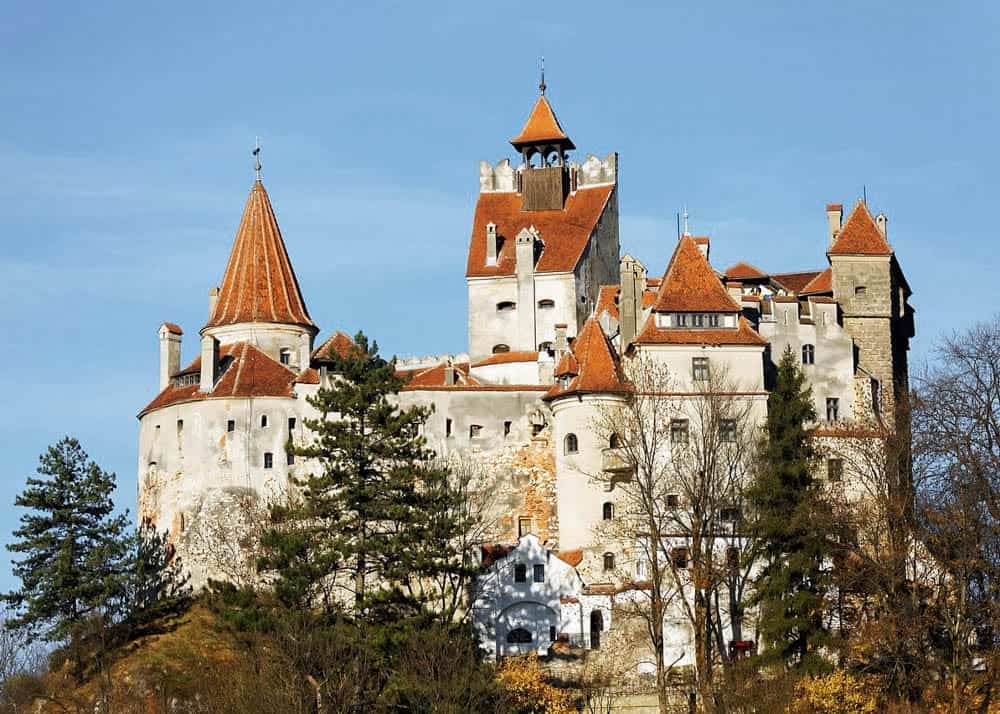
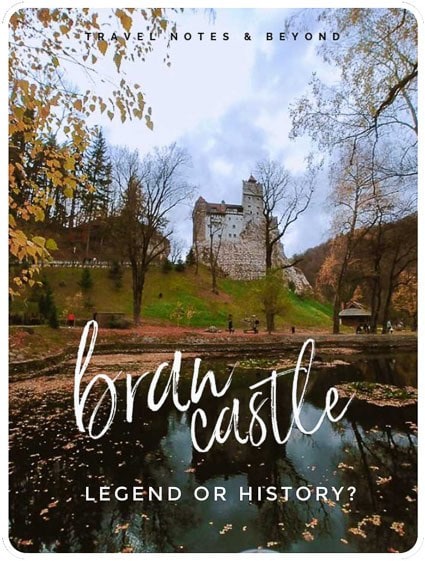
From its rock foundation near the riverbed, the imposing silhouette of Bran Castle rises majestically above the valley below. A somber and solitary structure that seems to be gazing down upon the hordes of visitors flocking at its gates. For most people, Bran Castle in Romania will evoke one name only: Dracula, the bloodthirsty character from Transylvania. But is Bran the real castle of Dracula? And did Dracula really exist, or he is just a fictitious character? The answer may surprise you!
Dracula and His Castle: Legend vs. History
All historic evidence indicates that Bran Castle was never Dracula’s castle. Count Dracula, the sadistic prince condemned to live off the blood of the living people for eternity, was the creation of Bram Stoker, a 19th century Irish novelist.
Inspired by the stories and legends of Transylvania, whose local population believed in strigoi (vampires), Stocker placed his character in a fortress that perfectly fits the description of Bran Castle.
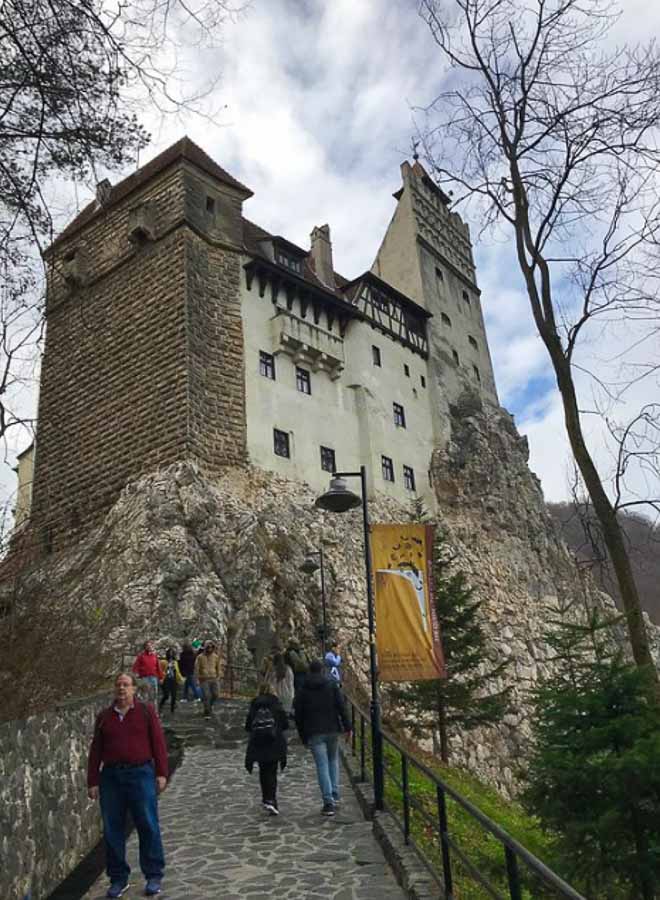
But in reality Bram Stoker never visited Romania. He depicted Dracula’s castle based on a description of Bran Castle that was available in Britain in the 19th century.
Connection to Bram Stocker’s Dracula
How about Dracula? Who inspired this character? Let’s examine the historical roots of the legendary vampire.
Although Dracula is an imaginary creation, Stoker named his infamous character after a real person: Vlad Tepes (the Impaler). Vlad the Impaler was Prince of Wallachia between 1431 and 1476. The cruel methods he used for punishing his enemies, made him a legend. Vlad was famous for beheading, boiling, burning and skinning his enemies alive.
One of the greatest examples of his cruelty was at the time when he used a forest of corpses to shock and repel an invading Ottoman army. But despite being portrayed as a sadistic and ruthless despot, Vlad Tepes was a great military leader and a hero to his people.
The character’s name – Dracula – derives from an appellation of Vlad II (Vlad Tepes’s father) who was also called ‘Vlad Dracul.’ The name Dracul, although translated in Romanian as the Devil, was in this case a title of the knightly Order of the Dragon, whose mission was to defend Christianity.
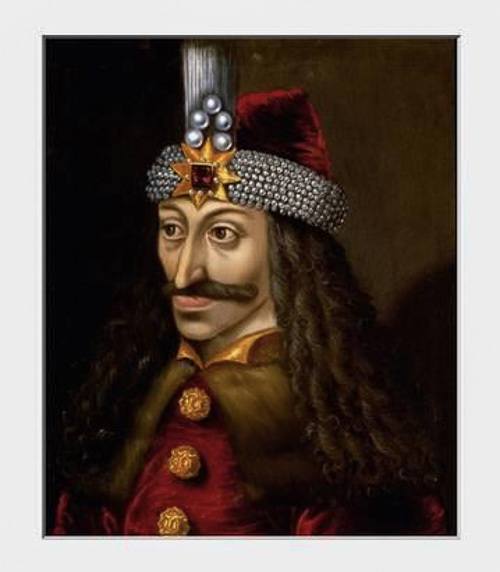
Vlad the Impaler’s only connection with Bran was through an alliance with the Princes of Transylvania who asked him to handle the anti-Ottoman resistance at the border. Some historic records also indicate that Vlad may have actually been a prisoner in Bran Castle for some time, before they transferred him to another prison near Budapest. His real castle was in fact at Poenari, which is now in ruins.
Is Bran Castle Worth Visiting?
If you’re a Dracula aficionado, this question may seem pointless. And yet, if you arrive determined to find the castle Bram Stoker describes in his novel, or the residence of Count Dracula himself, you may walk away disappointed. Neither ever existed here. There are no coffins, no crypts, no trace of the fanged count. Only the legend that clever marketing wrapped around these stone walls.
But if you come to see one of Romania’s most beautiful and historically rich castles — a place where real people lived real lives — then yes, Bran is absolutely worth the visit. This is where Queen Marie made her favorite royal home, where a secret tunnel hides behind a fireplace, and where centuries of Transylvanian history are layered into 57 rooms perched above a mountain pass. The story here isn’t fiction. It’s better, because it’s true.
My honest advice: come for the history, the architecture, and the views, not for vampires. Set your expectations accordingly and you’ll leave enchanted. Arrive at opening time to beat the tour buses. By late morning the line snakes all the way through the market to the main road, even in the off season.
A Brief History of Bran Castle
Like many other castles in Romania, Bran was at first a military fortification built by the Teutonic Knights in 1211. In 1377 the Hungarian King Louis I of Anjou granted the people of Brasov the privilege of building a castle over the fortress ruins.
The location of Bran fortress was very strategic: up on a high cliff within a narrow gorge, on the passageway between Transylvania and Wallachia (in old Romania).
Over the course of history the fortress changed hands many times. It passed from King Sigismund of Luxembourg to his ally, Prince Mircea the Elder of Wallachia, then to the Princes of Transylvania.
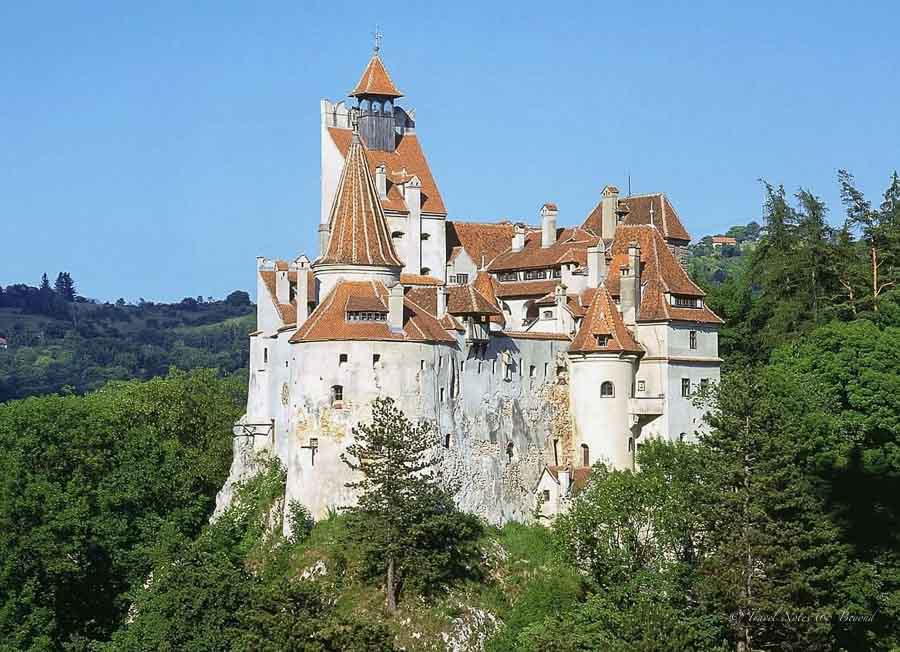
In 1500, one of the Kings of Hungary who owned Bran at the time, borrowed a large sum of money from the town of Brasov, mortgaging the Castle. But after the expiration of the term, the Hungarian King wasn’t able to repay his debt. As a result, Bran Castle became the property of the town of Brasov who transformed it into a customhouse for the merchants crossing the Bran Pass.
READ NEXT: What You Should Know About Romanians Before You Travel to Romania
Bran Castle in Modern Times
By 1836, after the border between Transylvania and Wallachia moved to the mountains, Bran fortress lost its military importance. The Revolution of 1848 left the magnificent medieval fortification in ruins.
In 1920, after Transylvania became part of Greater Romania, the castle became the property of Queen Marie of Romania. The Queen turned it into her favorite royal residence in the years after the First World War.
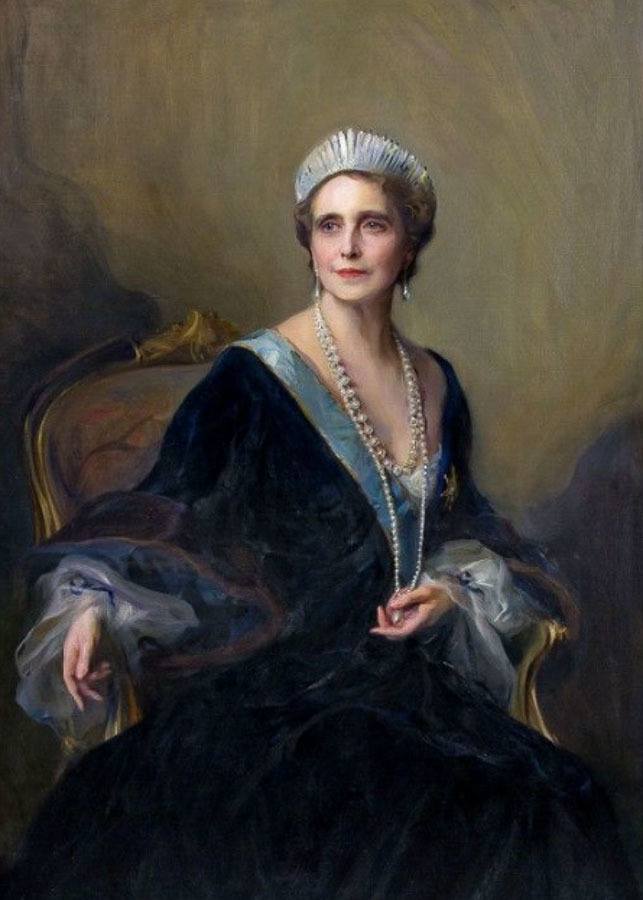
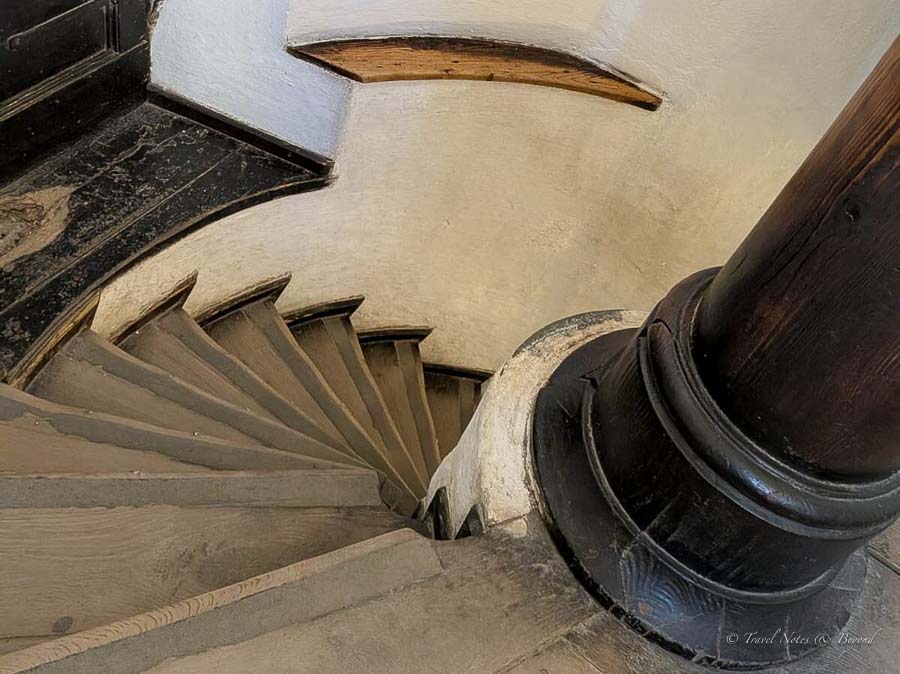
Extremely talented and a very astute decorator, Queen Marie used her feminine touch to transform the place into a fairytale home. She enlarged the windows, built new spiral stairs, installed telephone lines, tap water and electricity and even an elevator.
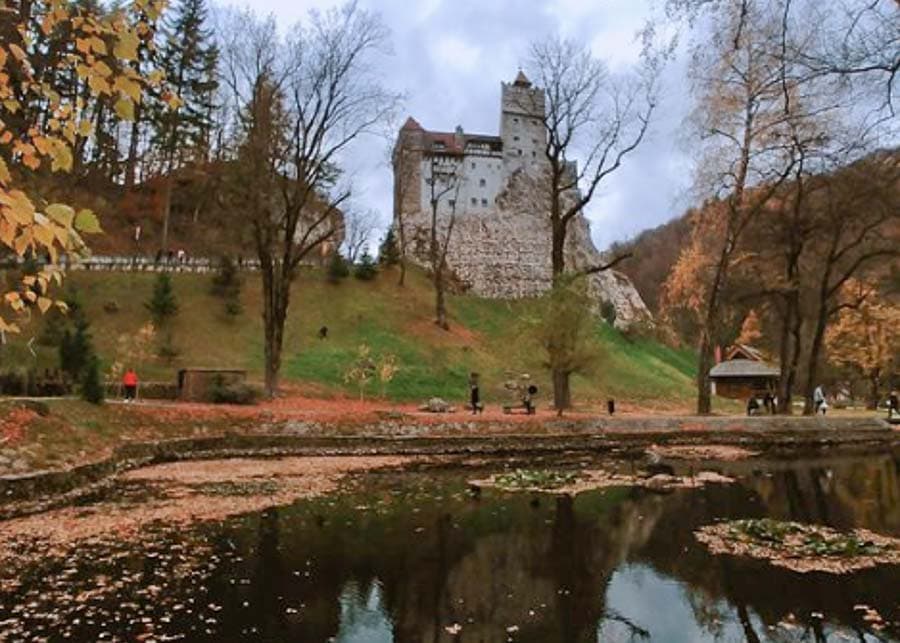
She turned the area around Bran Castle into an English park with two ponds and a Tea House. Queen Marie also added a guesthouse, a wooden church, staff housing, stables and a garage.
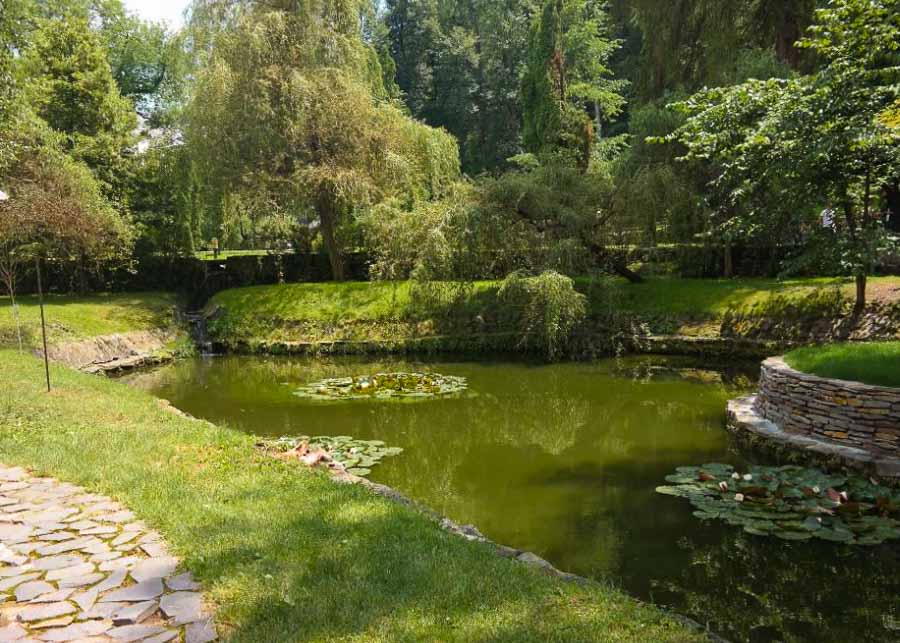
After the Queen’s death in 1938, Bran Castle became the property of Princess Ileana, the Queen’s daughter.
In 1948, the newly installed communist regime in Romania seized all the royal properties. As a result, Bran Castle became the property of the Romanian State.
In 1956 the Castle became a museum with three departments: Royal Heritage, Medieval Customs and Ethnography. Currently, Bran Castle fully re-entered in the possession of its legal heirs: Archduke Dominic, Archduchess Maria Magdalena and Archduchess Elisabeth, the three children of Princess Ileana.
What to Look for Inside Dracula’s Castle
The castle itself is not very big, but it holds a few secret places that you could miss if you are rushing through it. There is a total of 57 rooms and an abundance of hidden corners, a beautiful winding wooden staircase and an enormous number of weaponry and armor that dates back to the 14th to the 19th centuries.
Here is what you should visit on your tour:
The Old Water Well
When visiting Bran Castle you’ll notice the top of a water well in the courtyard, but no well. The well is not just ornamental though. Back in the 14th century when the fortress was built, a 60 feet deep well was dug here through the solid rock. Also carved in the rock, just above the water level, there was secret room that served as a hiding place for the castle’s treasures in case of an attack. So what happened to the well?
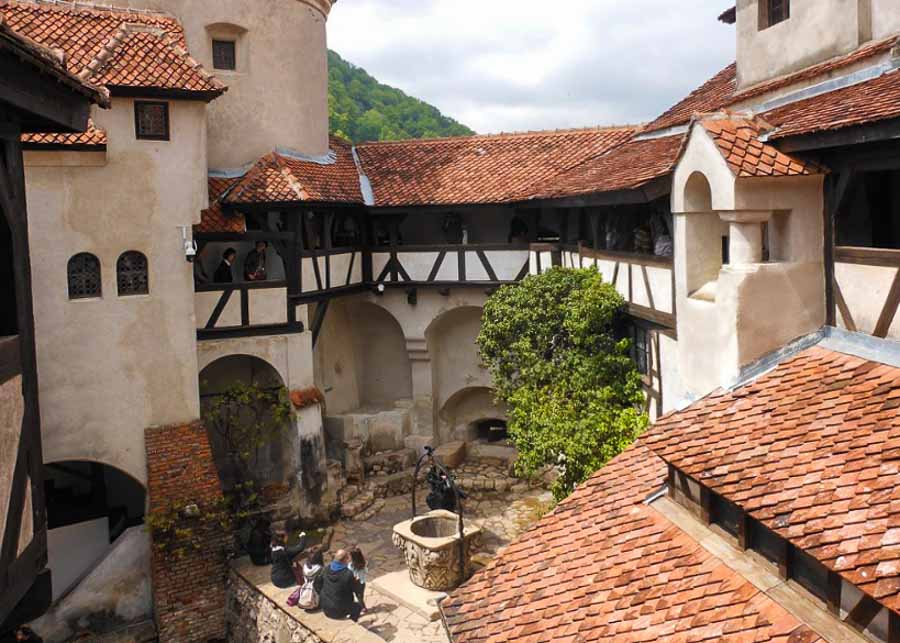
When Queen Marie remodeled Bran Castle, she extended the secret room into a corridor that reached out at the bottom of the cliff below the castle. The old well became an elevator shaft, so the Queen could go down in the gardens below without climbing all the stairs.
Today, a modern new elevator with smoke and earthquake detectors took the place of the old one. This is the longest elevator shaft in Romania, measuring 31.5 meters between the two stations (start and arrival).
The Rooms
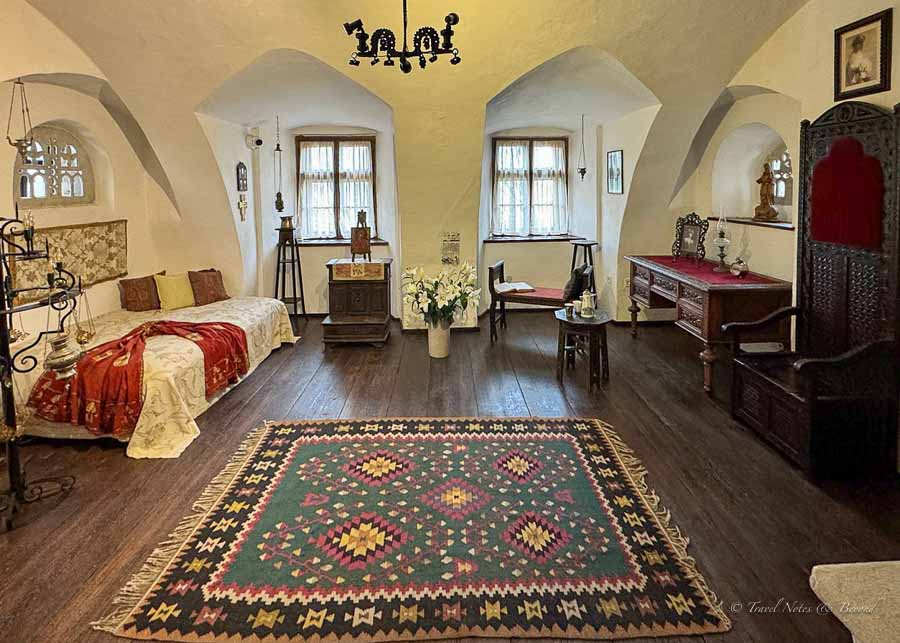
While the castle has 57 rooms in total, only a portion of them are open to the public and can be visited on the standard tour route. The ones that are open for visitation are furnished in a rather minimalist style, which was typical for the time when the castle was built.
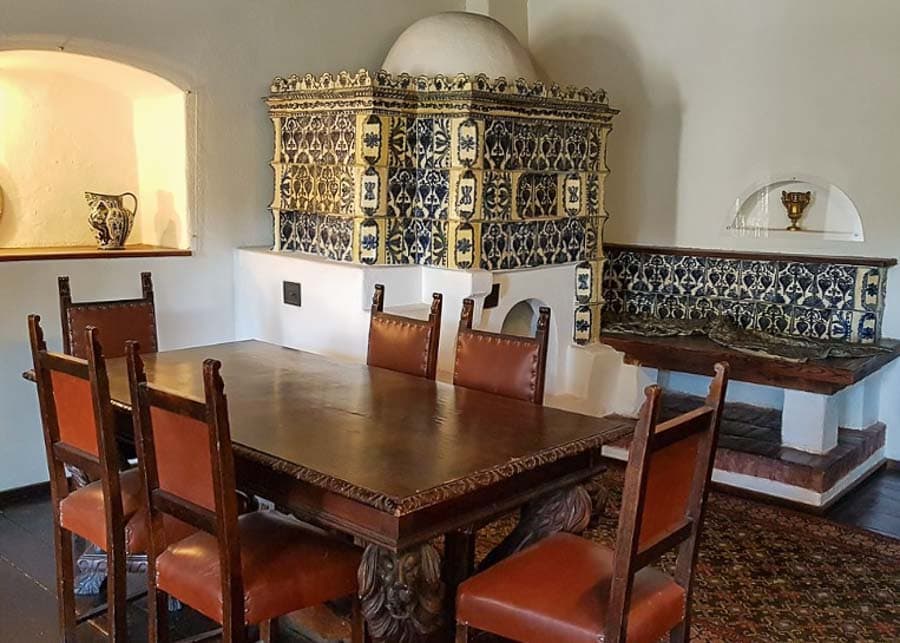
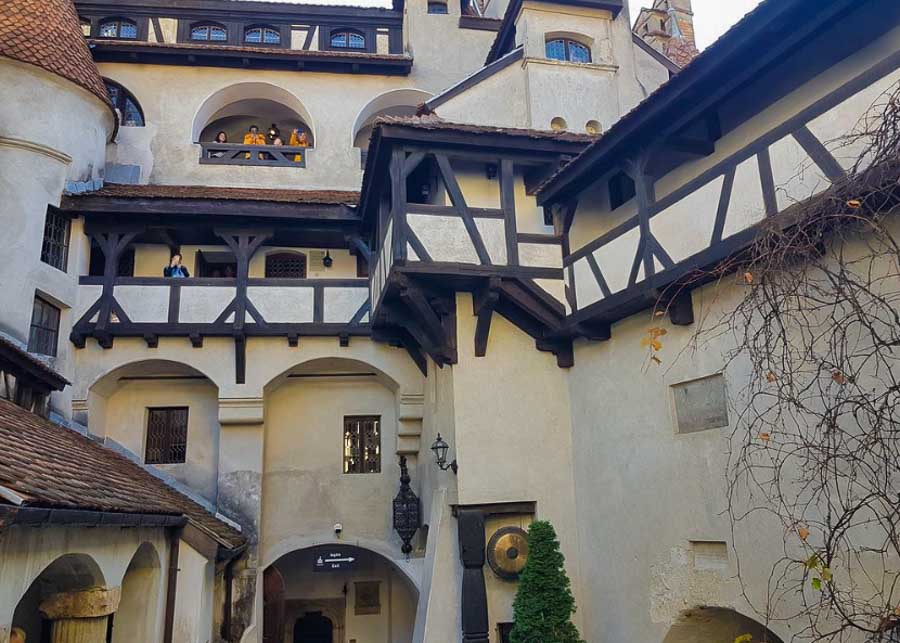
You can still see the original brickwork and some other beautiful original features, like the arched windows and doorways, turrets and spires.
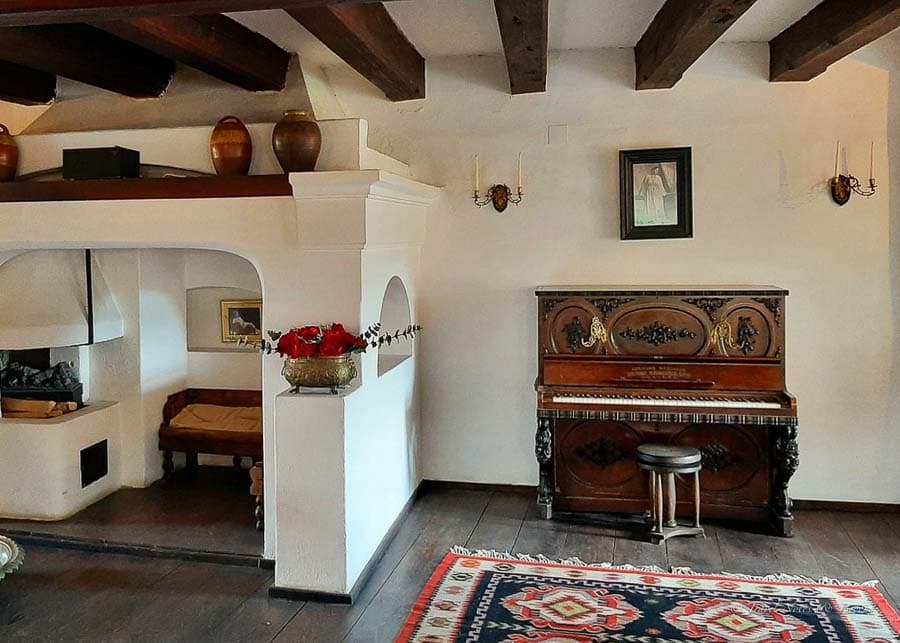
Although there is not much furniture around, there is a certain level of charm to the dark wood paneled rooms and stark white walls.
The Dungeon
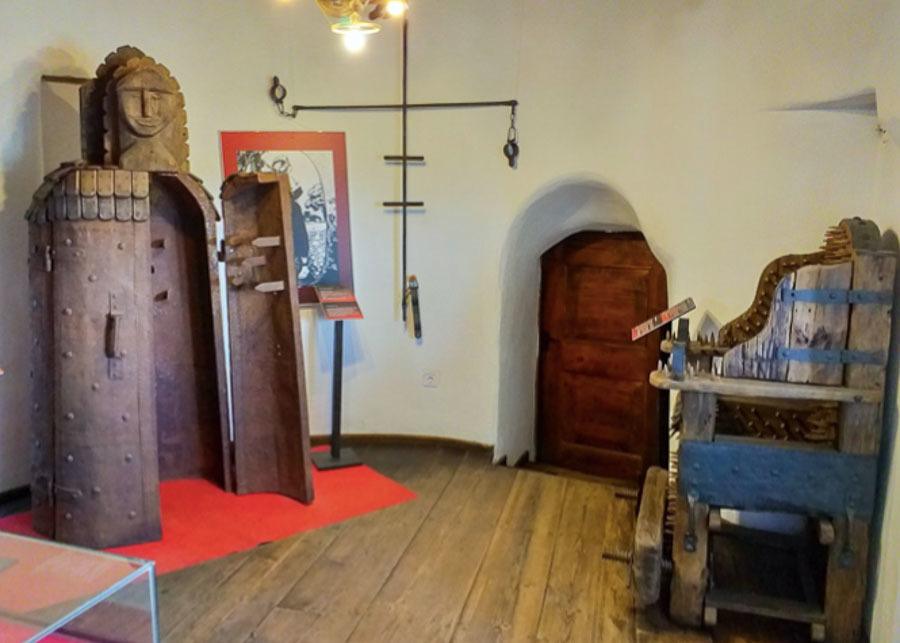
If you like spooky, you should also visit the Dungeon, where you can see all sorts of torture instruments (makes you cringe to think they have been used on people!)
The Spiral Staircase
The spiral staircase (or secret passage) directly connects the first floor with the third floor of the castle. This passage was originally hidden behind a fireplace and served as a quick escape route or a secret passage for guards and servants.
The Secret Tunnel
In 1920s, when the castle went through renovations, the workers discovered a secret tunnel in the wall. Queen Marie wanted a quick, discreet way down to the Royal Park without having to climb the steep stairs. So the castle’s old well was transformed for this purpose: a vertical shaft about 30–40 meters deep was dug through the rock to hold an elevator, and a roughly 40-meter horizontal tunnel was carved through the mountain to connect the base of the shaft to the outside.
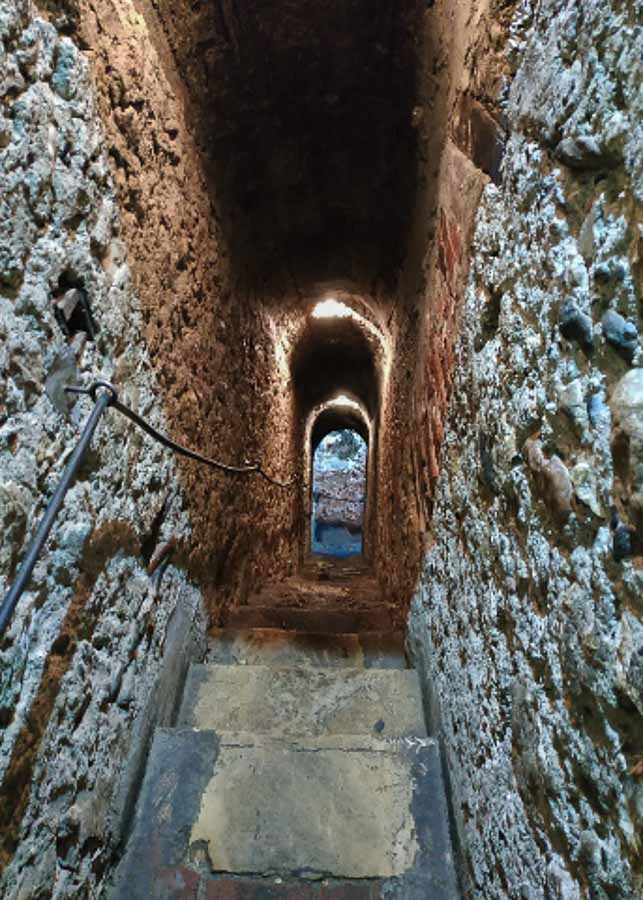
The well sat abandoned for decades until 2018, when the shaft and tunnel were fully restored as a visitor experience called the Time Tunnel, where guests now descend in an ultra-modern lift.
The Donjon
Bran Castle features a remarkable gothic architectural design. The imposing building is made from a combination of wood and stone. One of the highlights of the castle is the round tower (the Donjon), which is incredibly well-preserved.
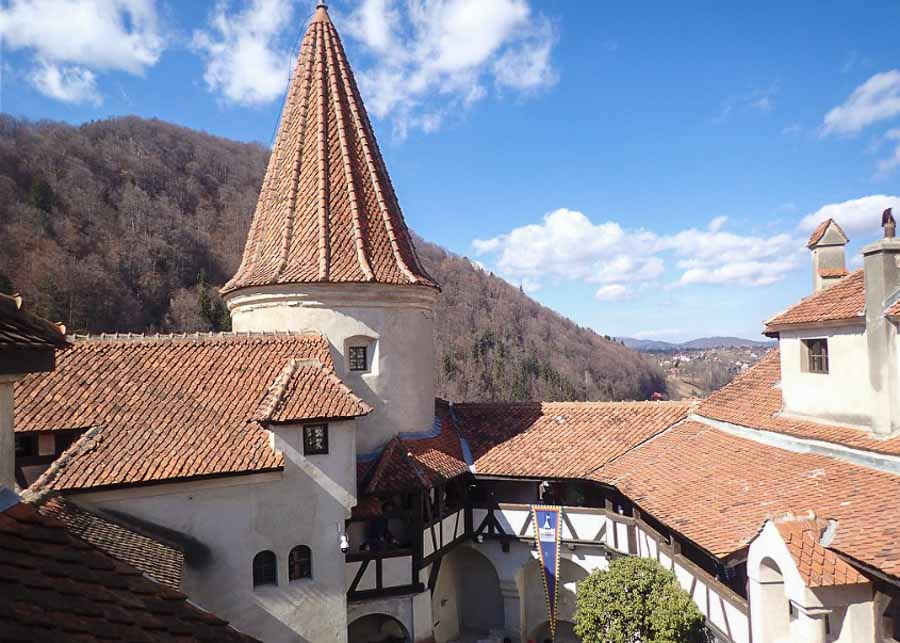
The present form of round tower dates from 1593, because the old tower was destroyed by lightning.
The Former Resting Place of Queen Marie’s Heart
Queen Marie of Romania’s heart traveled for 77 years before finding its final resting place in 2015. Encased in a silver casket, it survived territorial annexations, World War II, and the communist regime. In the end, it finally returned to the royal bedroom where the British-born queen took her last breath.
Before her death in 1938, Queen Marie asked that her heart be interred in a chapel in the town of Balchik. That seaside resort at the Black Sea, where her family had a castle, was the queen’s favorite summer residence. But after Balchik was returned to Bulgaria in 1940, the queen’s heart was moved to Bran Castle, her second favorite place.
Today you can still visit the carved stone niche and cross located near the forest, on the castle grounds, although the heart is no longer here.
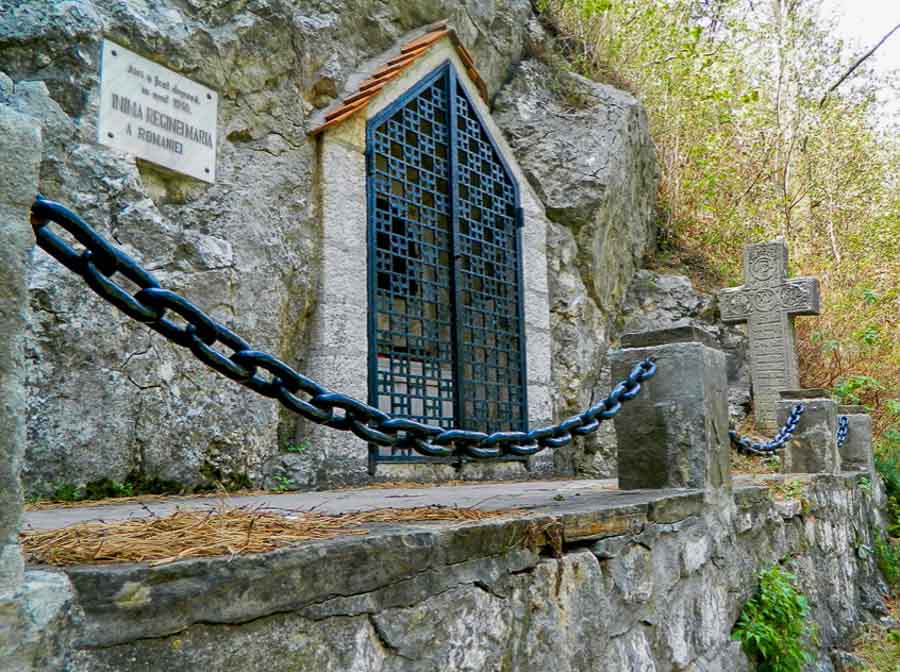
During the Communist regime, the heart was moved to the National Museum of Romanian History in Bucharest in 1971 where it stayed until 2015.
The Final Resting Place
On November 3, 2015, at the request of King Michael, her grandson, Queen Marie’s heart was permanently moved to Pelișor Castle, one of the most beautiful castles in Romania. The Queen’s body is buried at the Curtea de Arges Cathedral, next to all the other monarchs of Romania.
How to Reach Bran Castle
The Castle is located on Strada General Traian Moșoiu 24, in Bran 507025.
From Bucharest, the castle can be reached either by car, or by public transportation. The best way to reach Bran Castle from Bucharest is by car. The drive will take around 2.5 hours (135 km) via DN1/E60.
If you want to come by train, the trip is a little longer (around 3.5 hours) and you’ll also have to take a bus from the train station to the castle.
The bus journey time between Bucharest and Bran is around 5h 50m, which is rather long and I don’t recommend it.
From Brasov, there are only 28 km to Bran Castle. It takes about 25-30 minutes to drive (via DN73), or you can take the bus which is quick, easy, and cheap. The bus will leave you very close to the castle entrance (about a hundred meters away).
Practical Information for Bran Castle
Bran Castle (aka Dracula’s Castle) is very popular, so you should expect crowds almost year round. We visited in fall, which is off season, and still the line snaked through the market, all the way to the main road!
The castle is easy to visit, so there is no need to book an organized tour. However, if you book a tour you’ll hear all kinds of funny stories related to the history of the castle and you’ll get a lot of useful information.
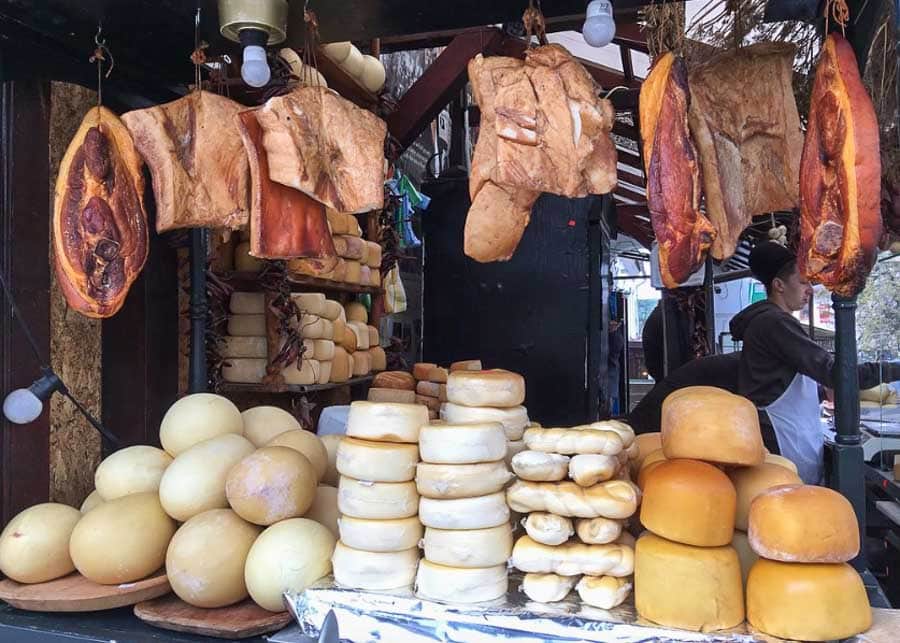
After visiting the castle you should take time to roam around the village of Bran or at stop at the souvenir and food stands on the castle ground. You can sample some of the fine delicacies or even try some authentic Romanian dishes.
Admission Fees and Opening Hours
Monday 12PM–7PM, Tuesday–Sunday 9AM–7PM (last entry 7PM), in season (May 1–Oct 31).
General entry prices at the ticket office are as follows:
- Adults: 100 lei
- Seniors (65+): 70 lei (requires ID)
- Students: 60 lei (requires valid student card)
- Children (5–17 years): 40 lei
- Children (0–4): Free
Combo & Fast-Track Options:
- Adult Royal Tour (Fast Track + Time Tunnel + Torture Chambers): 170 lei
- Child Royal Tour: 110 lei
- Guided Royal Tour (Adult): 210 lei
Plan your trip and purchase advance tickets via the Bran Castle Official Website.
Best Time to Visit the Castle
If you’re hoping to visit Bran Castle without crowds, your chances are somewhere between slim and nonexistent. This is Romania’s most famous attraction, and people come here year-round regardless of the weather. Even on cold, foggy days outside the main tourist season, you’ll still find tour buses in the parking lot and groups moving through the castle’s narrow corridors. The Dracula connection is simply too powerful.
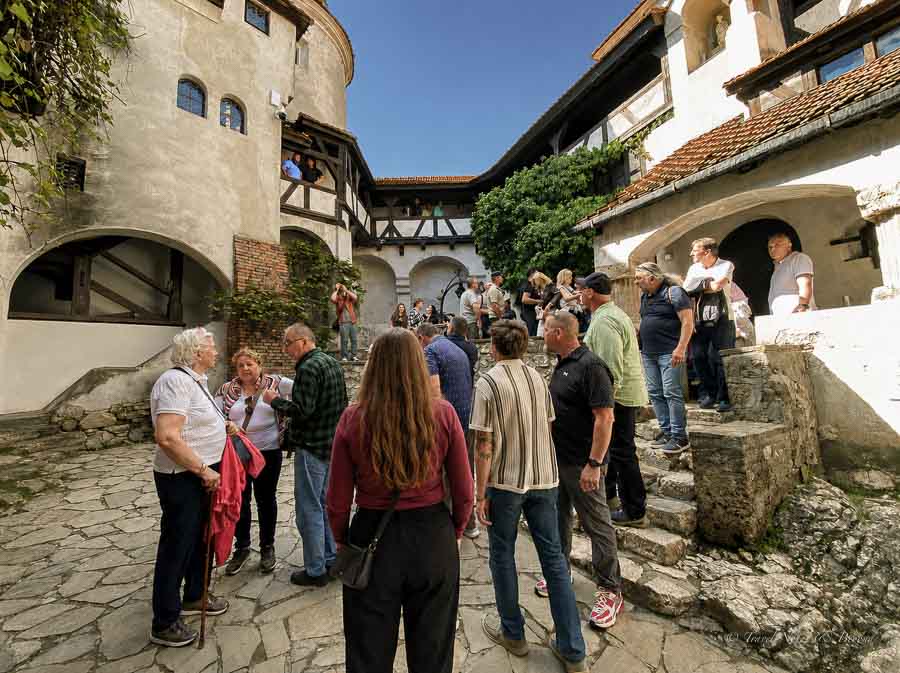
That said, there are two periods when Bran Castle becomes noticeably more crowded than usual. The first is summer, especially July and August, when school vacations bring a surge of both international visitors and Romanian families.
The second is Halloween. This is when Bran fully embraces its Dracula reputation with special events, themed tours, and thousands of visitors who come specifically for the atmosphere. During these periods, long entry lines are common and the castle can feel packed from the moment it opens. If you visit then, arriving early in the morning is about the only advantage you’ll have.
READ NEXT: Monemvasia – the Longest In habited Castle-Town in Greece
Frequently Asked Questions About Bran Castle
Is Bran Castle really Dracula’s castle?
No. Bran Castle was never home to Vlad the Impaler, and Bram Stoker — who created Count Dracula — never visited Romania. The link is marketing, not history. The real-life Vlad’s castle was Poenari. Bran earned the “Dracula’s Castle” label because its dramatic clifftop look matches Stoker’s fictional description.
Is Bran Castle worth visiting?
Yes, if you go for the real history and Queen Marie’s royal residence rather than expecting vampire scenes. The 57 rooms, the secret tunnel hidden behind a fireplace, and the medieval weaponry are the highlights. Go early to beat the crowds, which build through late morning.
How long do you need at Bran Castle?
Most visitors spend 1 to 1.5 hours inside the castle, and up to 2 hours if you also explore the grounds and the village market as well.
How do you get to Bran Castle from Brașov or Bucharest?
From Brașov, it’s about 28 km. The local bus from Brasov’s Autogara 2 takes 45–60 minutes and drops you steps away from the entrance; by car it’s 25–30 minutes via DN73. From Bucharest, the trip is longer but still manageable as a day trip. Driving takes roughly 2.5 to 3.5 hours, depending on traffic and the season. Or you can take a train to Brașov and continue by bus or taxi.
Can you visit Bran Castle without a tour?
Yes. Bran Castle is easy to visit independently, and most visitors explore it on a self-guided basis after purchasing an entrance ticket.
Who owns Bran Castle today?
Bran Castle is privately owned by the heirs of Princess Ileana — Archduke Dominic, Archduchess Maria Magdalena and Archduchess Elisabeth — who reclaimed it in 2009. However, the castle operates as a museum.
A Final Word
Bram Stoker’s story brought a lot of fame and glory to Bran Castle, which is now one of the most popular places to visit in Romania. Today, Transylvania is not so much known for its spectacular scenic beauty or its medieval towns, as it is for being the home of Dracula.
Along with Dracula’s fame came the inevitable vampire-themed tourism and the many themed souvenirs, which is rather sad. English speaking tourists began flocking to Bran in search of, well, vampires! So all around the fortress you’ll find hundreds of stalls selling souvenirs for vampire enthusiasts.
The real Dracula Castle at Poenari never rose to fame because of its isolated location and dismal state. So people continue to come to Bran Castle, which became a preferred tourist destination in Romania.
OTHER INTERESTING PLACES TO VISIT IN ROMANIA:
- 10 Reasons to Visit Romania and Why You Shouldn’t Postpone It
- 15 Fun and Interesting Things About Romania You Probably Didn’t Know
- Bucharest Village Museum – a Fascinating Insight into Romania’s Rural Life
- Best Restaurants in Bucharest, Guaranteed to Impress You
 Best Things to Do in Zermatt, Switzerland (Besides Skiing)





Ankita Sharma
This post has fascinating pictures. I have no idea about it before read this post.
Thank you for adding new experience of knowledge to my life.
John
As I was reading through the article, I couldn’t help but notice in most of the pictures, it was sunny there. So naturally, I was thinking it’s too sunny for a vampire! Jokes aside, that is one beautiful destination. Also thank you for educating me about its history of it. I hope one day I can visit this castle and see it with my own eyes
Anda
I hope you will, John.
Boobie Needham
My ex husband Valerian was from Arges, Romania. There’re ruins of a castle that also belonged to Vlad in that town.
Poenari Castle also known as Poenari Citadel was a home of Vlad the Impaler. The Citadel is situated on top of a mountain and accessed by climbing 1,480 concrete stairs.
Anda
Actually Plenari is the real castle of Vlad the Impaler. Bran castle was tied to his name only through the resemblance Bram Stocker’s character, Count Dracula.
Monica White
No, Romanians are not happy at all about the association of Vlad Tepes, to Dracula. In fact it mounts to an insult. Vlad Tepes was the prince of Wallachia and a military commander who has led heroic battles against the Ottoman Empire occupation of the country. Killed in battle in 1476, he is considered a national hero of Romania. You should brush up on your knowledge of history before making assumptions.
Anda
I’m not sure what your beef is exactly, but you seem a little lost. Are you sure you read this post? Because this article is about Bran Castle and not about Vlad Tepes. Vlad the Impaler was erroneously association with this castle or with Bram Stocker’s character, Dracula. So whether he is considered a national hero or not, it’s irrelevant in this particular case.
Subhashish Roy
I have always loved visiting Castles and this Bran Castle looks a such a wonderful one to be visiting. Romania is one of the few countries in Europe that we haven’t visited and this lovely castle would probably be one of the reasons to visit. With 57 rooms to visit it certainly would mean a lot of history to look back on. The village of Bran would also be nice to visit as well as the food and souvenirs corners.
Anda
Bran Castle is definitely one of the places you should visit in you go to Romania.
Paula
This was such an interesting story. Bran Castle is definitely a place we would love to visit. Not only that we loved visiting castles in Europe but this one has a special legend attached to it. Romani just as itself too seems very interesting country to visit. I will bookmark this for sure for our future travels!
Chloe Beaver
This is so interesting! I had no idea that Bran Castle was where the legend of Dracula comes from. So cool that you got to visit it, too! I’m sure my family would love to check this out.
Umiko
Reading this is like refreshing my memory about what I read about the castle. But yours is definitely more informative. As a dracula lover – at least I used to – I still want to make a visit here although I know the story behind it. I wonder whether Bram Stoker ever got recognition from the Queen Marie family as he made this castle famous all over the world.
Anda
The novel wasn’t known in Romania at the time. It actually became famous much later. But I’m sure Romanians are very happy that Bran Castle was associated with Dracula’s story. This drives a lot of tourism to it.
Natascha
Nice pictures of Bran Castle! I visited the castle a few year ago and also found it very inspiring. I think the whole village lives on the Dracula story and the castle. We stayed at the local campsite called Vampire camping.
Anda
I had no idea they have a camping with that name, hahaha!
Linda (LD Holland)
On the travel wish list! Would love to visit Romania. And no visit would really be complete without a stop at the Bran Castle. Even if only the description of the place inspired Dracula. That lovely spot with the English park does not really match the dark castle of the stories. I will certainly plan enough time to see the whole 57 rooms.
Bhushavali N
This is really fascinating. I always love hearing local legends plus authentic history from historians and just wonder at our human minds. It’s funny how the local legend formed here after a fiction was written loosely based of a this castle. I read a bit about Vlad III and now I can relate to the similarity with Dracula… Intriguing. Now, it is quite a stark difference from Vlad’s castle to Queen Marie’s castle. That’s beautiful.
Anda
The thing is that Bran Castle was actually never Vlad III’s castle. That was only a speculation based on Bram Stocker’s novel “Dracula”.